Process Type
Graphical expression
Mind Type
Structured expression
Note Type
Efficient expression
Treemap
Bracket Diagram

Default Mode





The core task of a product manager is essentially to "make the right decisions with limited resources." However, faced with complex and ever-changing user needs, fierce market competition, and the challenges of internal collaboration, relying solely on intuition or experience can easily lead to confusion. At this point, some classic mental models act as "cognitive scaffolding," helping product managers quickly break down problems, see the essence of the issue, and make more rational judgments.
This article will introduce the eight most commonly used thinking models for product managers and show you how to visualize these models using charting tools such as ProcessOn, making abstract thinking clear at a glance.
Mental models are frameworks or patterns for problem-solving. They allow us to quickly analyze problems by standing on the shoulders of giants, rather than starting from scratch every time.
The three major values of mental models:
Reduce cognitive biases: Avoid being misled by personal preferences or partial information.
Improve communication efficiency: Align your understanding with your team using a common model language.
Structured decision-making: breaking down complex problems into assessable dimensions.
Visualizing these mental models will yield even better results. A picture is worth a thousand words—this is the core value of diagramming tools like ProcessOn .
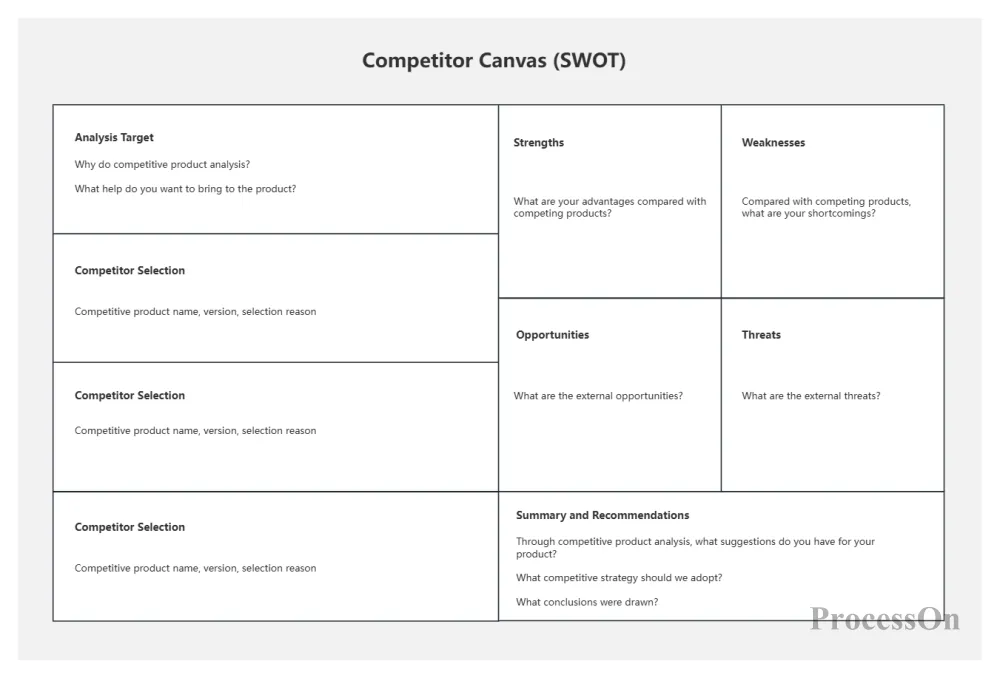
Definition: SWOT is an acronym for Strengths, Weaknesses, Opportunities, and Threats. It involves the cross-analysis of internal factors (strengths/weaknesses) and external factors (opportunities/threats) to develop strategies.
Product manager applications include: product initiation, version review, and competitor comparison. For example, before launching a new product, list its internal strengths and weaknesses, as well as opportunities and threats in the market.
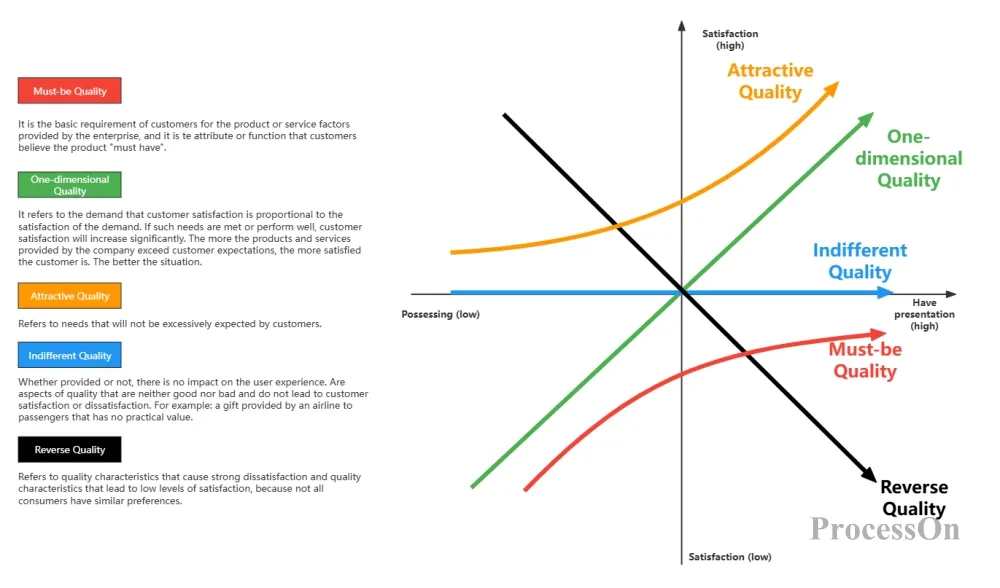
Definition: The Kano model categorizes user needs into basic, expected, exciting, indifferent, and reversed types. Users will complain if basic needs aren't met; the better expected needs are met, the greater the user's satisfaction; and exciting needs bring pleasant surprises.
Product manager application: During requirements review, it helps the team identify which features are "must-do" and which are "icing on the cake".
Definition: Describes the complete process from user interaction with a product to achieving a goal, including behavior, touchpoints, emotions, and pain points.
Product manager applications: Optimize registration processes, shopping cart conversion rates, and customer service experience. Identify key points of user churn through journey mapping.
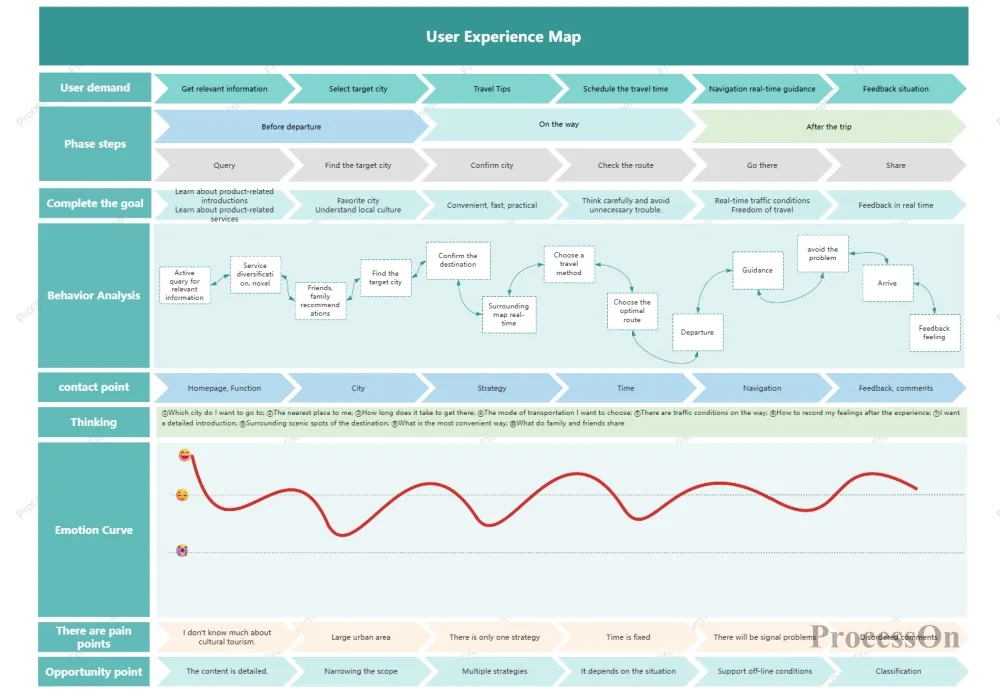
User Experience Map-Tourism Products
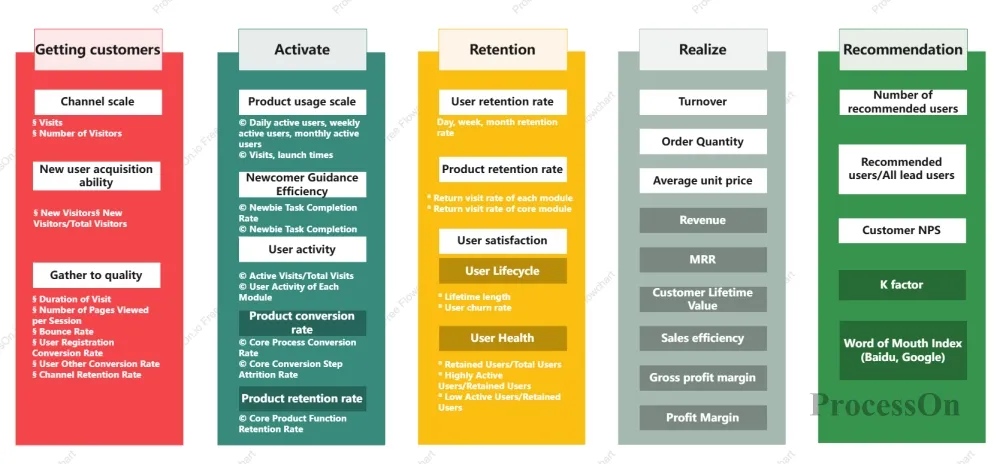
Definition: AARRR is an abbreviation for Acquisition, Activation, Retention, Revenue, and Referral, which describes the user lifecycle.
Product manager application: Analyze which stages have low conversion rates and develop targeted growth strategies. For example, a low activation rate may require optimization of the first-time user onboarding.
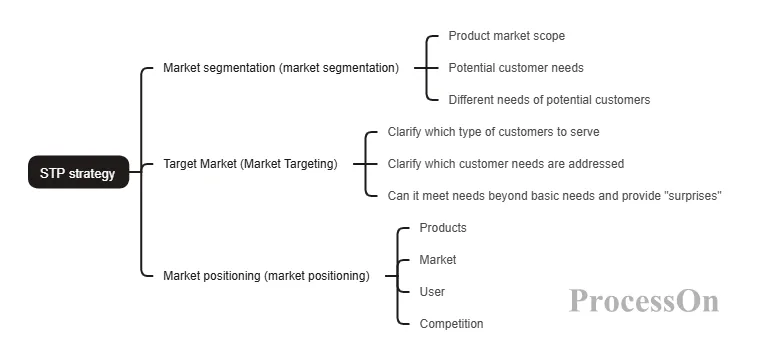
Definition: Market segmentation → Targeting → Positioning. This involves dividing the customer base, selecting the most advantageous group, and establishing a unique perception within that group.
Product Manager Application: In the early stages of product development, define the target user profile to avoid "trying to do everything but doing nothing well".
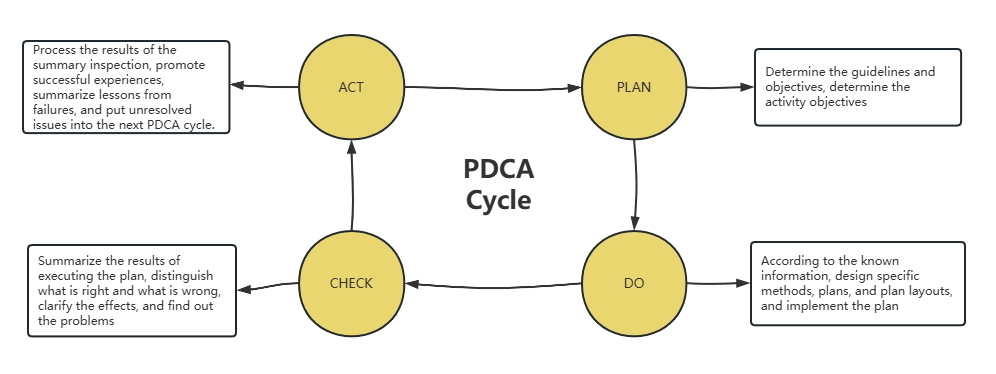
Definition: The cycle of Plan, Do, Check, Act, used for quality management and process optimization.
Product manager applications: Iterative development and post-feature launch performance evaluation. Each iteration cycle should follow the PDCA (Plan-Do-Check-Act) cycle.
Definition: It includes nine modules: customer segments, value proposition, channels, customer relationships, revenue streams, core resources, key business activities, key partners, and cost structure, describing how a company creates and delivers value.
Applications for product managers: writing business plans for new products and presenting startup projects.
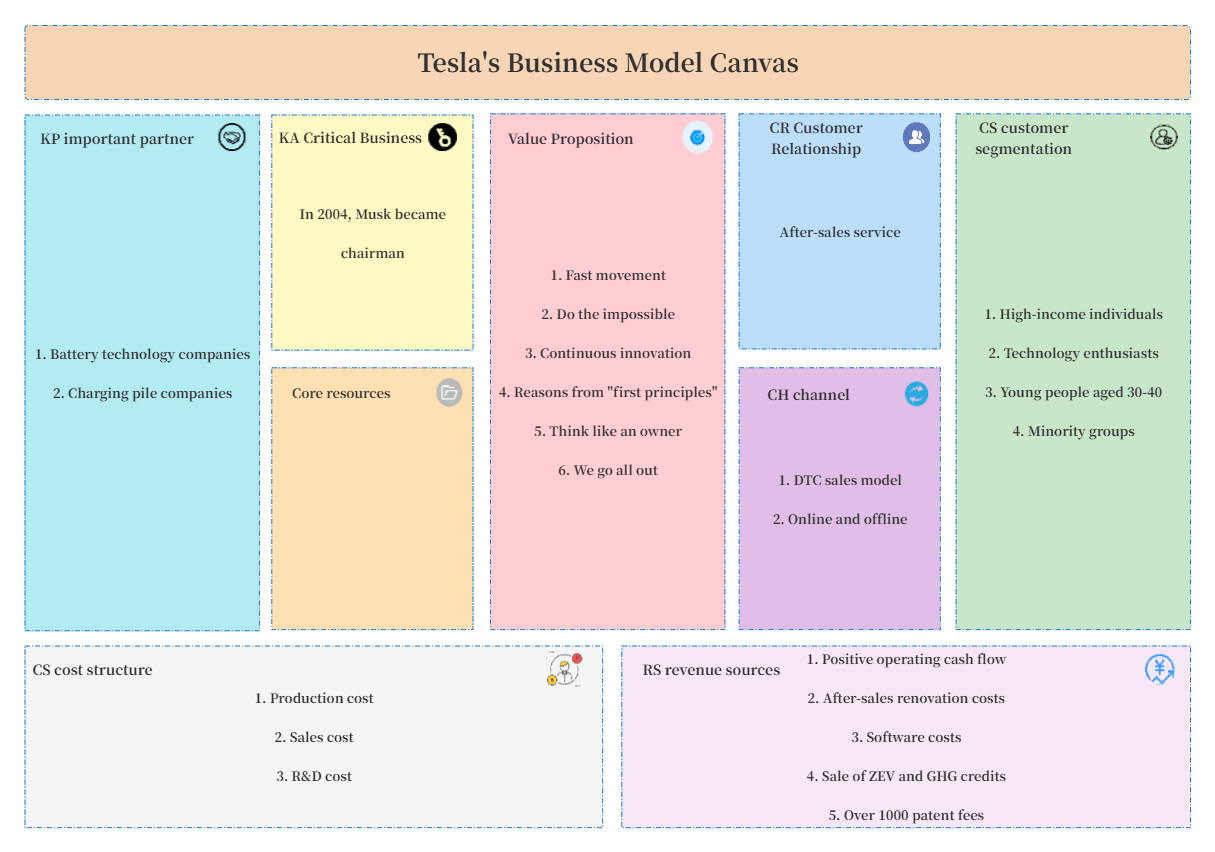
Tesla Business Model Canvas Example
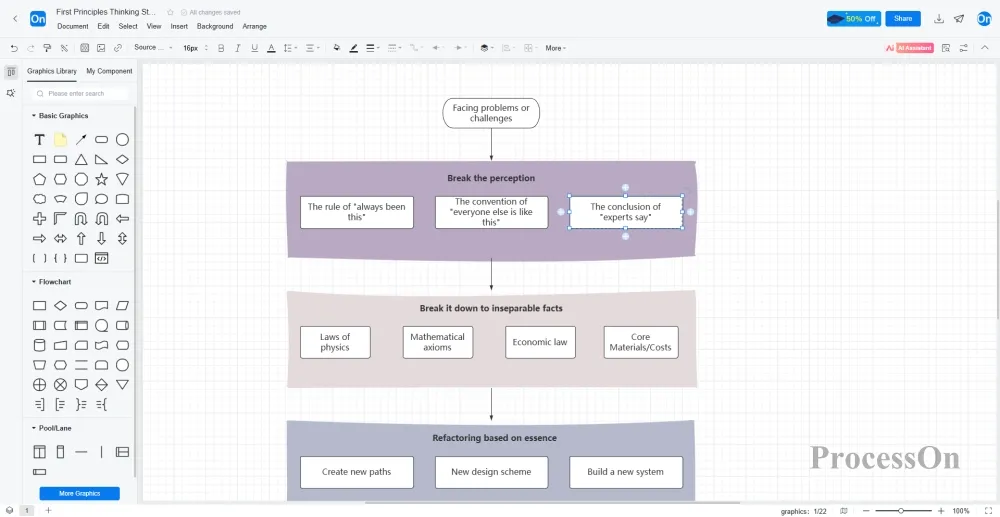
Definition: Returning to the most basic physical or logical truths of things, without being limited by existing solutions or analogies.
Product Manager Application: When a product falls into the trap of blindly following the competition by doing whatever the competitors have, use first principles to rethink "what are the most fundamental needs of users".
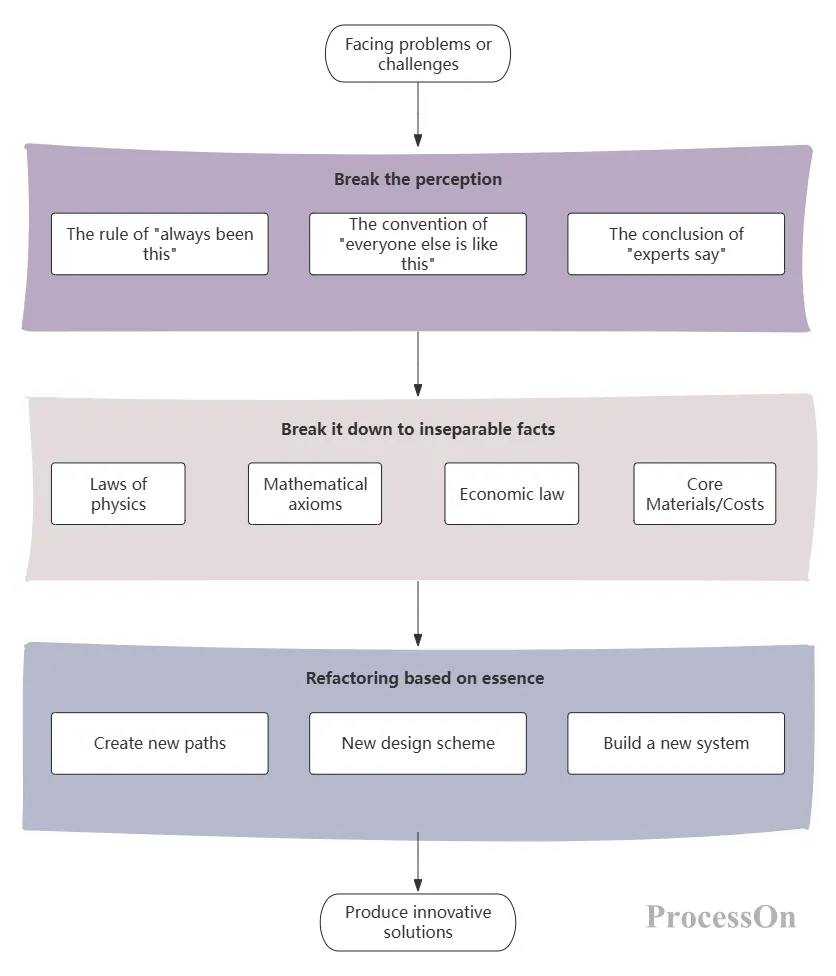
First Principles Thinking Steps
The effectiveness of these models will be greatly reduced if they only exist in the mind or are written in plain text. Visualization is an "add-on" to thinking; it forces us to structure and deduce logically.
ProcessOn, as an online charting tool, offers product managers three major conveniences:
Massive templates for one-click reuse: Search for keywords such as "SWOT", "user journey map", and "business model canvas" to directly use community templates without having to draw from scratch.
Collaboration and Comments: Invite team members to edit online, add comments to specific nodes, and discuss in real time to reduce disputes during meetings.
Export in multiple formats: Export as a PNG embedded in a PRD, or export as a PDF to share with the development team .
1. Go to the ProcessOn file page, search for model keywords in the template community, or create a new flowchart;
2. Click on the [Style] on the left to select a style and color scheme, then switch to [Graphics], drag and drop graphics from the graphics library onto the canvas, add text content for the mental model, and after building the framework, the top toolbar allows you to make individual style modifications to graphics, text, and connections;
3. Once the drawing is complete, you can click the "Share Collaboration" button in the upper right corner to generate an online link for others to view or edit. You can also export it in PNG, JPG, SVG, or other formats.
Mental models are a product manager's "toolbox," but tools only create value when they are used. Regularly review these models and consciously apply them in your work to gradually internalize them into intuition.
Charting tools are the perfect partner for visualizing these models. The next time you face a complex decision, try opening ProcessOn and drawing the corresponding model diagram. You'll be surprised to find that previously tangled thoughts naturally become clear during the drawing process.