Process Type
Graphical expression
Mind Type
Structured expression
Note Type
Efficient expression
Treemap
Bracket Diagram

Default Mode





Every Friday afternoon, does the reminder to "Report Weekly Work Summary" send a shiver down your spine? You've been busy all week, but when it comes time to write the report, your mind goes blank, and after a long pause, you can only manage a few sentences: "Completed XX feature development this week," "Handled XX customer inquiries," and even then, you feel like you're just going through the motions . Even more embarrassing is that your colleague's weekly report reads like a battle report, and the boss nods in approval, while yours, after a week of hard work, is just a rambling account that the boss skims over and forgets .
Where is the problem? It's not that your work isn't important, it's that you don't know how to present yourself effectively .
According to survey data from the ONES R&D management platform, writing weekly reports takes an average of 20-30 minutes, accumulating to over 25 hours per year . More importantly, the time spent yields little result—not because you're not working hard, but because you haven't mastered effective reporting methods. This article will help you completely master weekly and monthly reports.
No matter how beautifully written the code is, if the weekly report only states "completed the development of XX interface" or "fixed XX bugs," to non-technical leaders, it's just: you're doing your job . We're used to describing "what was done," not "what was accomplished or what value was brought." As a result, the weekly report becomes a dry task list, causing pain for both leaders and subordinates.
Many people's weekly reports are just a single paragraph or a list of tasks . After reading them for a while, the manager still doesn't know what the key tasks were, what difficulties were encountered, or what support was needed. An unstructured weekly report, no matter how dense the information, is ineffective communication .
Four weeks of work condensed into a single report, which should both review and plan, summarize achievements and analyze problems . Many people write monthly reports that are either too general ("work completed on time this month") or too detailed (listing everything in great detail), failing to reveal the work's trajectory and growth over the month .
Core understanding: Weekly reports are not homework, but a tool for upward management.
Many new employees treat weekly reports as mere "tasks to be completed," which causes them distress. You need to understand: weekly reports are a golden opportunity to proactively manage your boss's expectations and showcase your personal value . Your boss uses weekly reports to evaluate your contributions, discover your potential, identify project risks, and allocate resources . If you write good reports, your boss will think of you first when good projects or promotion opportunities arise.
An excellent weekly report essentially answers three questions: What did I do last week? How well did it go? What are my plans for next week?
Briefly summarize the main tasks and overall progress of the week, allowing readers to quickly grasp the core information. Use 3-5 sentences to summarize the overall work of the week, extracting the most important tasks.
This is the "heart" of the weekly report, and the part that best reflects your personal value. Don't just list what you've accomplished; show what you've achieved and what value you've brought.
Incorrect syntax: "Optimized query interface performance"
Correct wording: "Optimized query interface response time, reducing it from 2.3 seconds to 0.5 seconds, significantly improving user experience and decreasing related complaints by 80%."
The trick is simple: add data to everything. Transform vague descriptions into concrete data—change "improved efficiency" to "efficiency increased by 30%", and "optimized performance" to "response time reduced from 2 seconds to 0.5 seconds" .
Problems and challenges are inevitable in the workplace, and it's not a bad thing to honestly raise these issues in your weekly report. On the contrary, it demonstrates your sense of responsibility and analytical skills . The key is to provide your thoughts and solutions along with the questions you raise .
Next week's plan can follow the SMART principle—Specific, Measurable, Achievable, Relevant, and Time-bound . Instead of simply writing "Continue to advance Project A," write "Complete the requirements analysis document for Project A and confirm it with the client by Friday . "
Connecting these three steps creates a clear weekly report. Spend 10 minutes each Friday following this process, and your weekly report will transform from a chronological account into a structured, data-driven, and valuable report.
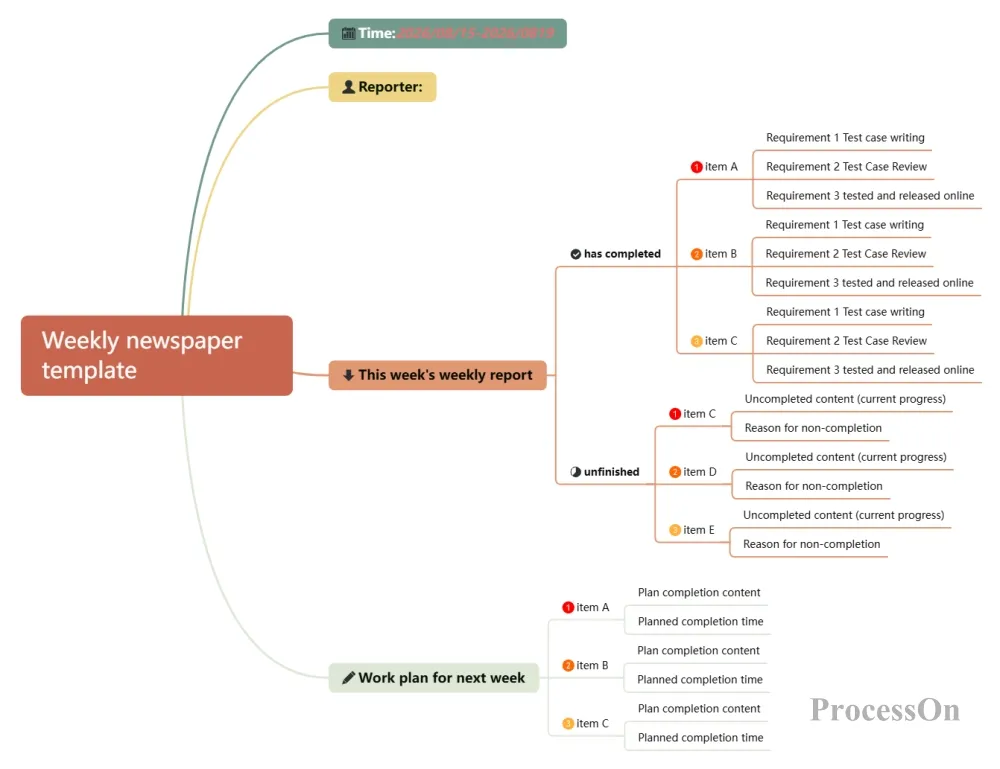
A monthly report is not simply a summation of weekly reports. It needs to reflect the overall workflow of the month—from goals to results, from problems to growth. A monthly report can be divided into four stages:
Let's review the goals set at the beginning of the month and let the data speak for itself—the number of tasks completed, quality indicators, customer satisfaction, etc. For example: "This month, we planned to complete 3 project deliveries, and we actually completed 3, 2 of which were delivered 2 days ahead of schedule. The customer satisfaction rating improved from 4.2 to 4.7."
Highlight the significant achievements or breakthroughs made this month . Use a "value-oriented" approach here—don't just say what was done, but also what impact it had.
Honestly pointing out problems and difficulties encountered at work not only demonstrates self-reflection but also provides an opportunity to solve problems . Summarizing the lessons learned this month demonstrates learning ability and growth .
Break down work objectives into specific tasks, prioritize them, and create a reasonable timeline . Next month's plan should address issues identified this month and propose improvement measures to maintain consistency .
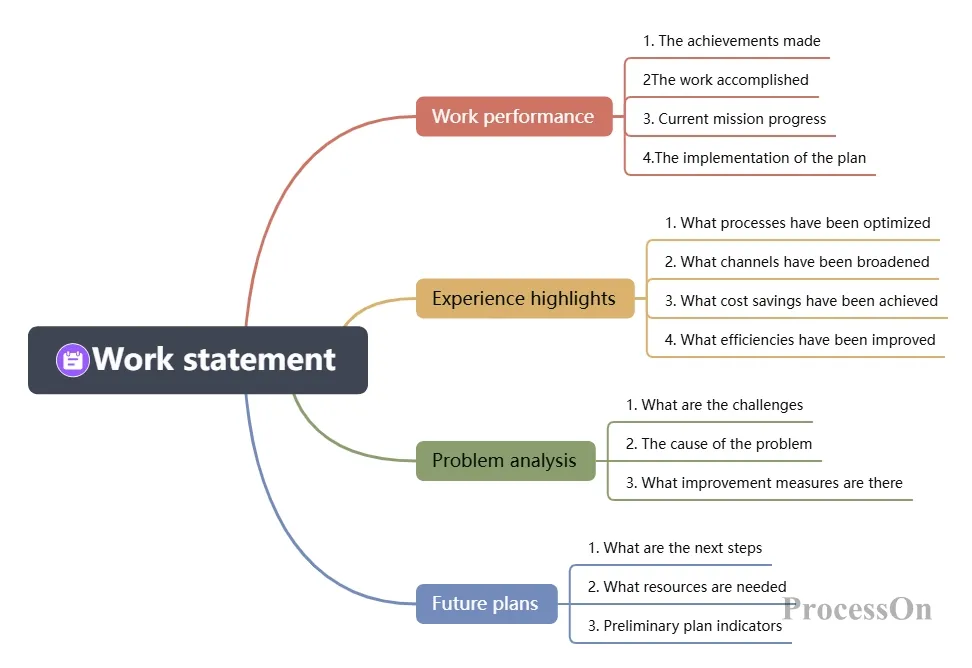
The core value of monthly reviews lies in their ability to help you see "where your time was invested and what you produced." Many people's anxiety stems from "being busy for a month but not knowing what they've accomplished"—monthly reports are designed to answer this question.
Even if the writing is excellent, if it's all dense paragraphs, the leader might not have the patience to read it all. That's when charts and graphs become the secret weapon to make weekly and monthly reports "speak" for themselves .
When you need to report the progress of multiple projects or tasks, a Gantt chart is the most intuitive choice. The horizontal axis represents time, and the vertical axis represents tasks. Each task is indicated by different colored bars representing its start and end times and progress. Leaders don't need to read the text descriptions word by word; a quick glance at the chart tells them which tasks are progressing on time, which may be delayed, and which require resource support.
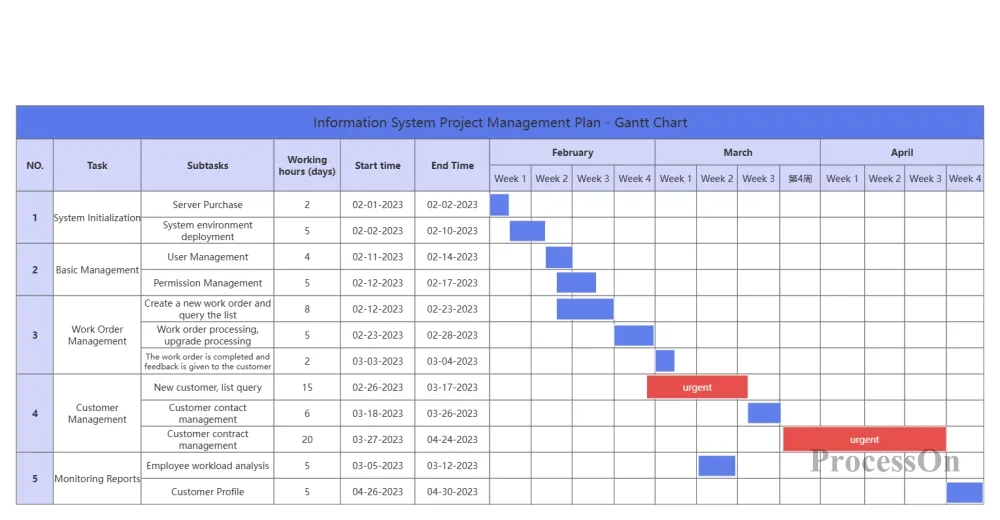
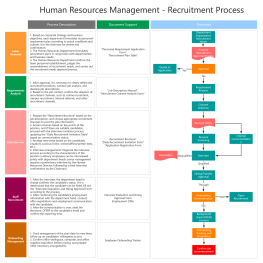
When you need to demonstrate "the complete process of a requirement from its inception to its implementation" or "the conversion path from customer inquiry to closing the deal," a flowchart is more efficient than a 500-word text description . Flowcharts make complex workflows clear at a glance and help the team quickly pinpoint "which link is stuck."

Product manufacturing process flowchart
When preparing monthly reports, use mind maps to break down the report into four modules: "Goal Achievement → Key Results → Problem Improvement → Next Month's Plan." Each module is then further subdivided into specific content and data. Compared to straightforward text paragraphs, the structured presentation of mind maps makes the monthly report's structure clearer and its logic more rigorous.
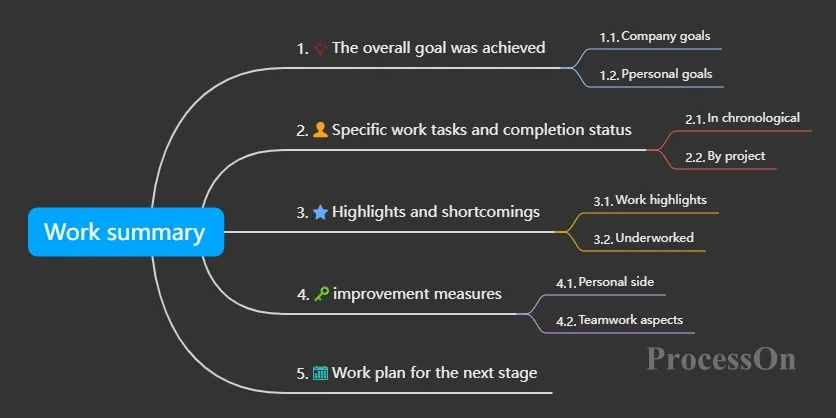
The core logic of chart-based weekly reports is that text tells the "story," while charts present the "data." Combining the two gives your weekly and monthly reports both warmth and impact.
Writing weekly and monthly reports is essentially a process of organizing structured information. Once you master a systematic approach—using structured frameworks to organize content, using data to highlight achievements, using visual charts to present information, and using AI tools to help generate drafts—you'll find that writing weekly and monthly reports is not only not painful, but rather a deep review and reflection on your work.