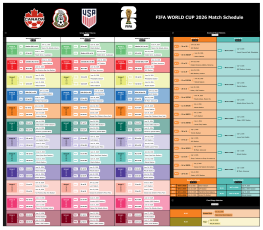
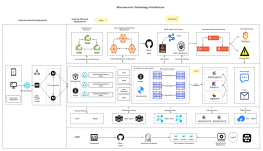
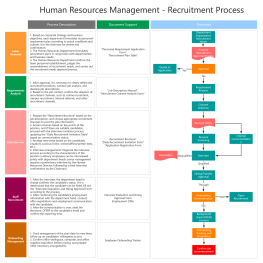
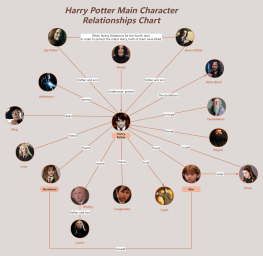
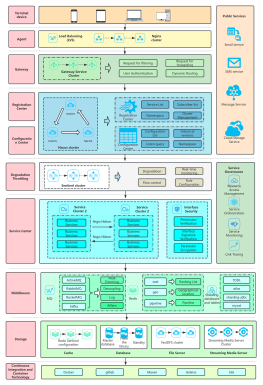
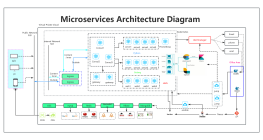
Process Type
Graphical expression
Mind Type
Structured expression
Note Type
Efficient expression
Treemap
Bracket Diagram

Default Mode





In 2026, the AI toolkit for product managers is redefining the concept of "product"—from using AI to generate PRDs and create prototypes through dialogue, to using intelligent agents for collaborative decision-making, AI is no longer just an efficiency-enhancing plugin, but the core productivity engine for product managers throughout the entire process from "idea" to "launch." Product managers who don't know how to use AI are falling behind their AI-savvy peers by a generational gap.
Have you ever had this experience? You've had a product idea swirling in your head for three days, then you open an AI and type, "Help me analyze whether this idea is feasible." Three seconds later, two thousand words appear on the screen, reading smoothly and logically. But after you finish reading and close your laptop, you still feel empty—it didn't tell you what to do next.
This is the biggest pitfall of general AI: it gives you "text," not "decision-making." It can chat with you, but it can't guide you through the entire process from an idea to its actual launch.
The most valuable asset for a product manager has never been their writing ability, but rather the methodology they possess: how to conduct user discovery, prioritize tasks, write product requirements (PRDs), price strategies, and plan launches. In 2026, true AI product tools are changing all that—they won't just help you write documentation, but will help you make decisions, streamline processes, and develop solutions.
By 2026, the product manager AI tool ecosystem had formed six core dimensions:
AI Product Assistant – An intelligent accelerator for PRD writing, requirement breakdown, competitor analysis, and user insights.
AI Prototyping: A Conversational Approach to Generating Interactive Prototypes
AI-powered demand management – the intelligent hub for demand flow, quality governance, and cross-team collaboration.
AI-powered visual collaboration – the core capability to transform fragmented knowledge into structured charts.
AI Data Analysis – Intelligent Questioning for User Behavior Tracking and Data Insights
AI User Research – Intelligent Insights Based on User Interview Analysis and Feedback
Based on the above framework, this article selects six essential AI tools for product managers in 2026 from six dimensions.
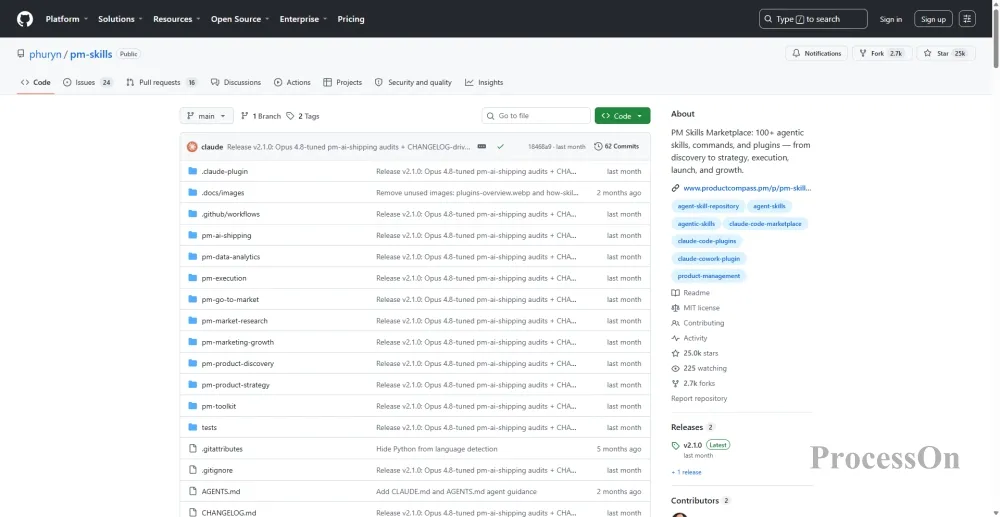
PM Skills is an open-source AI skill library for product managers, packaging 9 plugins, 68 skills, and 42 interconnected workflows into AI-accessible capability modules. It integrates the methodologies of top product experts such as Teresa Torres, Marty Cagan, and Alberto Savoia into daily workflows, rather than leaving them gathering dust on a bookshelf.
The foundation of PM Skills rests on only three concepts; once you understand them, the entire system becomes clear:
Skills are the smallest building blocks of knowledge. Each Skill "teachs" a mature product methodology to AI, such as "identifying risk assumptions," "opportunity solution trees," and "prioritizing." The AI will determine which skill is relevant to the current conversation and automatically retrieve the corresponding framework.
Commands are like a well-connected pipeline. Skills are individual building blocks, while Commands are the assembly of several blocks into a complete pipeline. The most typical example is `/discover`—this single command connects four skills: brainstorming ideas → identifying hypotheses → prioritizing hypotheses → designing validation experiments. Typing `/discover` once guides you from "a vague idea" all the way to "what experiments should be done to validate it."
Plugins are skill sets packaged by domain. Each plugin bundles related skills and commands into an installable package, with each plugin covering a specific product domain. Installing the marketplace once provides all nine plugins.
PM Skills' nine plugins cover the entire process from discovery, strategy, execution, deployment, growth to delivering AI code:
pm-product-discovery: Idea generation, experimental design, hypothesis testing, user interviews
PM-product-strategy: Vision and Strategy Formulation
pm-market-research: Personnel Profiling and Market Research
PM-execution: PRD writing, review, and ranking
pm-analytics: Data analysis – data drops → find the cause → provide suggestions, a complete process.
pm-go-to-market: Beachhead Market and Online Launch Planning
Applicable scenarios: The entire process of product development from 0 to 1—from idea discovery, strategy formulation, PRD writing to launch planning and growth strategies.
The essence of PM Skills: General AI gives you text, and it gives you structure.
By 2026, the AI prototyping tool market had formed a three-way competition among v0, Lovable, and Bolt. Among them:
v0 (from Vercel)'s core advantage lies in its deep integration with the Next.js ecosystem, generating React component code of extremely high quality and clear structure. Product managers can describe interface requirements in natural language and generate a runnable front-end code prototype within tens of seconds. It is suitable for teams with technical backgrounds, especially those already using the Next.js technology stack.
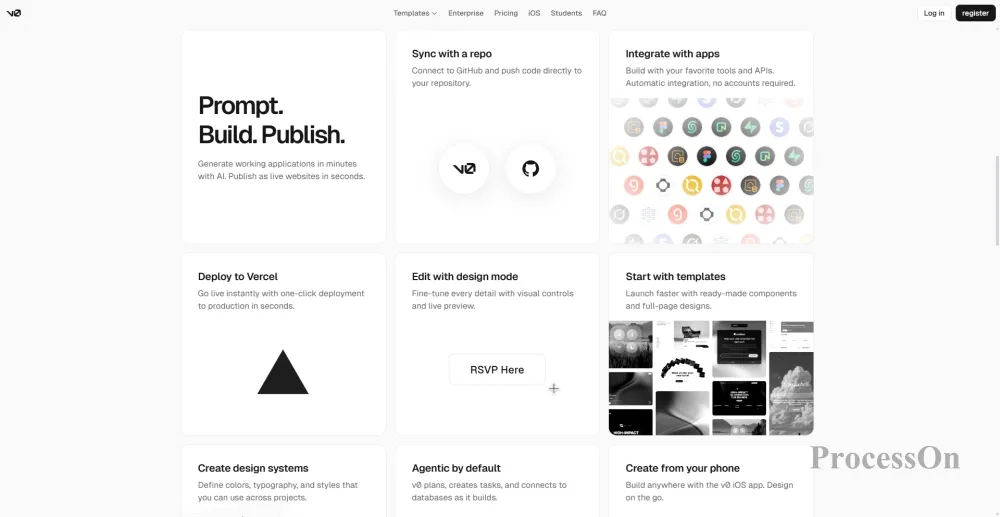
v0
Lovable follows a "full-stack application generation" approach, capable of generating complete application prototypes, including front-end, back-end, and database, starting from a requirements description. It performs particularly well in B2B product scenarios (such as e-commerce back-ends, CRM systems, and data dashboards). It is suitable for product managers to conduct proof-of-concept and business process prototyping.
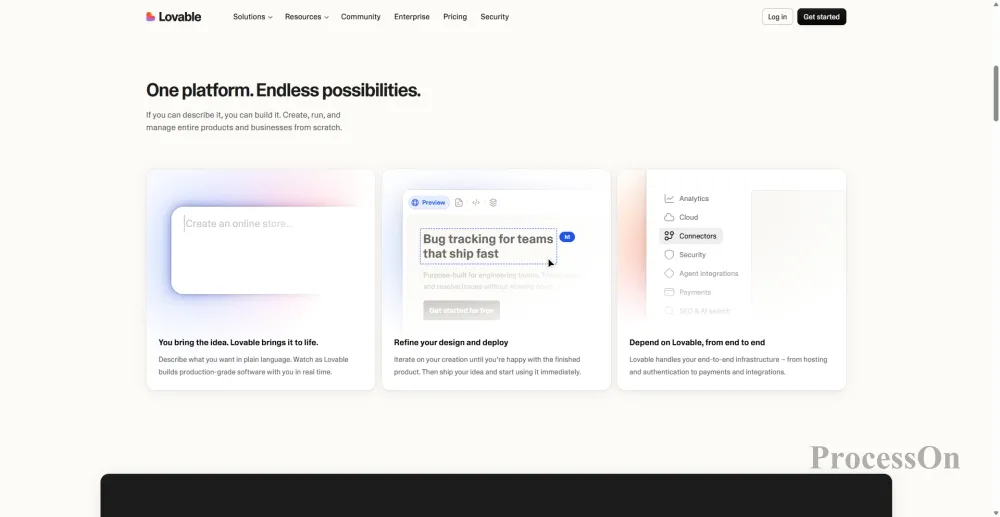
Lovable
Recommendation: If your team has a strong technical background and uses Next.js, choose v0; if you are a B2B product manager and need to quickly validate complete business processes, choose Lovable.
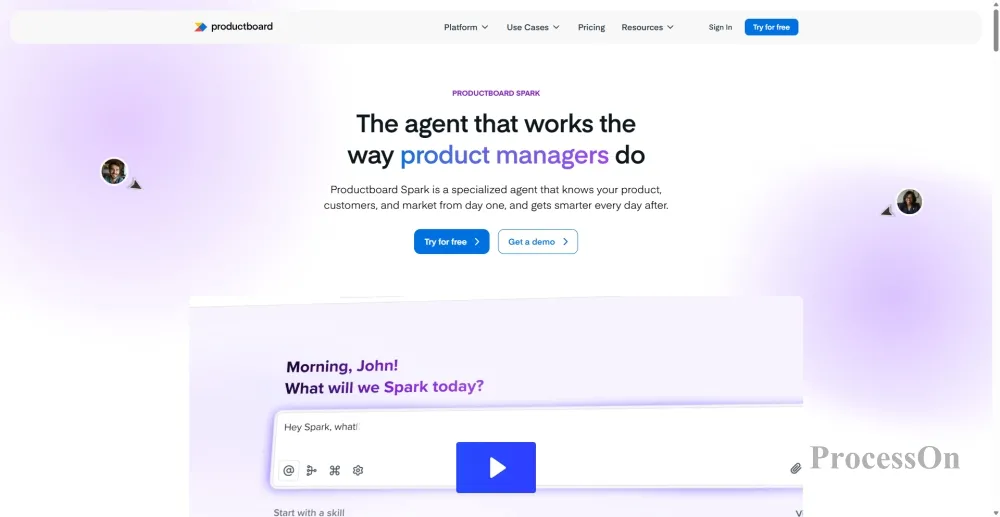
Productboard Spark
Productboard is a leading platform in the global product management field, used by numerous product teams to track customer feedback and manage product roadmaps. In June 2026, Productboard released Productboard Spark—the world's first "Agentic Product System".
Spark's core capabilities include:
Specialized AI agents: Instead of using a single general-purpose AI to handle all tasks, specialized agents are used for different tasks such as feedback analysis, specification writing, competitor research, and codebase understanding.
Automatic context loading: Product strategy, OKRs, user personas, and historical decisions are automatically retrieved into each task.
Traceable output: Every insight and every suggestion is linked back to real customer feedback and data sources.
Real-time collaboration across the entire team: Product managers, designers, and engineers work on the same interface, eliminating the need for "handover fees."
Productboard Spark frees product managers from the tedious task of "manually compiling feedback, writing specs, and updating stakeholders," with all work completed automatically based on real product data.
Applicable scenarios: Product teams that need to systematically manage customer feedback, product roadmaps, and cross-team alignment.
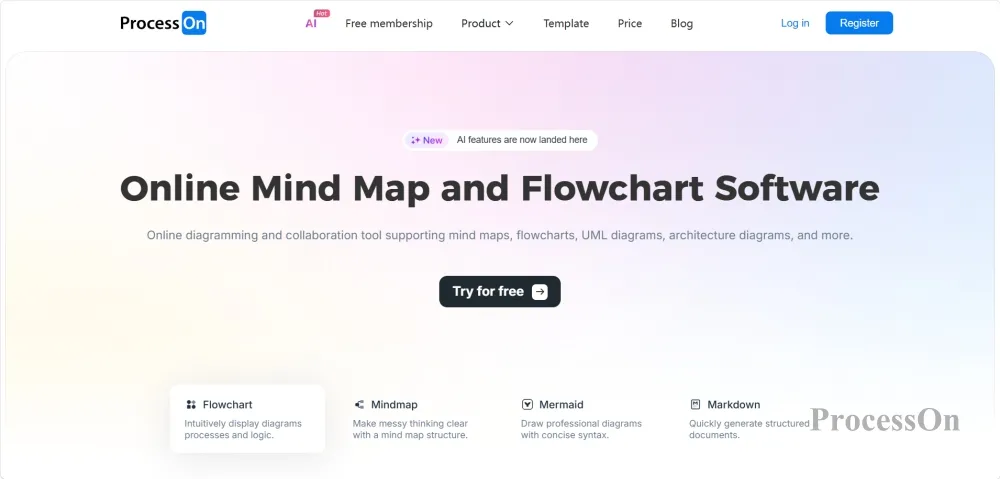
ProcessOn is a one-stop online AI-powered diagramming and collaboration platform, covering the entire visualization needs of product managers, from requirements gathering, process design, and architecture planning to project management. In 2026, ProcessOn fully upgraded its AI capabilities, supporting the automatic generation of various charts such as flowcharts, mind maps, Gantt charts, and sequence diagrams from text descriptions.
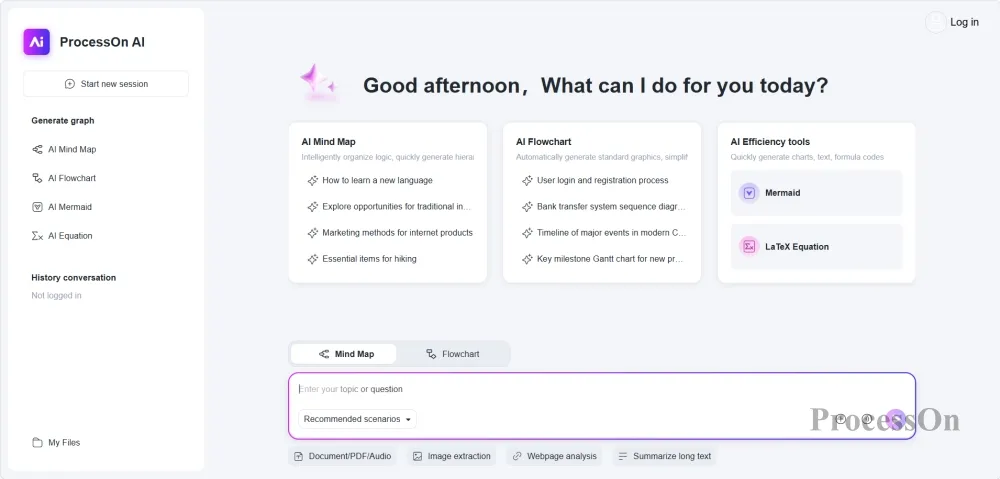
Scenario 1: AI-Generated Mind Maps – From “Thinking it Through” to “Drawing it Clearly” in Requirements Analysis
One of the most frequent tasks for product managers is to organize requirements. In the past, they relied on manually drawing mind maps, drawing as they thought, resulting in fragmented thinking. Now, ProcessOn AI supports generating mind maps from a single sentence—you only need to provide a description of the requirement, and AI will automatically break it down into multiple layers such as goals, strategies, and execution nodes, generating a complete mind map with one click, which also supports secondary editing.
Scenario 2: AI-generated flowcharts – business processes instantly become visual.
Product managers frequently need to draw user operation paths and business logic flows. ProcessOn AI supports automatically generating flowcharts from text descriptions. For example, inputting "User login process: Enter username and password → Verification → Successful login redirects to homepage, failure displays error message," AI automatically generates a complete swimlane diagram or flowchart.
Scenario 3: AI-Generated Gantt Charts – From Guess-Based Project Scheduling to AI-Driven Planning
When product managers schedule projects, the most troublesome parts are task breakdown and time estimation. ProcessOn AI supports one-click Gantt chart generation—you only need to describe the requirements, and AI can generate a clear, well-structured, and task-specific Gantt chart within 10 seconds. AI will automatically identify task content and supplement project tasks; you only need to associate the responsible person, set the deadline, and prioritize.
Scenario 4: AI-generated time sequence diagrams – professional diagrams generated instantly through system interaction.
When product managers describe system interaction logic to R&D teams, sequence diagrams are the most effective communication language. ProcessOn AI recently upgraded its sequence diagram generation capabilities, allowing users to directly input requirements and generate professional-grade sequence diagrams in seconds. For example, inputting "user login process" will generate a complete sequence diagram showing the interaction process between users, front-end, back-end services, and the database.
ProcessOn supports the professional creation of dozens of chart types, including flowcharts, mind maps, brain maps, organizational charts, network topology diagrams, UML diagrams, sequence diagrams, Gantt charts, product architecture diagrams, swimlane diagrams, BPMN diagrams, relationship diagrams, Venn diagrams, fishbone diagrams, and timelines.
Applicable scenarios: Product requirement analysis, business process design, product architecture planning, project scheduling management, system interaction instructions, and technical documentation.
ProcessOn's essence: the shortest path for product managers to transform "ideas" into "visual solutions"—a single diagram explaining product logic is better than a thousand-word document.
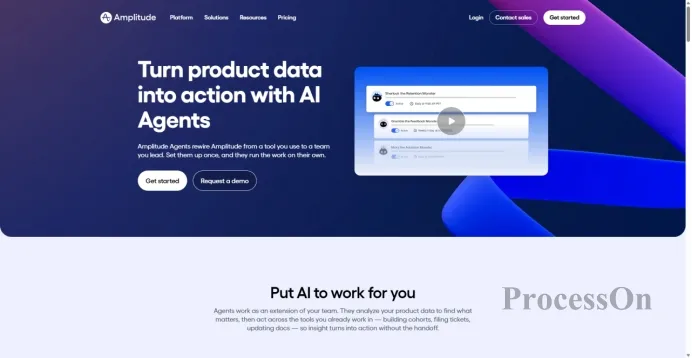
Amplitude
Amplitude, a leading platform in the product analytics field, launched its Agentic AI Analytics series of AI agents in February 2026, marking a new stage in product analytics from "passive data collection" to "proactive insight." As AI programming assistants significantly improve the speed of feature delivery, the challenge for teams has shifted from "can we make it?" to "once it's made, will anyone use it, and will it be effective?"—AI-driven behavioral analytics tools have become more important than ever before.
The biggest pain points for product managers when doing data analysis are: monitoring data is too time-consuming, anomaly detection is too slow, and analysis and attribution are too laborious. Amplitude's AI agent system solves these problems:
Global Agent: Ask complex questions in natural language, and AI will provide the answers directly—automatically analyze data, build dashboards, investigate root causes, and explain what is driving changes in the funnel, experiments, segments, and user journey, then recommend the next steps and execute them directly within Amplitude.
Native integration: Amplitude's AI capabilities have been integrated into the tools that product managers use daily—directly ask questions about user behavior data and pull charts in Claude or ChatGPT, obtain product context when verifying and debugging features in Cursor or Claude Code, and identify user friction and generate data-supported prototypes in Figma.
Applicable scenarios: daily monitoring of product data, user behavior analysis, A/B test design and analysis, automatic attribution of abnormal indicators, and user experience optimization.
The essence of Amplitude is to liberate product managers from passive monitoring by "staring at the dashboard looking for anomalies." AI proactively discovers problems, analyzes causes, and recommends actions—you only need to make decisions.
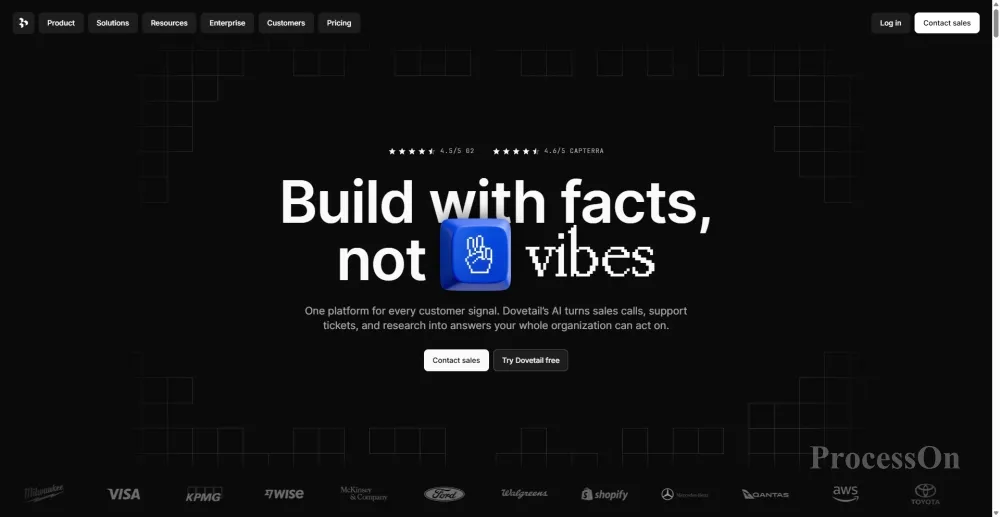
Dovetail
Dovetail is the AI tool of choice for product managers to conduct qualitative user research in 2026, focusing on user interview transcription, feedback synthesis, and insight extraction.
The most time-consuming part of user research for product managers is: recording interviews → listening to recordings → transcribing → tagging → finding commonalities → generating reports. Dovetail automates this entire process using AI:
Automatic transcription: User interview recordings are automatically transcribed into text, eliminating the need for manual editing.
AI-powered intelligent tagging: AI automatically performs sentiment analysis and topic tagging on interview content.
Centralized research repository: All user research data is stored centrally and can be retrieved at any time.
Pattern Recognition: AI automatically identifies common patterns, sentiment trends, and anomalous signals in cross-user interviews.
Applicable scenarios: Data support for user interview analysis, usability test feedback organization, user profile construction, and requirement prioritization.
The essence of Dovetail is to free product managers from the tedious task of "listening to recordings and labeling," allowing them to spend their time "understanding users and making the right decisions."
Q1: What AI tools should a novice product manager start learning in 2026?
A: I recommend starting with three tools: ① ProcessOn – uses AI to generate mind maps and flowcharts, quickly establishing the basics of requirements analysis and process design; ② Calicat – uses natural language to generate high-fidelity prototypes and simultaneously produce requirement cards, handling prototypes and PRDs in one stop; ③ WorkBuddy – uses AI to assist in PRD writing and competitor analysis, establishing standardized product documentation capabilities. After building a solid foundation, gradually try more advanced tools such as PM Skills.
Q2: What is the difference between PM Skills and general AI (such as ChatGPT)?
A: General AI gives you "text"—it can chat with you about the product, but it can't guide you through the entire path from idea to launch. PM Skills gives you "structure"—it encapsulates mature product methodologies (user discovery, prioritization, PRD writing, etc.) into skills and commands that AI can invoke. You type /discover once, and AI guides you from a vague idea to a validation experiment. General AI is a chat partner; PM Skills is a work partner.
Q3: What is the difference between v0/Lovable and Figma?
A: Figma is a professional UI design tool, suitable for refined visual design and team collaboration. v0 and Lovable are AI prototyping tools—you can generate runnable code prototypes simply by describing your requirements in natural language. v0 excels at generating high-quality React components, while Lovable excels at generating complete applications including front-end and back-end. Both are suitable for product managers to quickly validate ideas, while Figma is suitable for designers to make the final delivery.
Q4: What practical value does ProcessOn's AI feature bring to product managers?
A: ProcessOn's AI capabilities have transformed the most time-consuming task for product managers—"drawing diagrams"—from "manual creation" to "dialogue-based generation." Previously, drawing a Gantt chart took half an hour; now, AI generates one in 10 seconds. Previously, drawing a sequence diagram required repeated adjustments; now, inputting requirements generates an AI diagram instantly. More importantly, ProcessOn supports real-time collaboration among multiple users—product managers adjust the requirement structure, designers simultaneously supplement interaction specifications, and developers annotate technical constraints; all modifications are synchronized in real time. A single diagram clearly explaining the product logic is more effective than a thousand-word document.
Q5: What kind of product manager is WorkBuddy suitable for?
A: WorkBuddy is suitable for product managers who need to handle a large amount of document writing, information integration, and cross-departmental communication. If you write PRDs, conduct competitive analysis, organize meeting minutes, and produce proposal reports every day, WorkBuddy can delegate these "copywriting" tasks to AI. Especially for teams in China that use WeChat, WorkBuddy's native WeChat integration function allows product managers to assign tasks to AI anytime, anywhere.
Q6: What new AI skills must product managers master by 2026?
A: I suggest focusing on three areas: ① Mastering AI product tools (PM Skills, v0/Lovable, Productboard Spark, etc.) to transform methodologies into callable AI capabilities; ② Mastering AI visualization and collaboration tools (such as ProcessOn) to improve cross-team communication and documentation efficiency; ③ Developing AI data thinking (Amplitude, Dovetail, etc.) to use AI-driven insights to assist product decisions.