Process Type
Graphical expression
Mind Type
Structured expression
Note Type
Efficient expression
Treemap
Bracket Diagram

Default Mode





Many teams and individuals fall into the same trap when managing goals: annual and quarterly objectives are announced with great fanfare, but their implementation ends up chaotic. Vague goals without direction, confused and misaligned hierarchies, untracked progress, hard-to-quantify results – in the end everything boils down to pure formalism, wasting nothing but time and energy.
OKR (Objectives and Key Results) is today's leading tool for efficient goal management and perfectly solves problems such as scattered goals and the disconnect between planning and execution – yet standardized writing, hierarchical breakdown and implementation tracking remain the pain point for most people. Authoritative data confirms this: according to the global business study conducted by The OKR Institute in 2024, over 60% of companies fail to achieve effective implementation in the initial phase of introducing OKRs – most often because the structure is not orderly, there is no tracking system and goals are not aligned, so everything degenerates into a formality. No trial and error from scratch: ProcessOn's complete OKR templates cover all scenarios – company, department, individual – allow you to structure goals visually and apply them with one click for direct implementation, easily achieving the closed loop from strategy to execution and greatly reducing the failure rate of OKR implementation.
Many people mistakenly believe that OKRs simply mean listing goals and writing plans, piling up text at random – and thus render management ineffective. The most common problems concentrate in 3 points:
The heart of good OKR management is: standardized structure + visual breakdown + continuous tracking. According to the «2024 Research Report on Collaborative Management of Chinese Companies», in companies that have implemented a standardized OKR management system the efficiency of organizational goal alignment increases by more than 40% and the on-time task delivery rate improves by 35%. ProcessOn's OKR templates are the all-in-one solution tailored precisely to these pain points, helping companies and individuals quickly build a standardized implementation system.
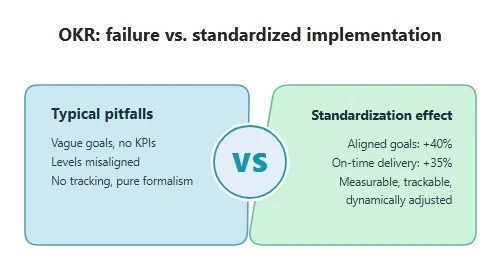
A good OKR template directly sidesteps the three implementation pain points described above: without having to build the framework from zero, OKRs quickly turn from a paper concept into executable work.
The template provides a fixed writing framework of O (Objective) + KR (Key Results) that steers goal descriptions toward a clear direction: every Key Result must be measurable and based on explicit criteria. While filling it in, “goals” and “tasks” are automatically distinguished, avoiding grand slogans – for every single KR you can check whether it was accomplished or not.
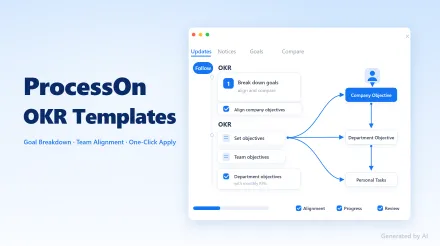
The template supports multi-level visual breakdown of OKRs: company, department, team and individual. Higher-level goals are broken down downward, individual results link upward: you can see at a glance which high-level objective each piece of work supports, quickly identify duplicated work and resource conflicts, reduce organizational friction, and keep everyone's goals on the same wavelength.
The template includes progress markers and interim review columns; the completion status can be updated at any time. Within the cycle you can record risks and adjust actions – OKRs don't disappear into a drawer after being written. Together with regular reviews, blockers are identified in time, the course is corrected, and OKRs are prevented from becoming one-off documents.
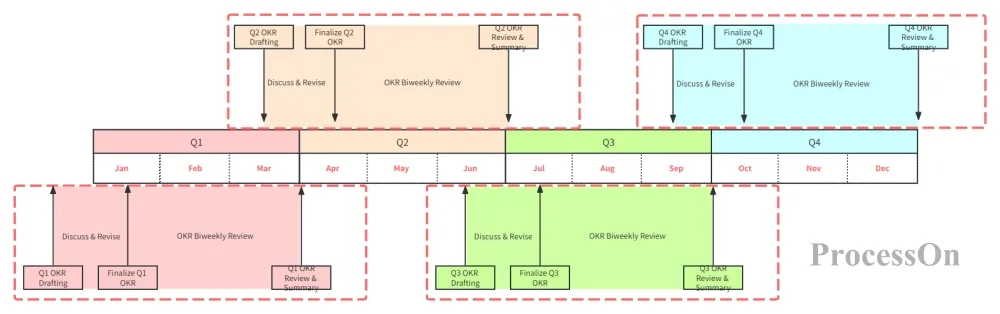
We have collected the most popular and most reused battle-tested OKR templates from the ProcessOn template community: they cover general and niche scenarios, are editable as soon as you open them and require no second round of creation. According to platform user behavior statistics, users of standardized OKR templates achieve a 28% higher goal completion rate than those writing on their own, and cut planning time by 80% – suitable for the vast majority of workplace and business management scenarios.
Suitable for quarterly and annual strategic planning meetings: the template fully presents the three-level goal alignment system of company–department–individual. Top-level strategic goals, middle-level bridging goals and grassroots execution goals are clearly separated, complemented by a percentage progress tracking module and an iteration log module – perfectly solving the problems of disconnected team goals and untracked implementation. It is the core foundational template for implementing OKRs in a company.
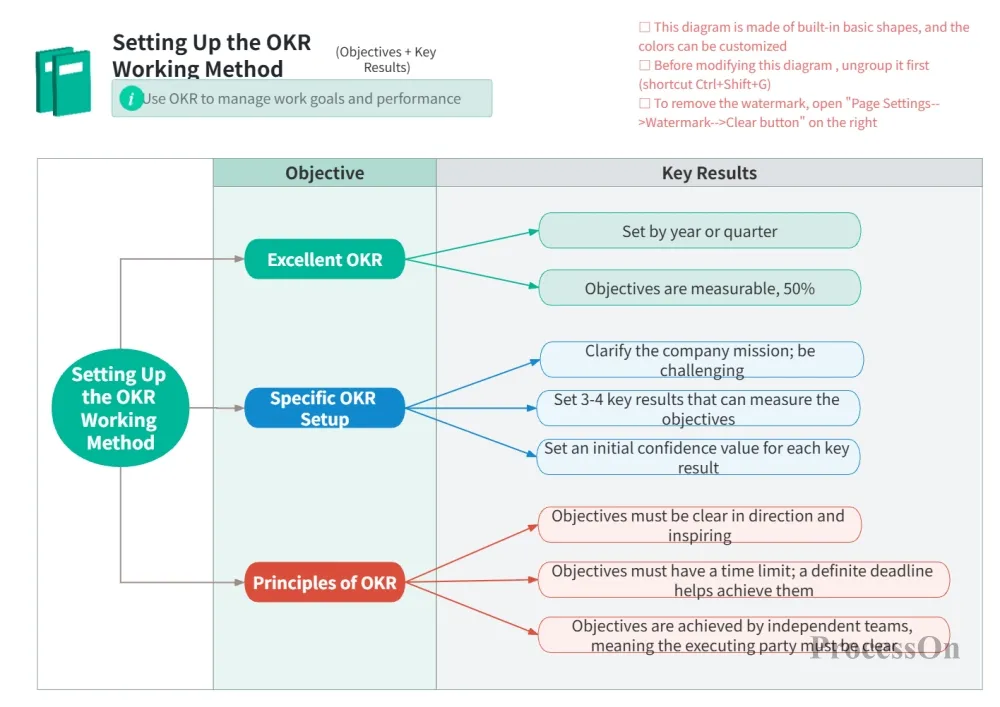
Definition of the OKR Methodology
Custom-designed for key positions – say goodbye to the adaptability shortcomings of universal templates. The sales template focuses on business growth, lead conversion and market expansion; the operations template on user growth, content monetization and campaign execution; the development template on project iterations, feature optimization and bug fixing. All KRs are industry-standard quantified indicators: just replace the data to use them right away, efficiently adapting to each role's work scenarios.
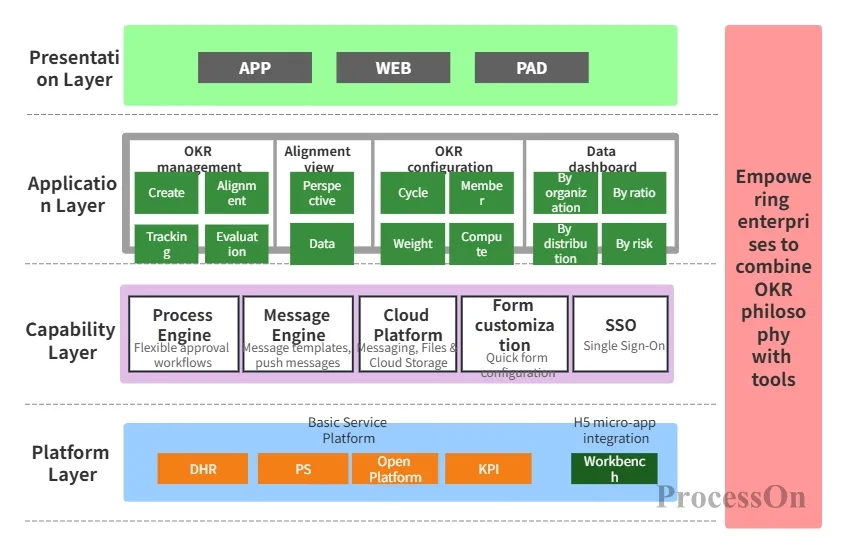
Suitable for individual self-management at work: the structure is simple and clear, comprising six modules – goal setting, Key Results breakdown, daily/weekly task splitting, progress self-check, problem review and optimization plan. It helps the individual focus on core work, avoid unproductive busyness, keep precise control over work progress, and quickly improve personal efficiency and the goal achievement rate.
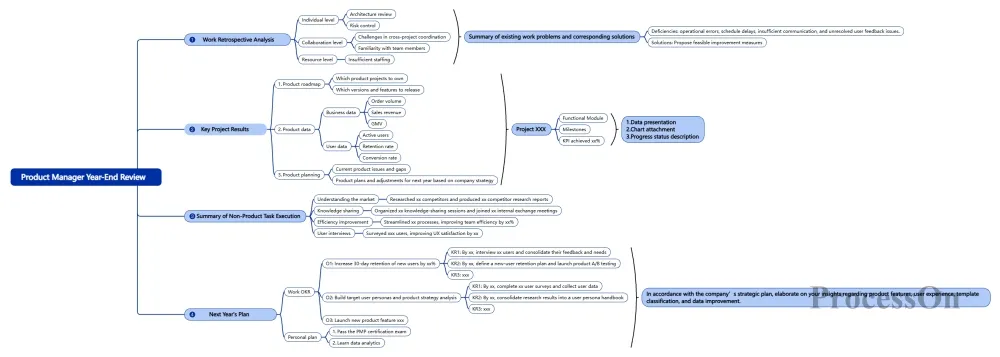
Product Manager Annual Summary
Suitable for in-company OKR implementation training: it covers content such as basic OKR knowledge, core principles, writing methods, rollout process, common pitfalls and detailed implementation rules. It can be used directly as courseware for team training and as teaching material for onboarding new hires, helping all staff quickly understand the OKR system, unify management awareness, and ensure the smooth rollout of the company's OKR system.
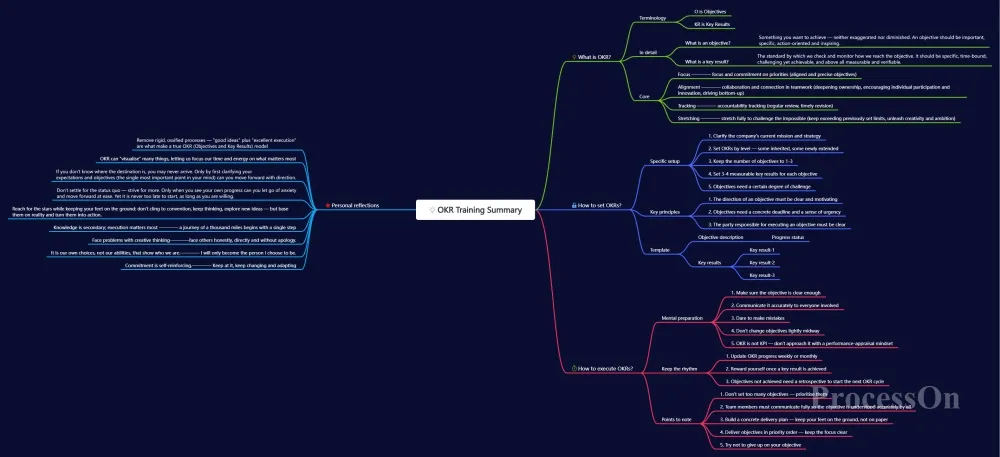
Just master three simple steps: even complete beginners can manage OKRs professionally and make their goals deliver real results:
1. Choose the right template precisely: Open the ProcessOn platform and filter the suitable OKR template by your use case (company strategy / department management / personal planning), position and time period.
2. Fill in and optimize quickly: Based on your own work goals, define the central Os (1–3 core objectives, no overload) and add 3–5 measurable, actionable KRs; replace the template content and fine-tune the structure to fit your needs.
3. Collaborate, track and review: In team scenarios, activate multi-user collaboration permissions so that everyone's goals are synchronized; update progress data regularly, review the causes of shortfalls at each stage and adjust dynamically – forming a complete management loop.
The core of OKR management has never been “writing templates”, but rather focusing on goals, implementing them consistently and iterating continuously. For most teams and individuals this means: no lengthy system building and no fumbling around with formats. With the mature ProcessOn OKR templates you avoid management mistakes and save 80% of the time for layout and structure building – leaving more energy for what matters: implementing goals and landing results.
Say goodbye to blind busyness and the pointless rat race – the starting point is standardized goal management. Visit ProcessOn, search for "OKR templates" and get a wealth of battle-tested templates for free: apply them with one click – for more efficient team management and clearer personal growth!
Absolutely! All OKR templates from ProcessOn are standardized finished products – no professional OKR theory required and no need to build your own framework. The templates come with a complete structure, industry-standard quantified indicators and implementation processes: beginners only need to replace the corresponding content to fit their scenario and can complete writing, breakdown and review following the filling instructions – professional OKR management is easy to pick up even with zero experience.
All templates support free editing and individual fine-tuning. Depending on the company's industry, team size, job profiles and cycle planning, modules can be flexibly added or removed, indicators adjusted and the hierarchy structure modified. Whether it is a small or micro business seeking a lean implementation or a medium-sized to large enterprise building a standardized system – each template can be adapted through fine adjustments to your specific management needs, without being tied to a fixed format.
The ProcessOn templates support real-time collaboration, permission management and one-click sharing. Users can share the edited OKR canvas with team members and grant different permissions such as viewing, editing and commenting – keeping the goals of the company, departments and individuals synchronized in real time. Everyone can view the goal breakdown logic, update work progress and discuss blockers via comments at any time – information asymmetry and desynchronized goals are finally a thing of the past.