

Summary of OKR Training
0 Report
Summary of OKR Training
Related Recommendations
Other works by the author
Outline/Content
See more
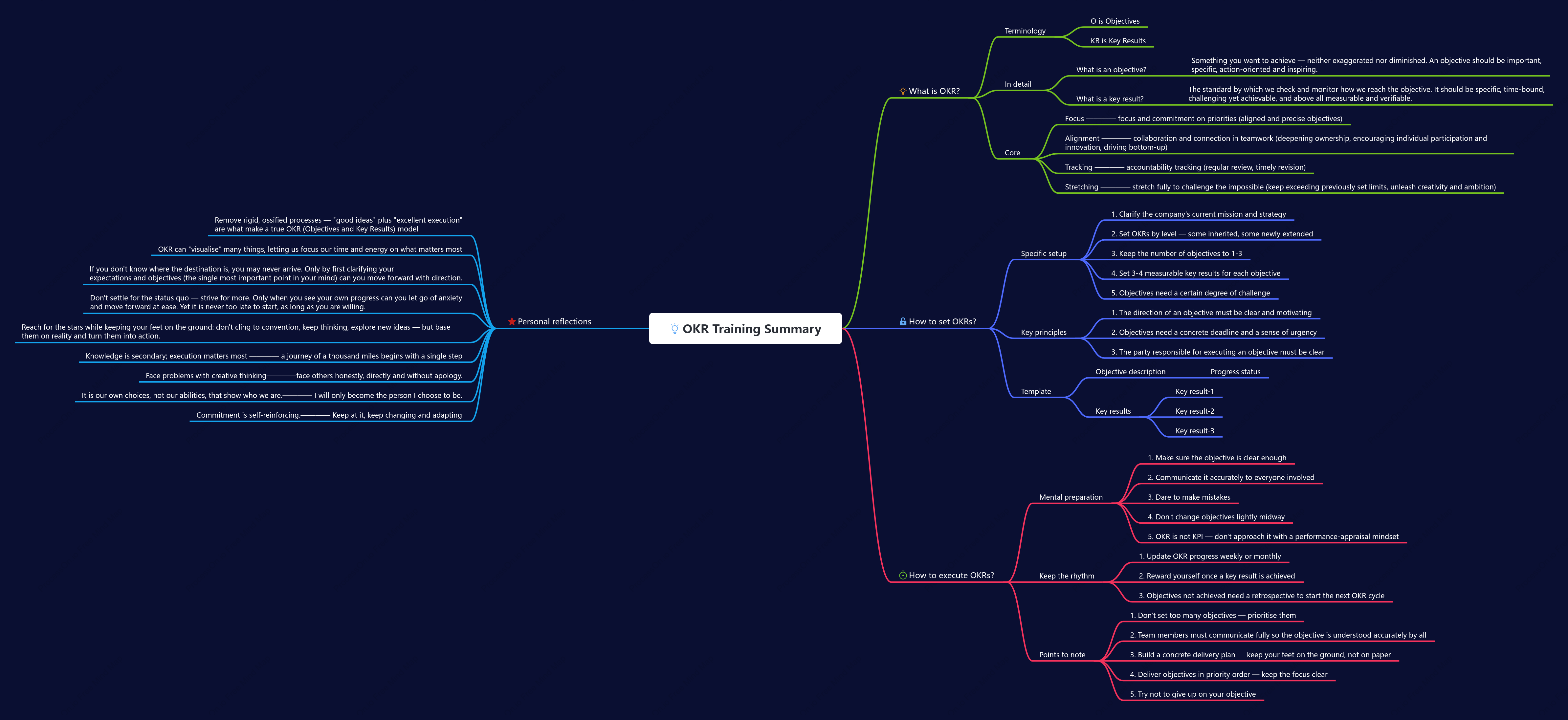
What is OKR?
Terminology
O is Objectives
KR is Key Results
In detail
What is an objective?
Something you want to achieve — neither exaggerated nor diminished. An objective should be important,
specific, action-oriented and inspiring.
specific, action-oriented and inspiring.
What is a key result?
The standard by which we check and monitor how we reach the objective. It should be specific, time-bound,
challenging yet achievable, and above all measurable and verifiable.
challenging yet achievable, and above all measurable and verifiable.
Core
Focus ———— focus and commitment on priorities (aligned and precise objectives)
Alignment ———— collaboration and connection in teamwork (deepening ownership, encouraging individual participation and innovation, driving bottom-up)
Tracking ———— accountability tracking (regular review, timely revision)
Stretching ———— stretch fully to challenge the impossible (keep exceeding previously set limits, unleash creativity and ambition)
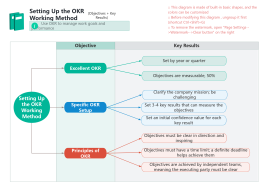
How to set OKRs?
Specific setup
1. Clarify the company's current mission and strategy
2. Set OKRs by level — some inherited, some newly extended
3. Keep the number of objectives to 1-3
4. Set 3-4 measurable key results for each objective
5. Objectives need a certain degree of challenge
Key principles
1. The direction of an objective must be clear and motivating
2. Objectives need a concrete deadline and a sense of urgency
3. The party responsible for executing an objective must be clear
Template
Objective description
Progress status
Key results
Key result-1
Key result-2
Key result-3
How to execute OKRs?
Mental preparation
1. Make sure the objective is clear enough
2. Communicate it accurately to everyone involved
3. Dare to make mistakes
4. Don't change objectives lightly midway
5. OKR is not KPI — don't approach it with a performance-appraisal mindset
Keep the rhythm
1. Update OKR progress weekly or monthly
2. Reward yourself once a key result is achieved
3. Objectives not achieved need a retrospective to start the next OKR cycle
Points to note
1. Don't set too many objectives — prioritise them
2. Team members must communicate fully so the objective is understood accurately by all
3. Build a concrete delivery plan — keep your feet on the ground, not on paper
4. Deliver objectives in priority order — keep the focus clear
5. Try not to give up on your objective
Personal reflections
Remove rigid, ossified processes — "good ideas" plus "excellent execution"
are what make a true OKR (Objectives and Key Results) model
are what make a true OKR (Objectives and Key Results) model
OKR can "visualise" many things, letting us focus our time and energy on what matters most
If you don't know where the destination is, you may never arrive. Only by first clarifying your
expectations and objectives (the single most important point in your mind) can you move forward with direction.
expectations and objectives (the single most important point in your mind) can you move forward with direction.
Don't settle for the status quo — strive for more. Only when you see your own progress can you let go of anxiety
and move forward at ease. Yet it is never too late to start, as long as you are willing.
and move forward at ease. Yet it is never too late to start, as long as you are willing.
Reach for the stars while keeping your feet on the ground: don't cling to convention, keep thinking, explore new ideas — but base them on reality and turn them into action.
Knowledge is secondary; execution matters most ———— a journey of a thousand miles begins with a single step
Face problems with creative thinking————face others honestly, directly and without apology.
It is our own choices, not our abilities, that show who we are.———— I will only become the person I choose to be.
Commitment is self-reinforcing.———— Keep at it, keep changing and adapting
Collect
Collect
Collect
Collect
Collect

Collect

0 Comments
Next Page