
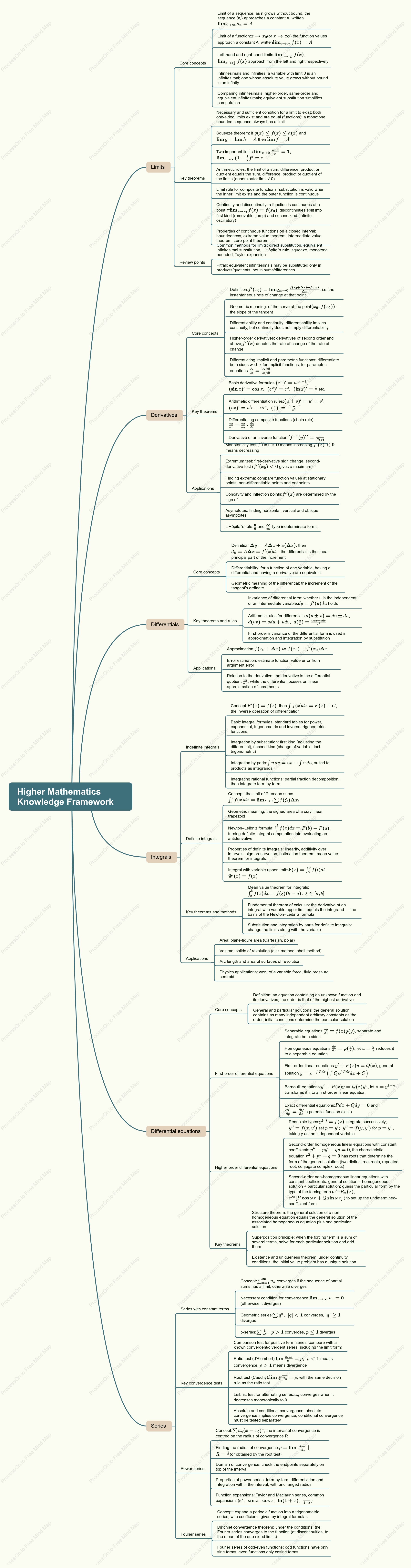

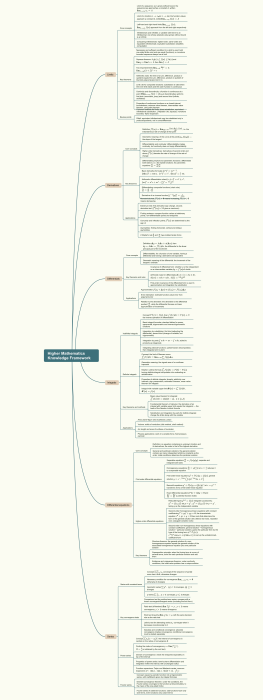
Higher Mathematics Knowledge Framework
0 Report
Higher Mathematics Knowledge Framework
Related Recommendations
Other works by the author
Outline/Content
See more
Limits
Core concepts
Limit of a sequence: as n grows without bound, the sequence {aₙ} approaches a constant A, written
Limit of a function:(or ) the function values approach a constant A, written
Left-hand and right-hand limits:、 approach from the left and right respectively
Infinitesimals and infinities: a variable with limit 0 is an infinitesimal; one whose absolute value grows without bound is an infinity
Comparing infinitesimals: higher-order, same-order and equivalent infinitesimals; equivalent substitution simplifies computation
Key theorems
Necessary and sufficient condition for a limit to exist: both one-sided limits exist and are equal (functions); a monotone bounded sequence always has a limit
Squeeze theorem: if and then
Two important limits:;
Arithmetic rules: the limit of a sum, difference, product or quotient equals the sum, difference, product or quotient of the limits (denominator limit ≠ 0)
Limit rule for composite functions: substitution is valid when the inner limit exists and the outer function is continuous
Continuity and discontinuity: a function is continuous at a point iff; discontinuities split into first kind (removable, jump) and second kind (infinite, oscillatory)
Properties of continuous functions on a closed interval: boundedness, extreme value theorem, intermediate value theorem, zero-point theorem
Review points
Common methods for limits: direct substitution, equivalent infinitesimal substitution, L'Hôpital's rule, squeeze, monotone bounded, Taylor expansion
Pitfall: equivalent infinitesimals may be substituted only in products/quotients, not in sums/differences
Derivatives
Core concepts
Definition:, i.e. the instantaneous rate of change at that point
Geometric meaning: of the curve at the point — the slope of the tangent
Differentiability and continuity: differentiability implies continuity, but continuity does not imply differentiability
Higher-order derivatives: derivatives of second order and above; denotes the rate of change of the rate of change
Differentiating implicit and parametric functions: differentiate both sides w.r.t. x for implicit functions; for parametric equations
Key theorems
Basic derivative formulas:、、、 etc.
Arithmetic differentiation rules:、、
Differentiating composite functions (chain rule):
Derivative of an inverse function:
Applications
Monotonicity test: means increasing, means decreasing
Extremum test: first-derivative sign change, second-derivative test ( gives a maximum)
Finding extrema: compare function values at stationary points, non-differentiable points and endpoints
Concavity and inflection points: are determined by the sign of
Asymptotes: finding horizontal, vertical and oblique asymptotes
L'Hôpital's rule: and type indeterminate forms
Differentials
Core concepts
Definition:, then , the differential is the linear principal part of the increment
Differentiability: for a function of one variable, having a differential and having a derivative are equivalent
Geometric meaning of the differential: the increment of the tangent's ordinate
Key theorems and rules
Invariance of differential form: whether u is the independent or an intermediate variable, holds
Arithmetic rules for differentials:、、
First-order invariance of the differential form is used in approximation and integration by substitution
Applications
Approximation:
Error estimation: estimate function-value error from argument error
Relation to the derivative: the derivative is the differential quotient , while the differential focuses on linear approximation of increments
Integrals
Indefinite integrals
Concept:, then , the inverse operation of differentiation
Basic integral formulas: standard tables for power, exponential, trigonometric and inverse trigonometric functions
Integration by substitution: first kind (adjusting the differential), second kind (change of variable, incl. trigonometric)
Integration by parts:, suited to products as integrands
Integrating rational functions: partial fraction decomposition, then integrate term by term
Definite integrals
Concept: the limit of Riemann sums
Geometric meaning: the signed area of a curvilinear trapezoid
Newton–Leibniz formula:, turning definite-integral computation into evaluating an antiderivative
Properties of definite integrals: linearity, additivity over intervals, sign preservation, estimation theorem, mean value theorem for integrals
Integral with variable upper limit:,
Key theorems and methods
Mean value theorem for integrals:,
Fundamental theorem of calculus: the derivative of an integral with variable upper limit equals the integrand — the basis of the Newton–Leibniz formula
Substitution and integration by parts for definite integrals: change the limits along with the variable
Applications
Area: plane-figure area (Cartesian, polar)
Volume: solids of revolution (disk method, shell method)
Arc length and area of surfaces of revolution
Physics applications: work of a variable force, fluid pressure, centroid
Differential equations
Core concepts
Definition: an equation containing an unknown function and its derivatives; the order is that of the highest derivative
General and particular solutions: the general solution contains as many independent arbitrary constants as the order; initial conditions determine the particular solution
First-order differential equations
Separable equations:, separate and integrate both sides
Homogeneous equations:, let reduces it to a separable equation
First-order linear equations:, general solution
Bernoulli equations:, let transforms it into a first-order linear equation
Exact differential equations: and a potential function exists
Higher-order differential equations
Reducible types: integrate successively; set ; for , taking y as the independent variable
Second-order homogeneous linear equations with constant coefficients:, the characteristic equation has roots that determine the form of the general solution (two distinct real roots, repeated root, conjugate complex roots)
Second-order non-homogeneous linear equations with constant coefficients: general solution = homogeneous solution + particular solution; guess the particular form by the type of the forcing term (、 ) to set up the undetermined-coefficient form
Key theorems
Structure theorem: the general solution of a non-homogeneous equation equals the general solution of the associated homogeneous equation plus one particular solution
Superposition principle: when the forcing term is a sum of several terms, solve for each particular solution and add them
Existence and uniqueness theorem: under continuity conditions, the initial value problem has a unique solution
Series
Series with constant terms
Concept: converges if the sequence of partial sums has a limit, otherwise diverges
Necessary condition for convergence:(otherwise it diverges)
Geometric series:, converges, diverges
p-series:, converges, diverges
Key convergence tests
Comparison test for positive-term series: compare with a known convergent/divergent series (including the limit form)
Ratio test (d'Alembert):, means convergence, means divergence
Root test (Cauchy):, with the same decision rule as the ratio test
Leibniz test for alternating series: converges when it decreases monotonically to 0
Absolute and conditional convergence: absolute convergence implies convergence; conditional convergence must be tested separately
Power series
Concept:, the interval of convergence is centred on the radius of convergence R
Finding the radius of convergence:,(or obtained by the root test)
Domain of convergence: check the endpoints separately on top of the interval
Properties of power series: term-by-term differentiation and integration within the interval, with unchanged radius
Function expansions: Taylor and Maclaurin series, common expansions (、、、、)
Fourier series
Concept: expand a periodic function into a trigonometric series, with coefficients given by integral formulas
Dirichlet convergence theorem: under the conditions, the Fourier series converges to the function (at discontinuities, to the mean of the one-sided limits)
Fourier series of odd/even functions: odd functions have only sine terms, even functions only cosine terms

Collect

Collect

Collect

0 Comments
Next Page