

Methods for Summarizing Educational Knowledge
0 Report
Methods for Summarizing Educational Knowledge
Related Recommendations
Other works by the author
Outline/Content
See more
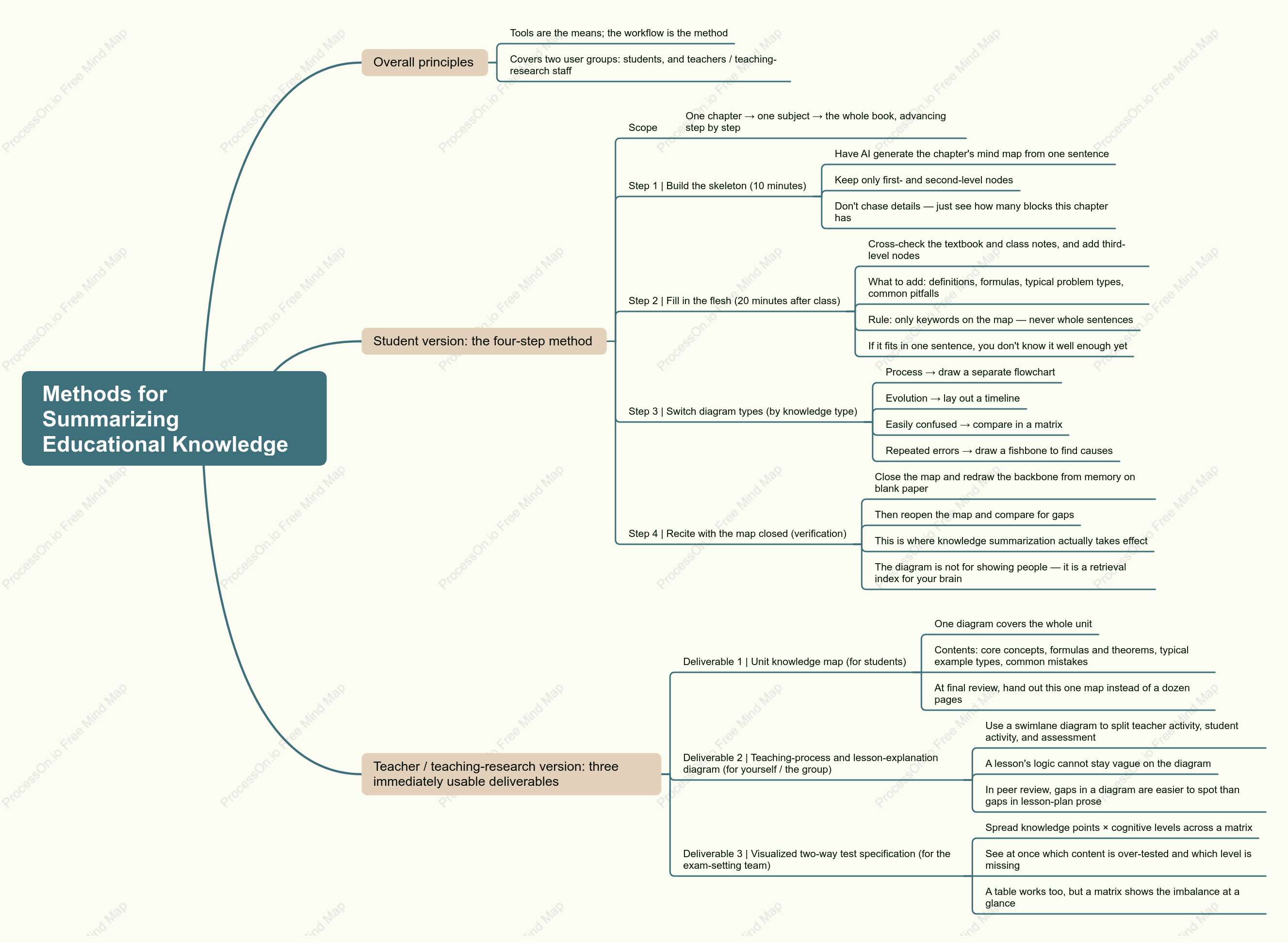
Overall principles
Tools are the means; the workflow is the method
Covers two user groups: students, and teachers / teaching-research staff
Student version: the four-step method
Scope
One chapter → one subject → the whole book, advancing step by step
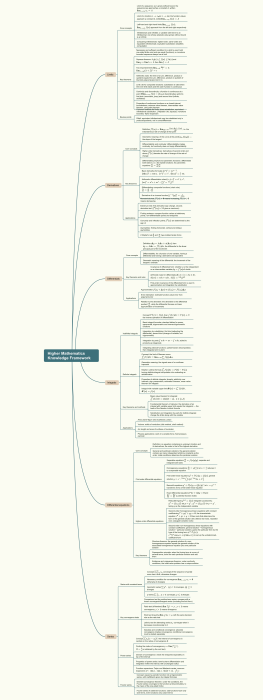
Step 1 | Build the skeleton (10 minutes)
Have AI generate the chapter's mind map from one sentence
Keep only first- and second-level nodes
Don't chase details — just see how many blocks this chapter has
Step 2 | Fill in the flesh (20 minutes after class)
Cross-check the textbook and class notes, and add third-level nodes
What to add: definitions, formulas, typical problem types, common pitfalls
Rule: only keywords on the map — never whole sentences
If it fits in one sentence, you don't know it well enough yet
Step 3 | Switch diagram types (by knowledge type)
Process → draw a separate flowchart
Evolution → lay out a timeline
Easily confused → compare in a matrix
Repeated errors → draw a fishbone to find causes
Step 4 | Recite with the map closed (verification)
Close the map and redraw the backbone from memory on blank paper
Then reopen the map and compare for gaps
This is where knowledge summarization actually takes effect
The diagram is not for showing people — it is a retrieval index for your brain
Teacher / teaching-research version: three immediately usable deliverables
Deliverable 1 | Unit knowledge map (for students)
One diagram covers the whole unit
Contents: core concepts, formulas and theorems, typical example types, common mistakes
At final review, hand out this one map instead of a dozen pages
Deliverable 2 | Teaching-process and lesson-explanation diagram (for yourself / the group)
Use a swimlane diagram to split teacher activity, student activity, and assessment
A lesson's logic cannot stay vague on the diagram
In peer review, gaps in a diagram are easier to spot than gaps in lesson-plan prose
Deliverable 3 | Visualized two-way test specification (for the exam-setting team)
Spread knowledge points × cognitive levels across a matrix
See at once which content is over-tested and which level is missing
A table works too, but a matrix shows the imbalance at a glance

Collect

Collect

Collect

Collect

0 Comments
Next Page