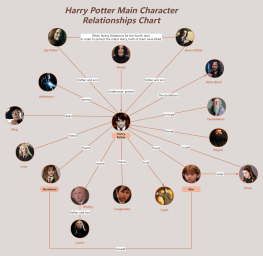
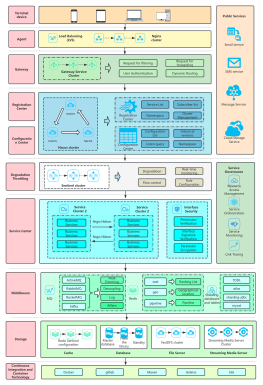
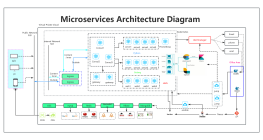
Process Type
Graphical expression
Mind Type
Structured expression
Note Type
Efficient expression
Treemap
Bracket Diagram

Default Mode





Mind maps can be used not only for note-taking, but also for brainstorming, reading notes, classroom learning, exam review, work summaries, project planning, meeting minutes, presentations, and knowledge system organization .
Simply put, mind mapping is suitable for tasks that involve a lot of information but lack a clear structure: start with a central theme, expand related content layer by layer, and then establish relationships between information through branches, levels, and keywords.
If you don't know how to use mind maps, you can start with these specific scenarios below.
Brainstorming is a very typical way to use mind mapping. When faced with a complex problem, you can first put the problem or goal at the center, and then add ideas around it continuously, rather than requiring every point of view to be complete and reasonable from the beginning.
For example, if a product team is preparing to discuss "how to improve user retention", they can start from the following directions : user needs → product features → user experience → content operation → event operation → user incentives → customer feedback → competitor analysis .
The first round focuses on brainstorming , recording as many possible ideas as possible; the second round involves categorizing, merging, and filtering to ultimately form an executable plan.
Because brainstorming itself involves two stages: generating ideas → organizing ideas .
Mind maps can accommodate the free-flowing ideas in the first stage, and can also reorganize the content in the second stage through nodes and hierarchical relationships.
However, it's worth noting that the conclusion that "team brainstorming produces more good ideas than individual brainstorming " is not easily drawn . Related research has found that brainstorming effectiveness is influenced by factors such as task type, interaction style, and team structure; some studies have even found that alternating between individual and team brainstorming may result in a higher number of creative ideas.
Therefore, rather than simply calling everyone together for "free expression," it is often a worthwhile approach to work by having individuals brainstorm first and then organizing the ideas collectively .
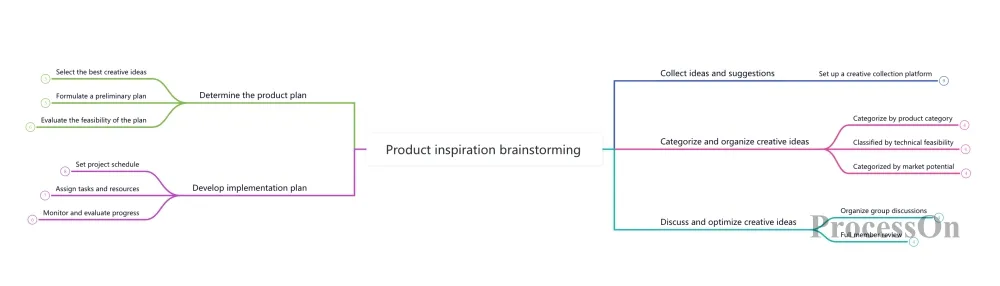
Product inspiration brainstorming
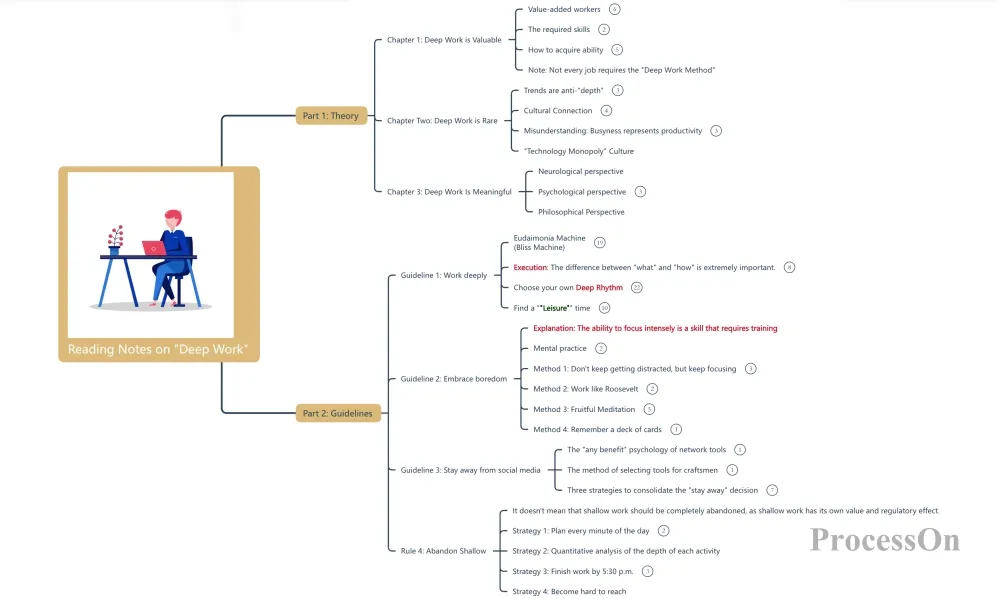
Reading notes are suitable for extracting the structure, core ideas, and personal understanding of a book.
Compared to traditional reading notes, mind maps do not require recording content in the exact order of reading; instead, they can reorganize the knowledge structure of a book.
For example, a management book can be organized as follows: Core viewpoints → Important concepts → Methodology → Case studies → Practical applications → Reading reflections .
For professional books, you can organize them according to: Chapter → Knowledge Points → Key Points → Difficult Points → Case Studies → Further Reading .
The value of this approach is not just in "recording," but in recompressing a book into a structure that can be quickly reviewed.
For example, after reading a book of several hundred pages, you can quickly recall it using a mind map:
Therefore, mind maps for reading notes are especially suitable for professional books, management books, exam textbooks, and knowledge-based reading that requires long-term accumulation .
A simple four-step method can be used:
Step 1: Determine the central theme
Use the book title as the central theme.
Step 2: Create a first-level branch
It can be divided according to chapters or core themes.
Step 3: Extracting Keywords
Instead of copying entire paragraphs from the book, extract the concepts, viewpoints, and key cases.
Step 4: Add your own understanding
Record "what the author said" and "what I learned" separately.
The resulting mind map is not only a book summary, but also a result of your own knowledge organization.
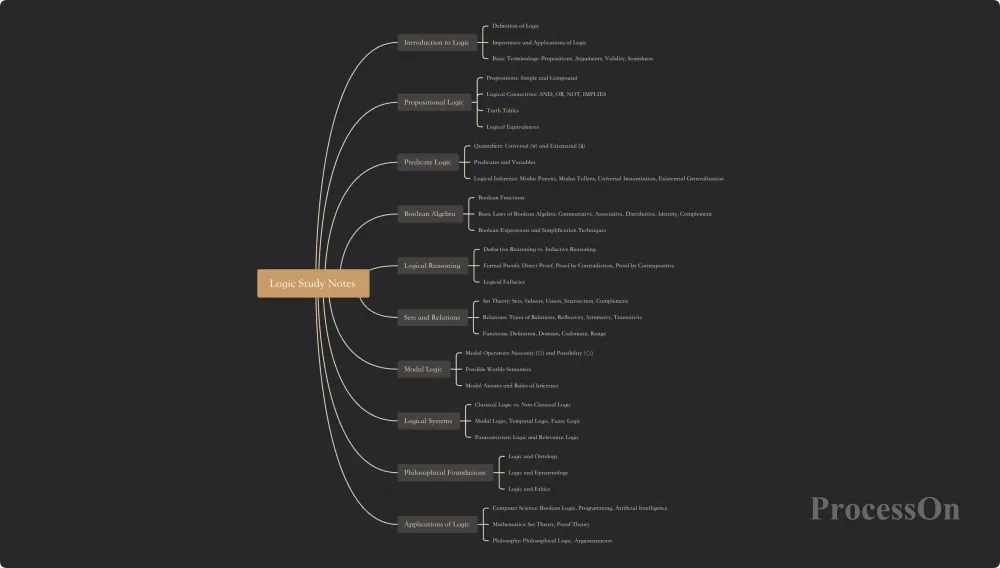
For students, mind maps can be used throughout the entire learning process: 『 Class notes → After-class organization → Knowledge review → Exam preparation 』.
The information received in the classroom is usually fragmented. The teacher may introduce concepts, cases, formulas and key points in the order of the lecture, while the textbook has its own chapter structure.
Therefore, you can use mind maps to reorganize the material after class: 『 Course → Chapter → Knowledge Points → Key Points → Difficult Points → Common Mistakes 』.
When it comes to the exam review stage, the key content that needs to be mastered is further condensed.
History can be organized according to the following sequence: Time → People → Events → Background → Process → Result → Impact .
Disciplines such as biology and medicine can establish their knowledge structure according to: 『 Concept → Classification → Characteristics → Function → Mechanism → Related Diseases/Case Studies 』 .
Mind maps can also be used in subjects with strong logical structures, such as mathematics and computer science, to organize the connections between formulas, concepts, methods, and knowledge.
There are numerous studies on this topic. For example, a 2024 report analyzed 5,364 students in grades 3-12, covering subjects such as physics, science, chemistry, and biology. The study found a moderate positive correlation between mind mapping instruction and improved science performance, with an overall effect size of g = 0.776 . The study also noted significant heterogeneity among different studies.
report from 2022 analyzed 21 studies involving 1,695 students and found that mind mapping methods , compared to traditional teaching, achieved effect sizes of g = 0.531 and g = 0.648 in terms of critical thinking ability and critical thinking tendency, respectively .
These studies are better suited to support a relatively cautious conclusion: Organizing knowledge in a structured and visual way can be beneficial for some learning tasks, but the actual effect depends on the subject, the task, the teaching method, and how students use it.
Therefore, mind mapping is more suitable as a learning and knowledge organization method than a "learning magic tool" that can automatically improve grades.
work summaries, job reviews, year-end summaries, and annual plans in the workplace .
Traditional work summaries are usually presented in chronological order, but before actually starting to write them, many people need to solve a problem first:
What exactly have I accomplished during this period? Which tasks were most important? What results have I achieved? What problems remain? What are my next steps?
This is precisely where mind mapping comes in.
For example , a monthly or quarterly work summary can be broken down around a central theme: key tasks → project results → data performance → problems encountered → experience summary → follow-up plans .
The year-end summary can be further expanded to include: work throughout the year → key projects → work results → data performance → problems and reflections → plans for the next year .
If you want to create an annual plan, you can also establish it from another perspective: work goals → learning goals → skills enhancement → career development → personal life → long-term goals .
In this way, mind maps can be used to review the past as well as plan for the future .
If you're faced with a blank document and don't know how to write a year-end summary, you can skip writing the article for now.
First, draw a mind map listing all the projects you've done in the past year. Then, add the following information to each project: " What was done → Why was it done → What results were achieved → What problems were encountered → What was learned ." Finally, convert the main branches of the mind map into an article structure . This will make it less likely to miss important work.
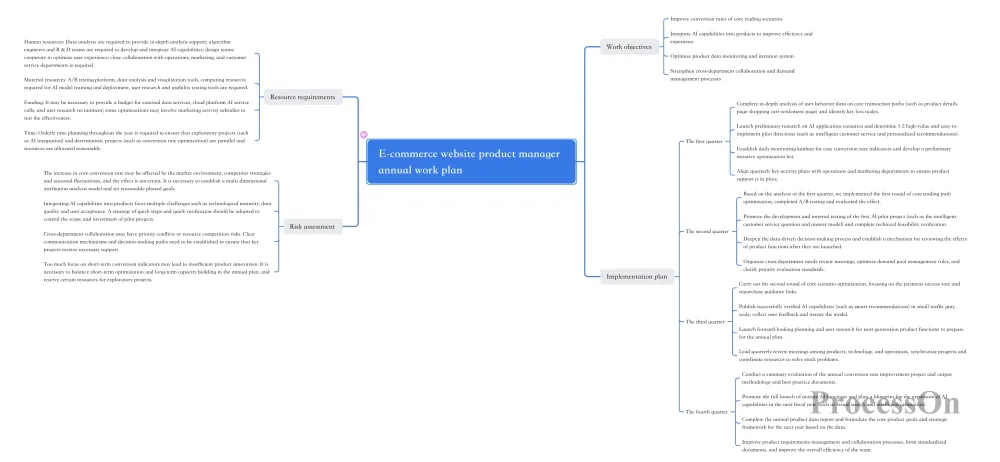
Annual Work Plan for an E-commerce Product Manager
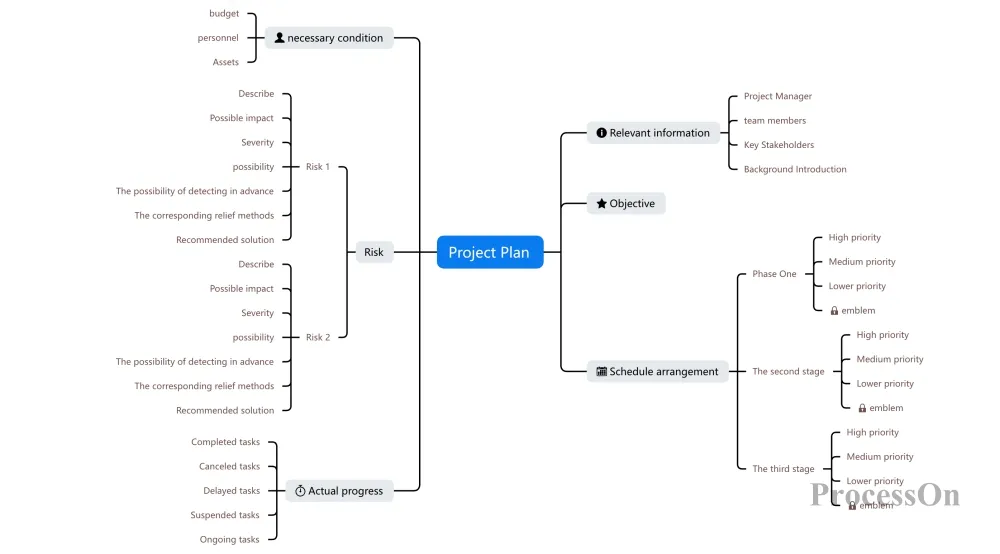
The more complex a project, the more important it is to clarify the issues before actually starting execution. Project planning mind maps can serve as a tool for organizing ideas during the project initiation phase.
For example, a new product project can start with: ' Project Objectives' → User needs → Product features → Project tasks → Personnel allocation → Time arrangement → Resources → Risks are discussed layer by layer.
In the field of project management, project plans are typically established from aspects such as scope, task breakdown, resources, schedule, risks, and stakeholders. Project planning documents involve requirements, project scope, work breakdown structure, activity sequence, schedule, resources, and risks.
This also illustrates an important point: mind mapping is not project management itself, but rather a way of organizing thoughts during the project planning phase.
For example:
Mind Map: First, clarify the project plan.
Flowchart: Clarify the process
Gantt chart: Organize your time effectively.
Project management tools: Tracking execution status
Therefore, if the project content is still in the discussion and planning stage, mind mapping is usually more flexible than creating a detailed project plan directly.
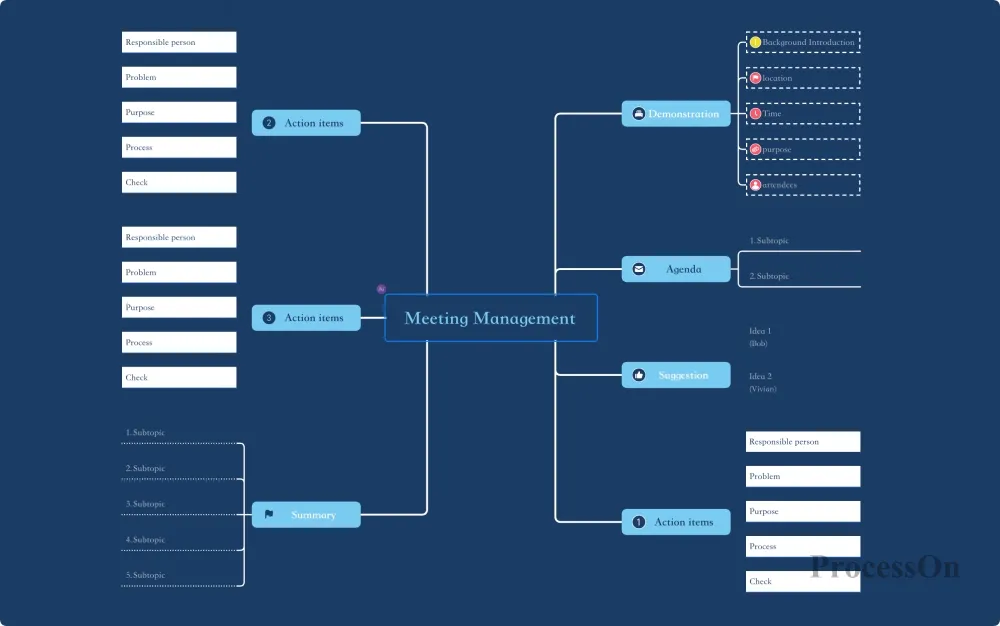
Meeting minutes and presentations may seem different, but they both need to solve one problem: how to organize a large amount of information into a clear logical structure?
Meetings often involve extensive discussions , and if notes are taken in the exact order of speaking, it may be difficult to quickly find the final conclusions after the meeting ends.
Map can be structured around the meeting theme: Meeting Objectives → Core Issues → Discussion Points → Final Conclusions → Tasks → Responsible Persons → Deadlines . In this way, the mind map becomes more than just "meeting minutes"; it becomes a map of meeting decision-making .
When preparing a speech or PowerPoint presentation, you can also use mind maps to organize the content first.
For example, a work report can be structured as follows: Background → Problem → Analysis → Solution → Execution Results → Follow-up Plan , and then each first-level branch can be converted into a PPT chapter .
The advantage of doing this is that it solves the problem of "what to talk about" first, and then the problem of "how to present it" . It is especially suitable for: job performance review , product report , project report , course sharing , speech , defense , and PPT outline .
If reading notes address the question: "What did I learn from this book?"
So, a knowledge system addresses the question: "What have I actually mastered through my long-term study of this field?"
For example, learning about artificial intelligence can be structured as follows: " Artificial Intelligence "
→ Machine Learning
→ Deep Learning
→ Natural Language Processing
→ Large Language Models
→ AI Applications
→ AI Tools
→ Industry Trends
When you read new books, articles, or take new courses in the future, you can continuously add new knowledge to the existing structure.
The value of mind mapping is not to save all your information, but to help you build a knowledge index and structure .
As your knowledge grows, you can use mind maps to quickly identify: what you already know → what is related to other content → what you don't yet understand → what you should learn next .
For example, when setting annual goals, one could start with " Personal Goals for 2026 " : [ Work] → Learning → Ability → Interest → Life → Break down long-term goals layer by layer.
By adding specific actions to each goal, a relatively abstract wish can be transformed into an actionable plan.
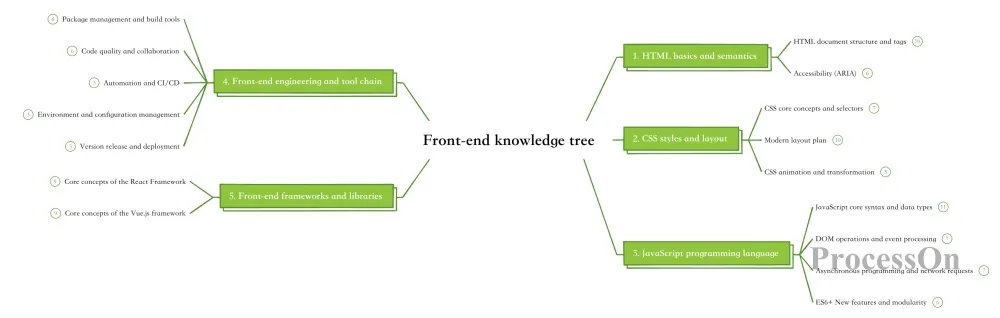
Front-end knowledge tree structure diagram
ProcessOn is an online drawing and visualization tool that supports mind maps as well as various diagrams such as flowcharts, UML diagrams, ER diagrams, and Gantt charts.
For mind mapping users, it can be used according to different needs:
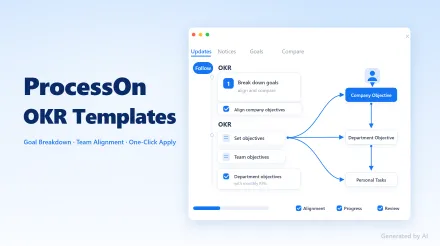
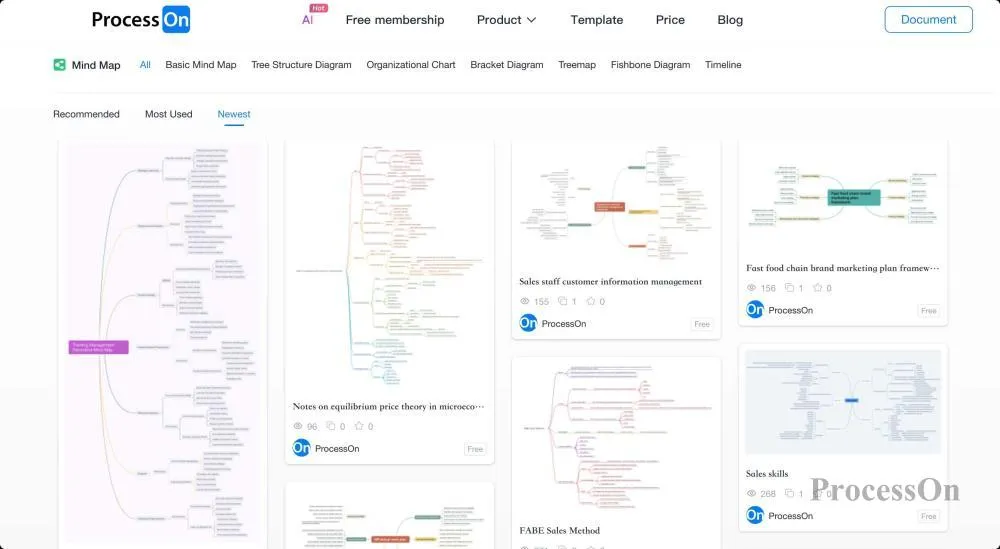
If you don't want to start with a blank canvas, you can also find mind map templates for your specific scenario in the ProcessOn template community and then modify them according to your content.
1. Can mind maps be used for class notes?
Yes, you can. After class, you can reorganize the scattered content into a structure such as "Chapter → Knowledge Point → Key Point → Difficult Point → Case Study". Compared to recording exactly in the order of class, mind maps are more suitable for reorganizing the relationships between knowledge.
2. Are mind maps suitable for exam preparation?
Mind mapping is suitable, especially for courses with a large number of knowledge points and requiring the establishment of an overall knowledge framework. It allows for the hierarchical organization of courses, chapters, knowledge points, key points, and common mistakes. However, mind mapping should be used as one of the review methods, not a replacement for practice, memorization, and actual tests.
3. Why is mind mapping suitable for brainstorming?
Because mind maps can expand outwards from a central question, they are ideal for recording a large number of ideas first, and then classifying, merging, and filtering them.
4. Can mind maps be used for work summaries?
Yes. You can create branches around the work cycle such as "Key Tasks → Work Results → Data Performance → Problems and Experiences → Next Steps", and then write a complete work summary or performance report based on the mind map.
5. Can mind maps be used for project planning?
Yes. In the early stages of a project, mind maps can be used to break down goals, requirements, tasks, personnel, resources, and risks. Once the project enters the execution phase, tools such as flowcharts and Gantt charts can be further used to manage specific tasks. PMI project planning materials also emphasize scope, work breakdown structure, resources, schedule, and risks.
6. Can mind maps be used to create PowerPoint presentations?
Yes, that's possible. A common approach is to first use a mind map to outline the logic of the presentation or report, then convert the first-level branches into PowerPoint chapters, and the second-level branches into specific page content.
 Following the tutorial to try
Free to use ProcessOn
Following the tutorial to try
Free to use ProcessOn