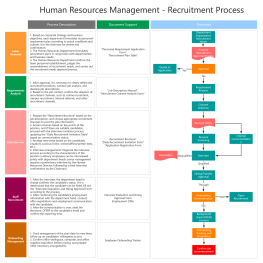
Process Type
Graphical expression
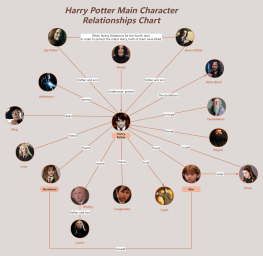
Mind Type
Structured expression
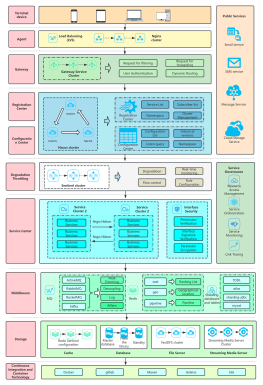
Note Type
Efficient expression
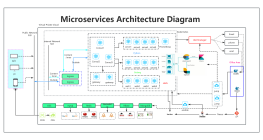
Treemap
Bracket Diagram

Default Mode





Many students feel they lack logical thinking skills, but few truly consider that logical thinking isn't an innate talent, but a skill that can be trained. Like building muscle, it strengthens with consistent, correct training. Mind mapping is one of the most direct and effective tools for developing logical thinking skills.
This isn't just saying "mind mapping is great." Tony Buzan, the inventor of mind mapping and a British brain development expert, discovered after decades of studying brain function that the human brain is naturally radial—one idea connects to another, and then to the next, branching out like tree roots. Traditional linear note-taking (writing line by line) directly contradicts this natural brain behavior. Mind mapping "draws" your thoughts, using images, colors, lines, and keywords, allowing the brain to work in its most natural way.
As Buzan once said, "Unorganized notes cannot form memories." Mind maps visually record the information and thought processes you absorb, connecting scattered ideas through a clear structure that makes the logical relationships within them clearly visible. This is the fundamental reason why mind maps can improve logical thinking—it doesn't help you "remember" anything, but rather trains your ability to "organize" information.
Many people think that mind maps are just "prettier notes," which completely misunderstands their essence.
The core of mind mapping is not "drawing", but "thinking".
When you draw a mind map, your brain is doing these things:
First, classification. Faced with a pile of information, you need to determine which are primary branches, which are secondary branches, and which are merely details. This process of judgment trains your inductive reasoning ability. You are forced to answer the question: "Of all this information, which is the core, and which is the supporting element?"
Second, hierarchical thinking. How many sub-concepts are there under a single concept? What is the relationship between these sub-concepts? Are they parallel, progressive, or causal? This process trains hierarchical thinking—the foundation of structured thinking.
Third, connection. You discover that a point in branch A is related to a point in branch B, so you draw a line connecting the two branches. This process trains your ability to associate and transfer ideas.
These three abilities—induction, stratification, and connection—together constitute the core of logical thinking.
From a cognitive science perspective, the effectiveness of mind mapping has a solid theoretical foundation. The dual coding theory posits that the human brain processes information through two channels: the linguistic channel and the visual channel. Mind mapping represents knowledge graphically, providing excellent support and supplementation for language-based comprehension, significantly reducing the cognitive load on the linguistic channel and accelerating the process of thinking. In other words, mind mapping allows you to process information using "two systems" simultaneously, naturally doubling your efficiency.
Studies have shown that students who use mind maps for thinking and learning exhibit significant improvements in logical thinking skills. Further research confirms that mind maps can help students grasp key points, difficulties, and crucial concepts, clarify the interrelationships between knowledge points, and cultivate students ' thinking abilities, personality, innovation, and holistic perspective.
Now that we've covered the theory, let's get back to the practical question: how exactly do students use it?
Most students take notes by simply writing down everything the teacher says and copying whatever is on the PowerPoint slides. The result is a notebook overflowing with notes, but when reviewing, they have no idea what the key points are.
Mind maps are used in a completely different way. In class, you're not "copying," but "extracting." After the teacher explains a concept, you think: "To which category does this concept belong? What is its relationship with the concept we discussed earlier?" Then you draw this relationship on a mind map.
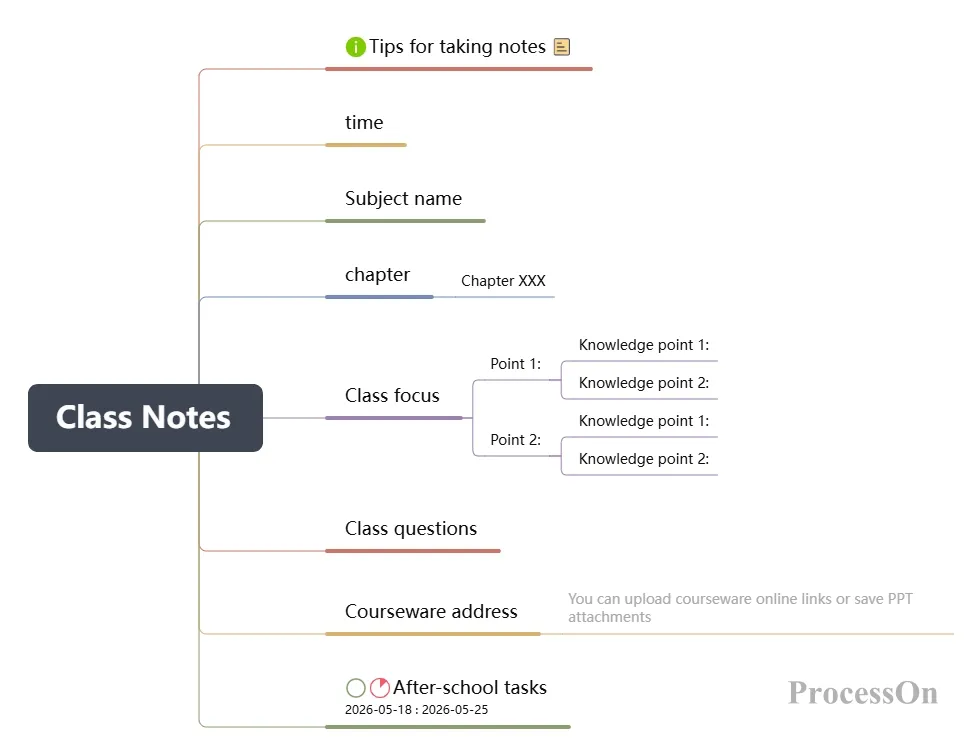
This process forces you to process information in real time, rather than passively recording it. After a lesson, you no longer have dozens of pages of scattered notes, but a clearly structured knowledge map. When reviewing, you're not looking at "what I wrote down," but rather "what this knowledge system looks like."
After university teaching teams promoted the use of mind mapping among students of different majors, they found that this method broke with traditional learning approaches and effectively cultivated students' divergent and logical thinking. Further research indicates that the mind mapping teaching model helps cultivate students' logical thinking and systematically build knowledge systems.
For many students, the most painful part of writing a paper is not "writing," but "not knowing where to begin." After reading dozens of papers, their minds are still a complete mess.
This is where the value of mind mapping becomes apparent. Before you start writing, use a mind map to outline the structure of your paper—what to include in the introduction, how many parts the literature review will have, what issues each part will discuss, and what the conclusion will address. This map is your "blueprint." As you write, follow the map step by step to fill in the content; the logic won't be chaotic, and the structure won't fall apart.
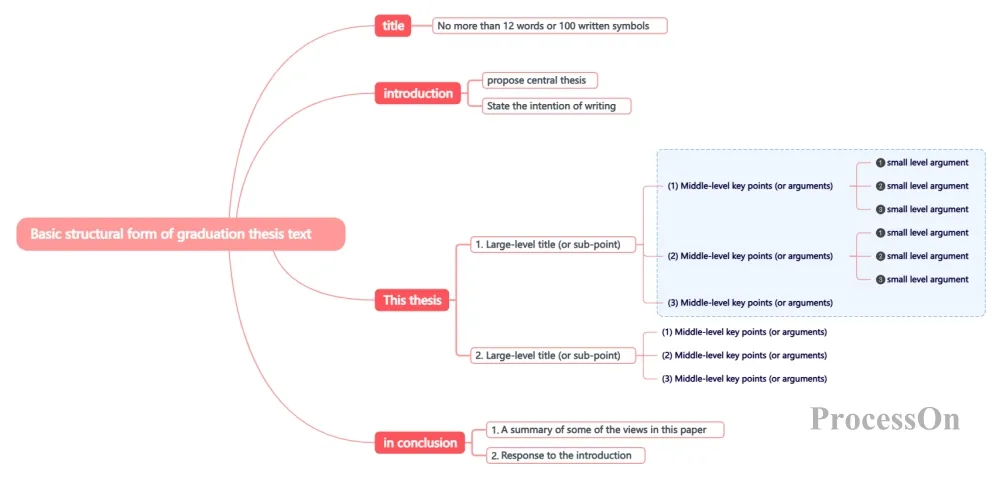
More importantly, mind maps can be used when reading literature. After reading each article, draw its core viewpoints, research methods, and conclusions on a mind map. After reading several articles, the connections and differences between them will naturally appear on the map—the "research gaps" in the papers are often hidden in those connections.
With seven or eight courses piled up for final exams, each with hundreds of pages of textbooks and PowerPoint presentations, the traditional way to review is to flip through them from beginning to end, only to find that I haven't remembered anything.
Reviewing with mind maps offers a completely different approach. You don't need to reread the textbook; you only need to look at the knowledge map you drew earlier—which parts are complete, which are vague, and which you can't recall at all. Go back and focus on the vague parts, and what you can't remember means you didn't fully understand it in the first place. One map can accurately pinpoint your knowledge gaps.
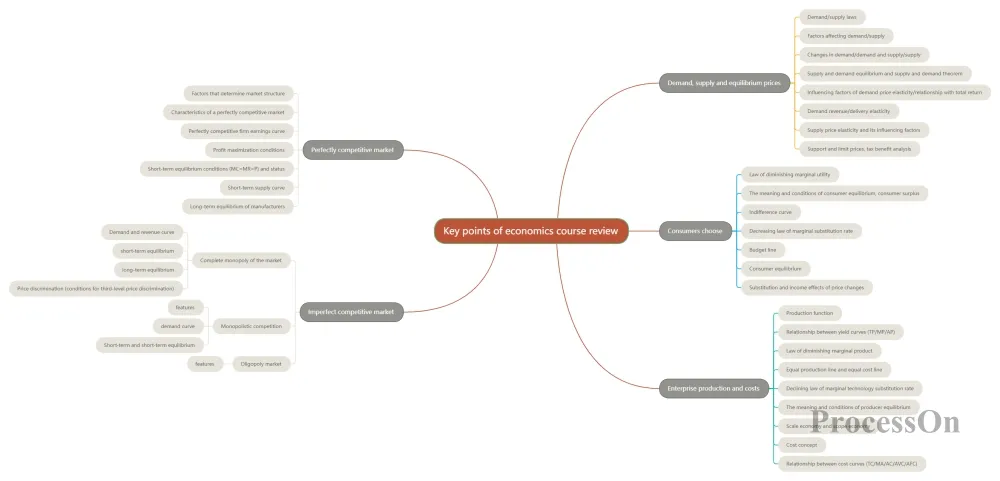
Key points of economics course review
Mind mapping combines the principles of retrieval and memory research: active recall is more effective than passive repetition. The process of recalling knowledge points by looking at a mind map is itself a "retrieval exercise," which is much more effective than repeatedly flipping through a book.
What's the worst thing about group discussions? It's talking for two hours and then no one remembers what was said when the meeting ends.
Mind mapping can change this. During discussions, have someone create a mind map—recording, categorizing, and connecting everyone's ideas on the spot. Who raised what viewpoint, which viewpoints are repeated, and which viewpoints have logical relationships—all are visualized.
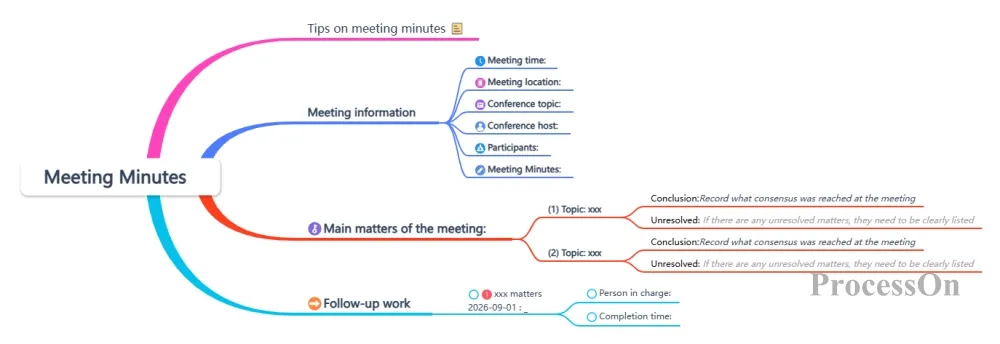
By the time the discussion ended, the outcome was already determined. There was no need to spend time compiling meeting minutes or repeatedly confirming "what exactly we decided." That mind map represented the consensus.
There are methods to creating mind maps; scribbling randomly is useless. Here are a few core principles:
Start with the core. A mind map should have only one central theme, with all branches revolving around it. Don't cram two central themes into one map; that will confuse the logic.
Use keywords, not sentences. Write only keywords for each section, not long sentences. The process of writing keywords is a process of "refining"—you need to figure out "what is the most essential word for this thing?"
The hierarchy should be clear. First-level branches are core concepts, second-level branches are supporting arguments, and third-level branches are details. A mind map with a chaotic hierarchy is illogical.
Use plenty of color and images. Color and images are not just decorations; they are the core of the dual-encoding theory—using the image channel to supplement the language channel, doubling the memory effect.
After finishing the drawing, you need to "go through it." After finishing, start from the central theme and go through the branches—check if the logic is smooth, the hierarchy is reasonable, and if anything is missing. This process itself trains logical thinking.
Mind maps can be drawn with pen and paper or with software. For students , software is more efficient.
ProcessOn is one of the most widely used online diagramming platforms among students . It's more than just a mind mapping tool—it supports over ten types of diagrams, including flowcharts, ER diagrams, sequence diagrams, UML diagrams, and Gantt charts. Essentially, any diagram you need to create during your four years of university can be completed within ProcessOn.
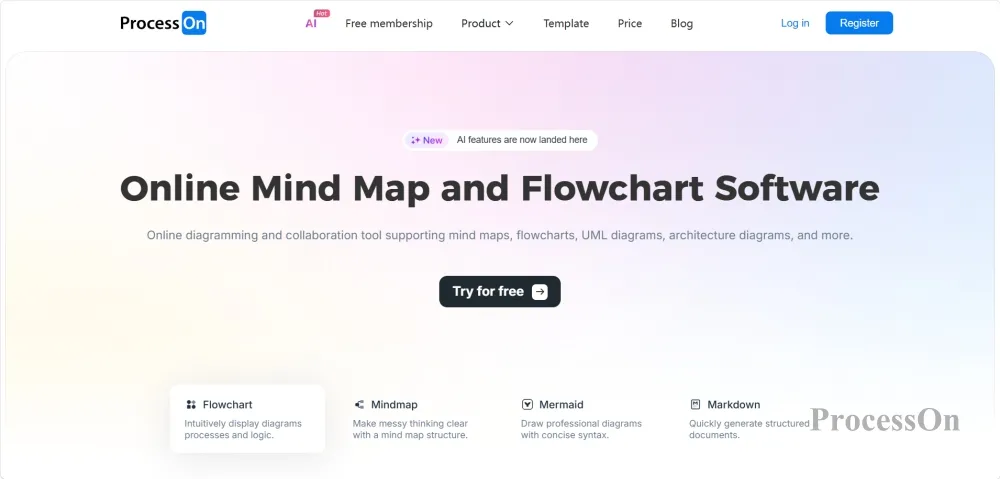
The template community has nearly a million templates, ranging from "Advanced Mathematics Knowledge Framework" to "English Review Plan", from "Graduation Thesis Writing Process" to "Product Business Model Canvas"—find a template and clone it with one click, without having to draw it from scratch.
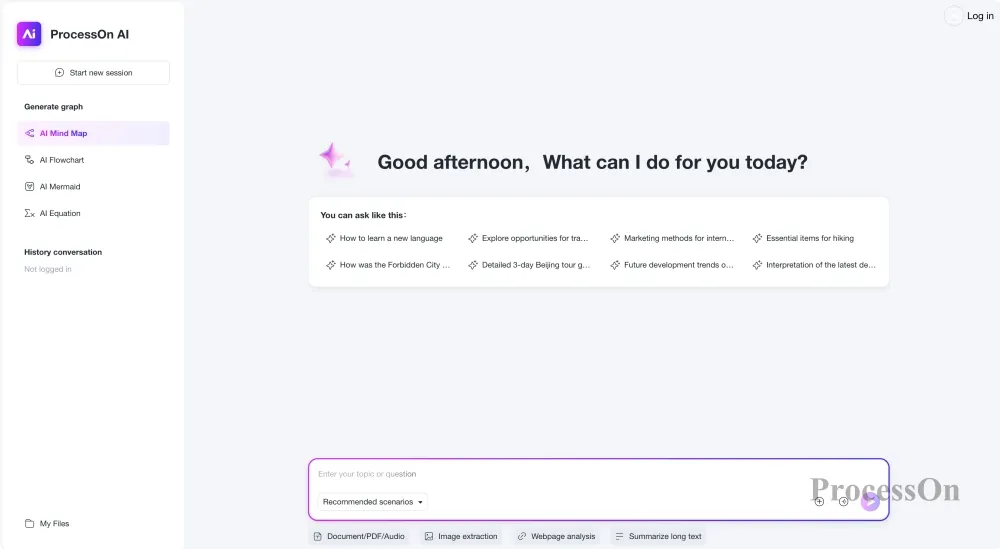
The AI one-click generation function is also very useful—enter a theme, and AI will directly generate a complete framework for you, saving you the time of "staring blankly at a blank canvas." Group projects support real-time collaboration among multiple people, allowing several people to edit a single image simultaneously, eliminating the need for "you finish drawing and send it to me, I revise it and then send it back to you."
Q1: What is the difference between mind maps and regular notes?
A: Regular notes are linear—written line by line from top to bottom, suitable for recording but not for understanding. Mind maps are radial—radiating outward from the center, suitable for both understanding and memorization. Regular notes tell you "what I wrote down," while mind maps tell you "what the relationships are between these things." The former is a recording tool, the latter a thinking tool.
Q2: Can drawing mind maps really improve logical thinking?
A: Yes, but only if you're genuinely "thinking" and not just "copying." Simply copying the table of contents into a mind map is useless. If you're reorganizing information based on understanding—determining what's core, what's supporting, and the relationships between them—then each mind map is a exercise in logical thinking. Research shows that students who use mind maps for thinking and learning demonstrate significant improvements in their logical reasoning abilities.
Q3: Is it better to draw with pen and paper or with software?
A: Each has its advantages. Paper and pen offer more freedom and are not limited by devices, making them suitable for quick brainstorming anytime, anywhere. Software is more efficient—it allows for easy modification and layout adjustments, insertion of images and links, and multi-person collaboration. For students , software is more suitable for daily learning and project collaboration, offering higher efficiency and maintainability.
Q4: Is mind mapping suitable for all subjects?
A: It's generally suitable. Humanities students can use it to organize theoretical systems and logical connections, science students can use it to organize the relationships between formulas and concepts, and engineering students can use it to plan projects and experimental procedures. Mind mapping trains universal thinking methods—classification, layering, and connection—abilities applicable in any discipline.
Q5 : Will ProcessOn's AI generation feature allow me to "not have to think"?
A: No. AI generates a framework, not an understanding. AI helps you generate the initial structure, saving you the time of "staring at a blank canvas," but the core thinking processes—filling in the content, adjusting the logic, adding details, and establishing connections—still need to be completed by yourself. AI is an accelerator, not a replacement.