

Annual Work Plan for an E-commerce Product Manager
3 Report
Annual Work Plan for an E-commerce Product Manager
Related Recommendations
Other works by the author
Outline/Content
See more
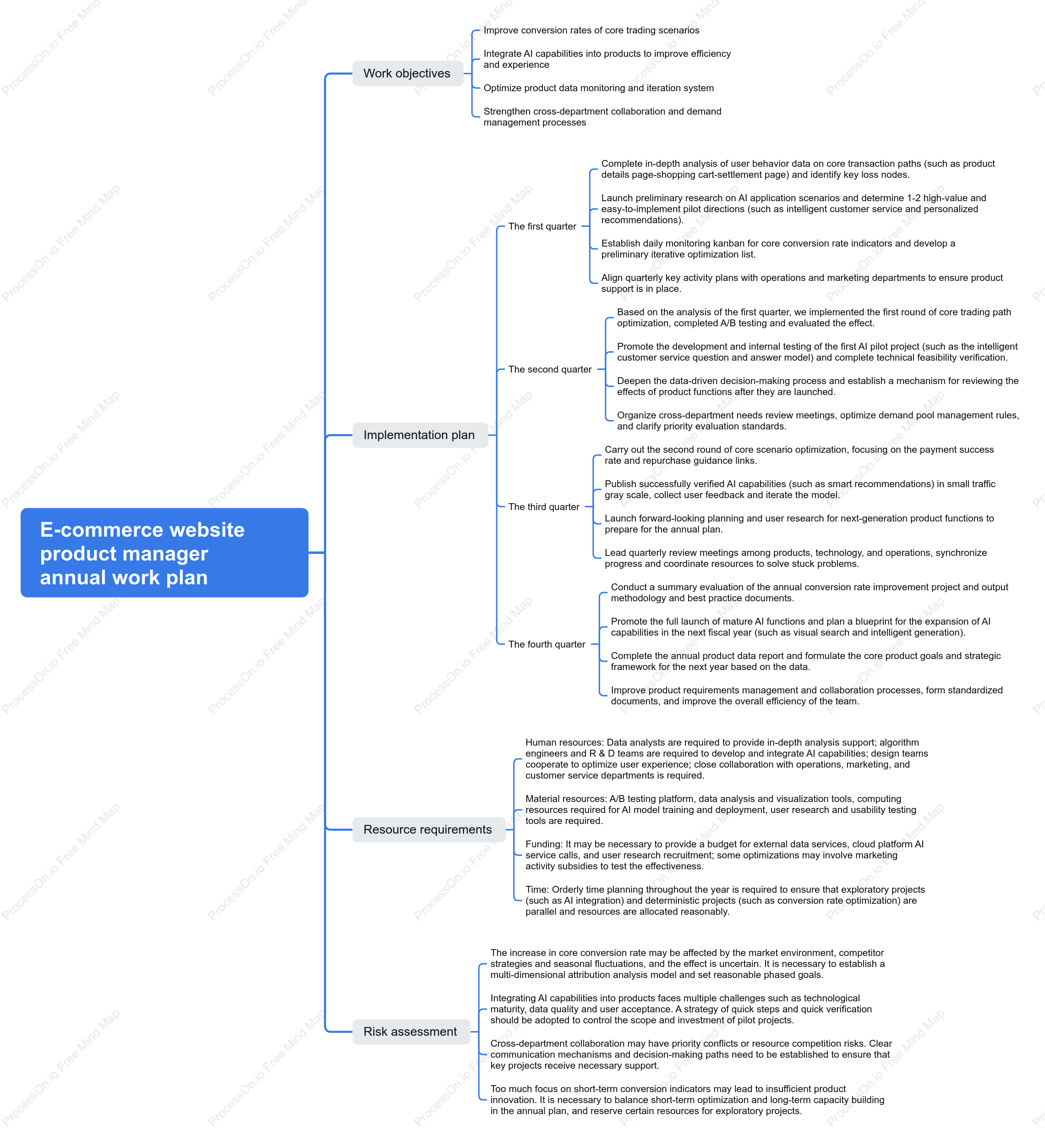
Work objectives
Improve conversion rates of core trading scenarios
Integrate AI capabilities into products to improve efficiency and experience
Optimize product data monitoring and iteration system
Strengthen cross-department collaboration and demand management processes
Implementation plan
The first quarter
Complete in-depth analysis of user behavior data on core transaction paths (such as product details page-shopping cart-settlement page) and identify key loss nodes.
Launch preliminary research on AI application scenarios and determine 1-2 high-value and easy-to-implement pilot directions (such as intelligent customer service and personalized recommendations).
Establish daily monitoring kanban for core conversion rate indicators and develop a preliminary iterative optimization list.
Align quarterly key activity plans with operations and marketing departments to ensure product support is in place.
The second quarter
Based on the analysis of the first quarter, we implemented the first round of core trading path optimization, completed A/B testing and evaluated the effect.
Promote the development and internal testing of the first AI pilot project (such as the intelligent customer service question and answer model) and complete technical feasibility verification.
Deepen the data-driven decision-making process and establish a mechanism for reviewing the effects of product functions after they are launched.
Organize cross-department needs review meetings, optimize demand pool management rules, and clarify priority evaluation standards.
The third quarter
Carry out the second round of core scenario optimization, focusing on the payment success rate and repurchase guidance links.
Publish successfully verified AI capabilities (such as smart recommendations) in small traffic gray scale, collect user feedback and iterate the model.
Launch forward-looking planning and user research for next-generation product functions to prepare for the annual plan.
Lead quarterly review meetings among products, technology, and operations, synchronize progress and coordinate resources to solve stuck problems.
The fourth quarter
Conduct a summary evaluation of the annual conversion rate improvement project and output methodology and best practice documents.
Promote the full launch of mature AI functions and plan a blueprint for the expansion of AI capabilities in the next fiscal year (such as visual search and intelligent generation).
Complete the annual product data report and formulate the core product goals and strategic framework for the next year based on the data.
Improve product requirements management and collaboration processes, form standardized documents, and improve the overall efficiency of the team.
Resource requirements
Human resources: Data analysts are required to provide in-depth analysis support; algorithm engineers and R & D teams are required to develop and integrate AI capabilities; design teams cooperate to optimize user experience; close collaboration with operations, marketing, and customer service departments is required.
Material resources: A/B testing platform, data analysis and visualization tools, computing resources required for AI model training and deployment, user research and usability testing tools are required.
Funding: It may be necessary to provide a budget for external data services, cloud platform AI service calls, and user research recruitment; some optimizations may involve marketing activity subsidies to test the effectiveness.
Time: Orderly time planning throughout the year is required to ensure that exploratory projects (such as AI integration) and deterministic projects (such as conversion rate optimization) are parallel and resources are allocated reasonably.
Risk assessment
The increase in core conversion rate may be affected by the market environment, competitor strategies and seasonal fluctuations, and the effect is uncertain. It is necessary to establish a multi-dimensional attribution analysis model and set reasonable phased goals.
Integrating AI capabilities into products faces multiple challenges such as technological maturity, data quality and user acceptance. A strategy of quick steps and quick verification should be adopted to control the scope and investment of pilot projects.
Cross-department collaboration may have priority conflicts or resource competition risks. Clear communication mechanisms and decision-making paths need to be established to ensure that key projects receive necessary support.
Too much focus on short-term conversion indicators may lead to insufficient product innovation. It is necessary to balance short-term optimization and long-term capacity building in the annual plan, and reserve certain resources for exploratory projects.
Collect
Collect
Collect
Collect

Collect

Collect
Collect

0 Comments
Next Page