Process Type
Graphical expression
Mind Type
Structured expression
Note Type
Efficient expression
Treemap
Bracket Diagram

Default Mode





Marketing is a systematic set of activities that businesses undertake around creating customer value, including understanding needs, designing products, pricing, channel distribution, promotion and communication, and customer relationship maintenance. Its ultimate goal is to achieve long-term profit growth for businesses while meeting customer needs.
Marketing is more than just "advertising" or "promotion"; it's the core of business operations. The underlying logic of modern marketing can be summarized in three levels:
Discover and understand customer needs – through market research, user profiling, data analysis, and other methods, figure out who the target customers are, what they want, and where their pain points lie.
Design and deliver exceptional value—develop the right products or services, set competitive prices, establish convenient purchasing channels, and communicate that value to customers.
Build and maintain long-term relationships – enhance customer satisfaction and loyalty through after-sales service, membership systems, and interactive content, ultimately maximizing customer lifetime value.
This defining framework originates from Philip Kotler's classic marketing theory and remains valid in the digital age, only with richer and more efficient means of implementation.
Regardless of technological advancements, the following classic models are essential tools that every marketer must master. They help you think about problems systematically and are well-suited for clear visualization. Online drawing tools like ProcessOn can quickly create mind maps, flowcharts, matrix diagrams, and more, transforming abstract strategies into intuitive visual language for easier team discussions and decision-making.
STP is an abbreviation for Segmentation, Targeting, and Positioning.
Market segmentation: Dividing the entire market into several sub-markets based on variables such as geography, demographics, psychology, and behavior.
Target market selection: Assess the attractiveness of each market segment and select one or more sub-markets where the company can best leverage its strengths as the main focus.
Market positioning: Establishing a unique and competitive position for the brand and products in the minds of target consumers.
In practice, marketers often use matrix diagrams or bubble charts to compare the size, growth potential, and competitive intensity of different market segments.
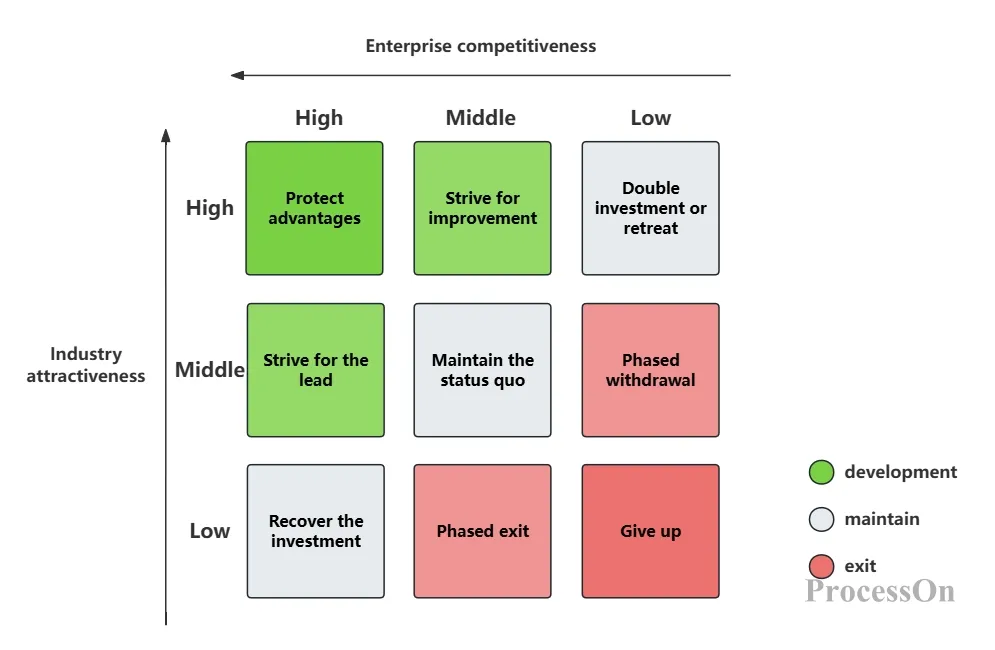
ProcessOn's built-in matrix templates can be used to quickly generate professional comparison charts, helping teams reach consensus in strategy meetings.
The 4Ps are a collective term for Product, Price, Place (distribution), and Promotion, providing a basic framework for developing marketing strategies.
Product: This includes functionality, quality, design, packaging, brand, etc.
Price: Pricing strategies (skimming, penetration, competition-oriented, etc.) and discounts, payment methods.
Channels: Direct sales, distributors, e-commerce platforms, offline stores, etc.
Promotion: Communication methods such as advertising, public relations, sales promotion, personal selling, and content marketing.
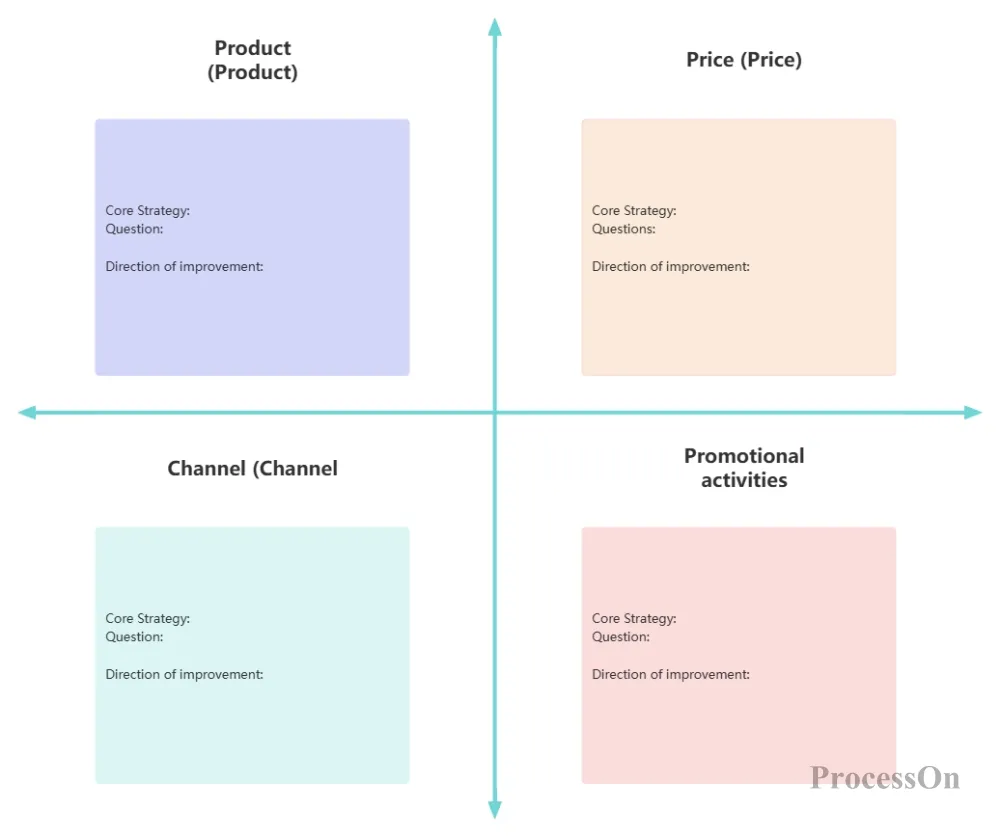
In the digital age, many scholars have proposed new frameworks such as 4C (Consumer, Cost, Convenience, Communication), but 4P remains the core tool for strategy implementation. ProcessOn's mind mapping can unfold each element of the 4P layer by layer, forming a clear strategy mind map, which facilitates subsequent breakdown into specific actionable steps.
SWOT (Strengths, Weaknesses, Opportunities, Threats) is used to assess a company's own strengths and weaknesses and the competitive environment, and is the starting point for strategy development.
PEST ( Political, Economic, Social, Technological) is used to scan the macro environment and help predict market trends.
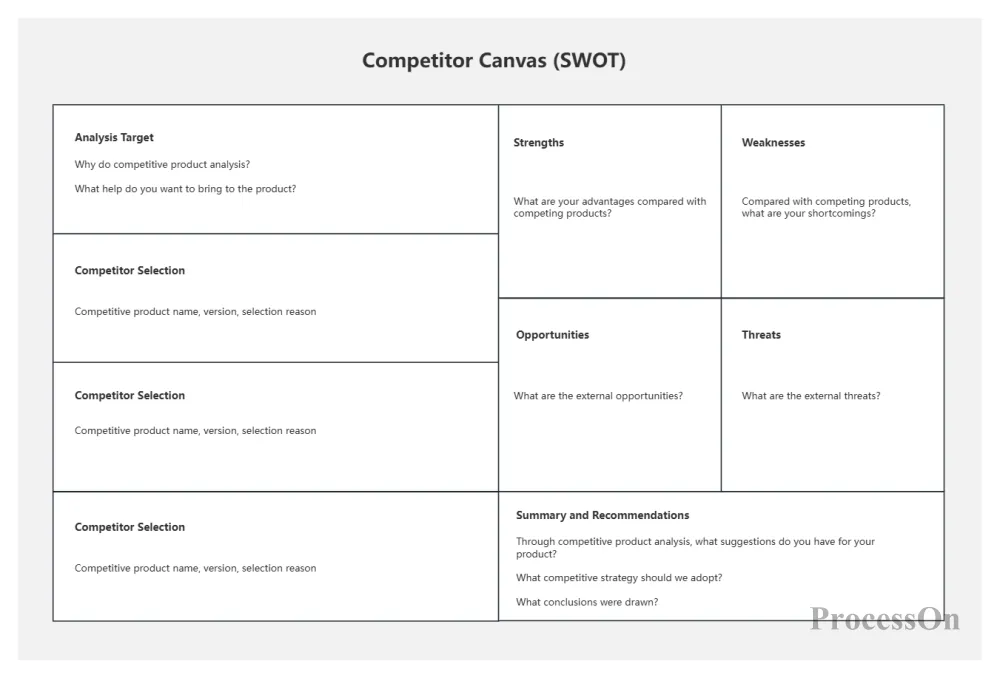
Competitive Analysis - SWOT Analysis
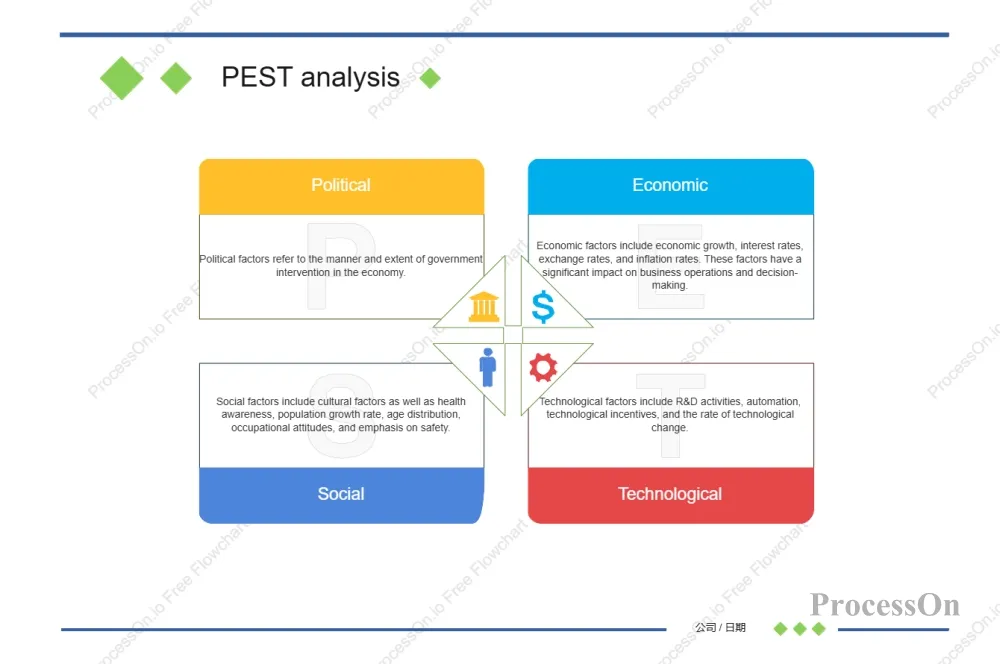
These two models are well-suited for visualization using four-quadrant diagrams. ProcessOn provides ready-made SWOT and PEST templates that can be directly cloned and used, allowing you to fill in internal and external factors one by one, and intuitively present the analysis conclusions, greatly improving the efficiency of proposals and reports.
The marketing funnel describes the gradual conversion process from "awareness" to "purchase" and even "recommendation" of potential customers. Common stages include: awareness → interest → consideration → purchase → loyalty.
For internet and SaaS products, the AARRR model (Acquisition, Activation, Retention, Revenue, Referral) provides a more granular perspective on user lifecycle management. Funnel charts can visually display the conversion rate at each stage, quickly identifying bottlenecks.
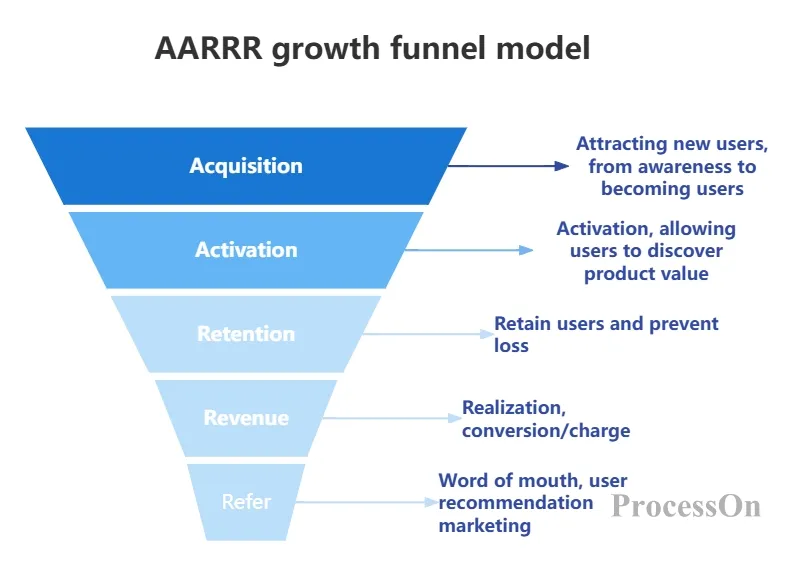
ProcessOn's funnel chart templates support customizable stages and data proportions, helping marketing teams monitor conversion performance and optimize strategies in real time.
While classic frameworks remain effective, today's marketing environment is entirely digital. The following three strategies are top priorities for marketing efforts in 2026:
The core of content marketing is not direct sales, but rather building brand trust and professional recognition by consistently delivering valuable information (articles, videos, white papers, case studies, etc.) to the target audience. Excellent content marketing can naturally attract potential customers and reduce customer acquisition costs.
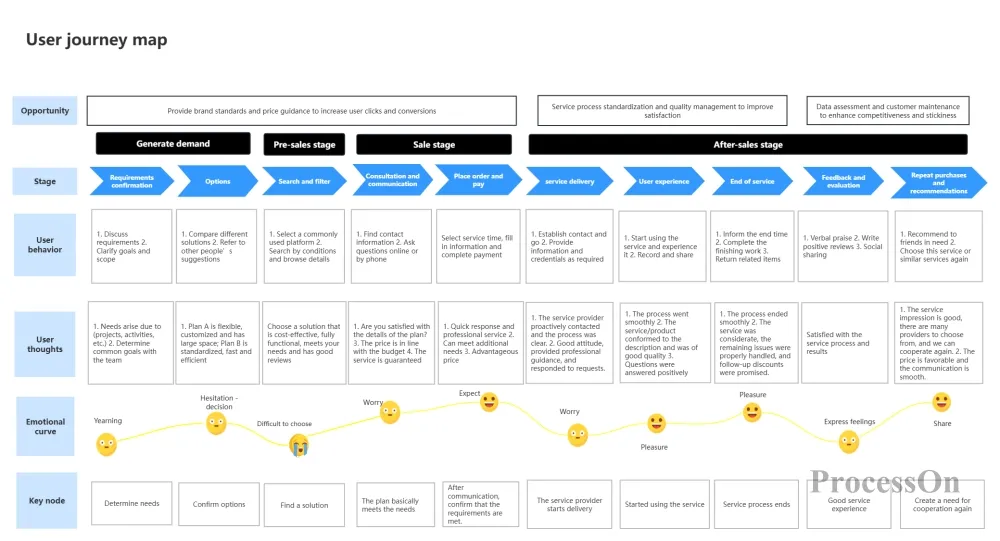
Customers may interact with brands through multiple touchpoints, including social media, search engines, physical stores, and e-commerce platforms. Businesses need to ensure consistent information and experiences across all channels, and be able to identify the same customer across channels to provide personalized services. Mapping the customer journey is an effective way to analyze the omnichannel experience. ProcessOn provides customer journey templates to help marketers visually depict user behavior, emotions, and pain points at each touchpoint, thereby enabling targeted optimization of key moments.
Data is collected using tools such as website analytics, CRM systems, and social media monitoring to monitor key metrics (conversion rate, average order value, repeat purchase rate, net promoter score, etc.) and marketing campaigns are rapidly iterated based on the data. Data capability has become a core competency for marketing departments.
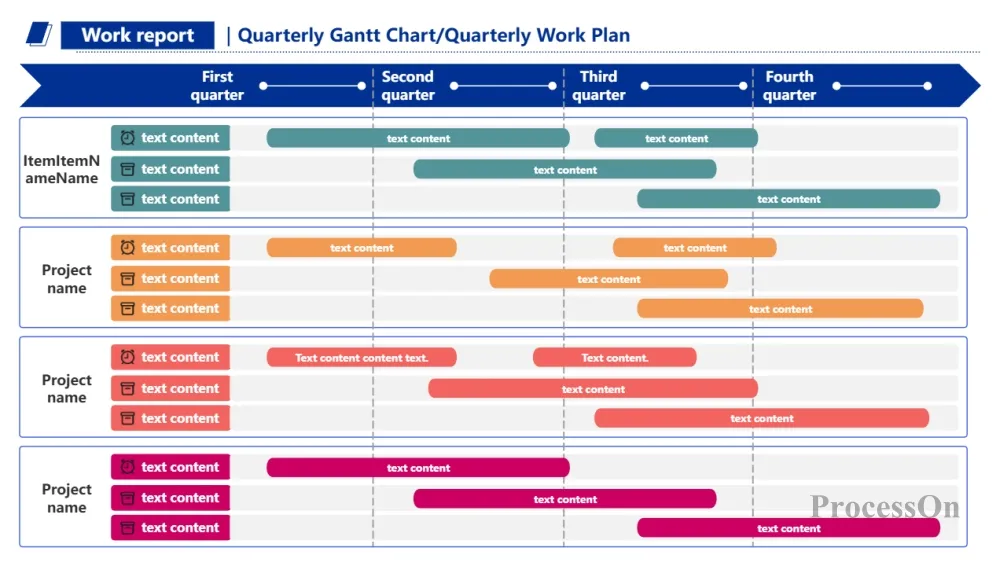
A complete marketing plan should include the following steps. It is recommended to use a flowchart or Gantt chart to plan the timeline and make each step clearly visible:
Situation analysis: Use SWOT and PEST to analyze the internal and external environment.
Define your goals: Set specific, measurable, and time-bound marketing objectives (e.g., "20% increase in website traffic in Q3").
Target Market and Positioning: Use the STP model to clarify the core audience and brand positioning.
Develop a 4P strategy: refine the specific actions for product, price, place (distribution), and promotion.
Budget and resource allocation: Clearly define the human resources, funds, and time invested in each stage.
Execution and monitoring: Proceed according to plan, regularly review key data, and make timely adjustments.
Effectiveness evaluation and optimization: After the activity, summarize the gains and losses to form a closed loop.
In practice, ProcessOn's Gantt charts can visually display the timeline and dependencies of various tasks, while flowcharts help teams clearly understand the execution chain and reduce communication errors. ProcessOn supports real-time collaboration among multiple users, allowing remote teams to collaboratively edit the same marketing action plan and ensure information synchronization.
Q1: What is the difference between marketing and sales?
A: Marketing focuses on "making products easier to sell," including front-end work such as market insights, brand building, product definition, pricing, channels, and promotion; sales focuses on "selling products," that is, one-on-one customer conversion and signing contracts. The two are interdependent, with marketing providing sales with leads and brand momentum, and sales providing marketing with feedback on the true voice of the market.
Q2: What marketing activities should small and medium-sized enterprises (SMEs) prioritize given their limited budgets?
A: I suggest focusing on three points first: ① Clearly define your core target customers and differentiated positioning (STP); ② Build low-cost content channels (such as Q&A platforms and short videos) to continuously deliver value; ③ Utilize free or lightweight tools to establish basic data capabilities. For strategy visualization, you can use the free version of ProcessOn to create various analytical charts, improving team collaboration efficiency without additional investment.
Q3: How do you measure the ROI of a marketing campaign?
A: ROI = (Net profit from marketing - Marketing expenditure) / Marketing expenditure × 100%. In practice, it's necessary to first set conversion goals (such as number of leads, sales revenue), and track the sources through UTM parameters, exclusive discount codes, CRM linkage, etc. For brand-related activities, indirect indicators such as search index and social media buzz can be used as supplementary monitoring.
Q4: What are the differences between the marketing funnel and the AARRR model?
A: The marketing funnel focuses more on the "from awareness to purchase" conversion process and is suitable for most consumer goods and B2B businesses; AARRR focuses more on the entire user lifecycle, especially "retention" and "spread," and is more suitable for subscription-based, SaaS, and mobile application products. The two can be used in combination, with the funnel focusing on the early stages and AARRR focusing on the later stages. Regardless of which model is used, ProcessOn's funnel chart templates can be used to quickly create and regularly update the data.
Q5: How long does it take to see results from content marketing?
A: Content marketing is a long-term strategy, typically requiring 3-6 months of consistent output to see significant organic traffic growth and lead conversions. The key lies in whether the content quality truly meets user needs and whether it aligns with SEO and distribution channels. It's recommended to set achievable milestones (such as readership or subscription numbers) to track progress and use ProcessOn's charts to record data changes at each stage for easy review.
Q6: How can visualization tools be used to improve the communication efficiency of marketing strategies?
A: Marketing strategies often involve a large amount of information and multi-party collaboration, and plain text documents can easily lead to misunderstandings. ProcessOn can transform complex content such as STP analysis, SWOT matrices, marketing funnels, and customer journeys into graphical displays, making them clear to team members, management, and customers at a glance. ProcessOn offers a wealth of marketing scenario templates (including mind maps, flowcharts, funnel charts, Gantt charts, etc.), supports online collaboration and real-time editing, helping marketing teams quickly translate ideas into actionable solutions and significantly reducing meeting and email communication costs.