Process Type
Graphical expression
Mind Type
Structured expression
Note Type
Efficient expression
Treemap
Bracket Diagram

Default Mode





In today's highly competitive business environment, talent has become the core driving force for enterprise development. How to accurately identify, cultivate, and select talent that meets the company's development needs is a core issue in every enterprise's human resource management. Competency models, as a scientific talent assessment tool, can help companies clearly define the required abilities and qualities for each position, providing clear standards and bases for talent recruitment, training, and performance management.
Visual charting tools help us more clearly organize the logical structure of competency models, transforming abstract skills and qualities into intuitive graphical information, thus improving communication and comprehension efficiency. These professional charts can be easily created using tools like ProcessOn . As an online graphical representation tool, ProcessOn supports various chart types, including flowcharts, mind maps, and UML diagrams, helping users quickly organize their thoughts, visualize complex information, and improve communication efficiency. It is suitable for multiple scenarios such as product design, project management, technical architecture, and business processes.
Building a competency model involves more than just defining skills and qualities; it's about applying them to every aspect of talent management. A complete competency model application process should begin by clarifying job requirements, then use talent profiling to accurately identify talent characteristics, and finally complete talent assessment through structured interviews.
The flowchart template below fully demonstrates the entire competency assessment system, from personnel requirements to talent profile analysis and interview assessment, providing companies with a practical talent assessment solution.
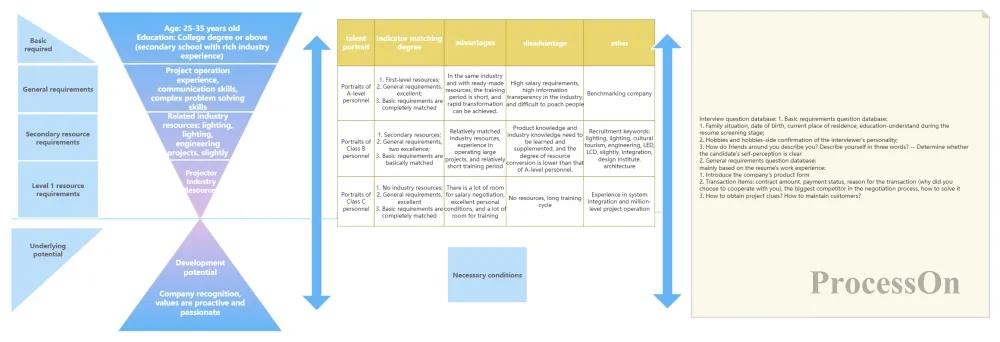
The template uses a funnel-shaped structure on the left, clearly illustrating the screening process from basic requirements to core competencies. The top layer of basic requirements includes fundamental conditions such as age and education, serving as the first hurdle in talent selection. The middle layer, general and resource requirements, further refines the experience and industry resources needed for the position. The bottom layer, development potential, focuses on the long-term growth potential of talent, reflecting the company's long-term investment perspective. This funnel-shaped screening logic helps companies gradually narrow down their talent pool and improve recruitment efficiency.
The talent profile comparison table in the middle of the template is the core of the entire process. By comparing and analyzing the matching degree of indicators, strengths, and weaknesses of talents at the A, B, and C levels, companies can clearly see the capability gaps between talents at different levels, providing a clear basis for talent selection and development. This tiered assessment method not only helps companies identify top talent but also enables the development of personalized development plans for talents at different levels, maximizing the value of talent.
The interview question bank on the right provides concrete tools for competency assessment. The question bank is categorized into three dimensions: basic, general, and work experience-related, covering all aspects from fundamental qualities to professional skills. Structured interview questions help interviewers more accurately assess candidates' abilities and avoid biases caused by subjective judgment. At the same time, these questions can also serve as a reference for talent development, helping employees identify their weaknesses and improve themselves in a targeted manner.
ProcessOn allows for the rapid creation of similar competency assessment flowcharts. The steps include: registering an account on the official website, selecting a suitable flowchart template, dragging and dropping graphic elements to build the process framework, adding text descriptions to refine details, and finally, supporting team collaboration, real-time saving, and exporting in multiple formats. Through this visual approach, companies can more efficiently build and apply competency models, improving the scientific nature and effectiveness of talent management.
The core of a competency model is defining the abilities and qualities required for a position. A scientific competency model should cover multiple dimensions of ability to ensure that talent can fully meet the job requirements. The diagram below illustrates the three core competency dimensions of a competency model: change management, interpersonal skills, and execution skills, providing a clear framework for building a comprehensive competency model.
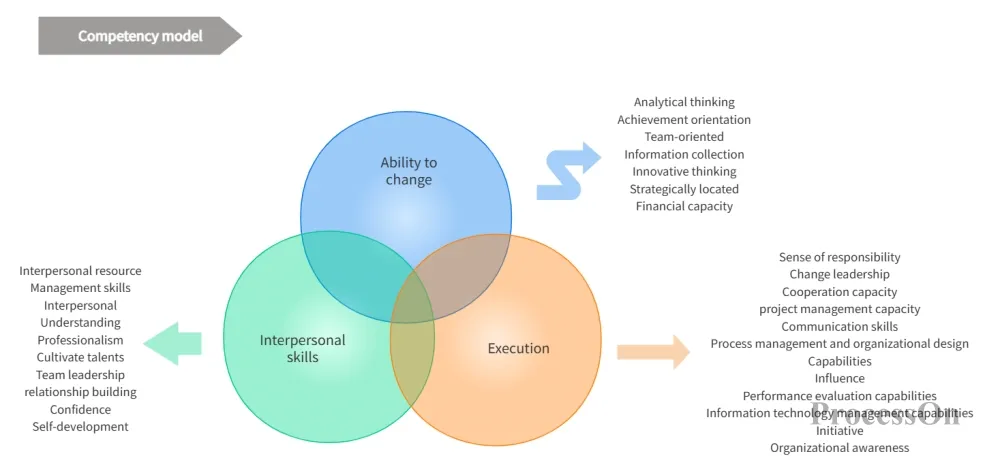
Transformative capability is a key competency for enterprises to cope with changes in the external environment. It includes sub-capabilities such as analytical thinking, achievement orientation, innovative thinking, and strategic positioning. In a rapidly changing market environment, enterprises need talent with transformative capabilities to drive organizational innovation and strategic transformation. These individuals can keenly identify market opportunities, formulate forward-looking strategic plans, and lead teams to achieve transformative goals.
Interpersonal skills are the foundation of teamwork and organizational harmony. They encompass sub-skills such as interpersonal resource management, interpersonal understanding, team leadership, and relationship building. Outstanding individuals not only need professional skills but also the ability to communicate and collaborate effectively with others, building strong interpersonal relationships. This ability is crucial for team management, customer relationship maintenance, and cross-departmental collaboration.
Execution is the key capability for translating strategy into tangible results. It encompasses sub-capabilities such as a sense of responsibility, project management skills, communication abilities, and influence. Even the most perfect strategy cannot achieve its intended goals without strong execution. Individuals with strong execution skills can efficiently organize resources, drive project progress, and ensure that tasks are completed on time and to a high standard.
These three core competency dimensions are interconnected and mutually supportive, together forming a complete competency model. The ability to adapt to change provides direction for the company, interpersonal skills ensure teamwork, and execution ensures the strategy is implemented. When building a competency model, companies need to adjust the weights of these three dimensions appropriately based on their strategic goals and job requirements to ensure the model truly reflects the core requirements of each position.
Job competency is a complex system that includes not only explicit knowledge and skills but also implicit qualities and motivations. The mind map template below analyzes the components of job competency from multiple dimensions, providing a rich perspective for a comprehensive understanding of it.
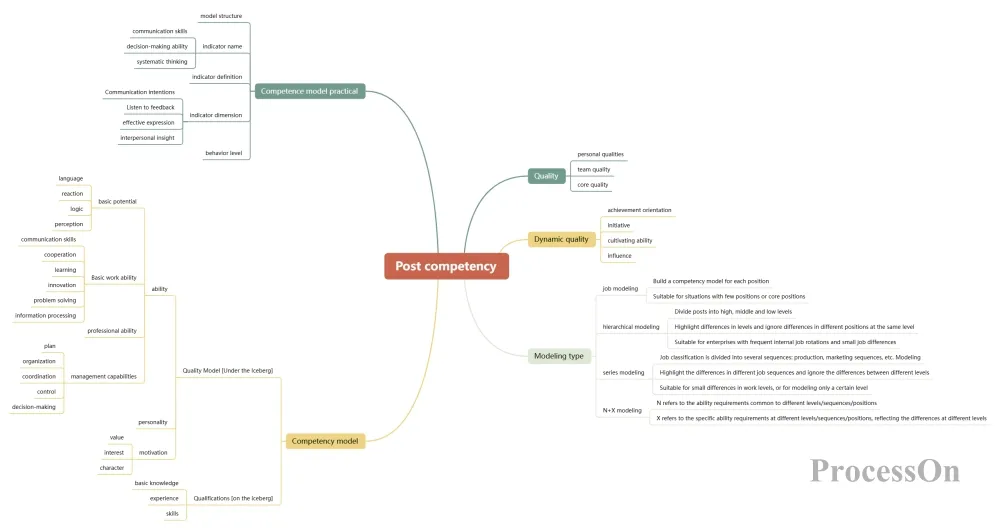
The diagram above comprehensively illustrates the components of job competency from multiple perspectives, including competency models, practical applications of competency models, personal qualities, and motivational qualities. The competency model section employs the classic "iceberg model," dividing competencies into explicit qualities (above the surface) and implicit qualities (below the surface). Explicit qualities, such as basic knowledge, experience, and skills, can be quickly improved through training and learning. Implicit qualities, such as personality and motivation, are relatively stable and difficult to change through short-term training, yet they are key factors determining long-term performance.
There are four common types of competency models : job modeling, hierarchical modeling, sequence modeling, and N+X modeling. Job modeling sets competency standards for specific jobs; hierarchical modeling sets differentiated competency requirements for jobs at different levels; sequence modeling sets a unified competency framework for jobs within the same sequence; and N+X modeling combines general and specialized competencies, ensuring organizational consistency while also considering the specificities of each job. Companies can choose the appropriate modeling type based on their organizational structure and management needs.
Job competency is divided into three levels: individual competencies, team competencies, and core competencies. Individual competencies focus on an employee's individual abilities, team competencies focus on an employee's collaborative abilities within a team, and core competencies reflect the company's values and are fundamental qualities that all employees should possess. This classification helps companies comprehensively assess an employee's overall competence, ensuring that employees not only possess professional skills but also align with the company's values and grow together with the company.
The section on motivational qualities emphasizes the importance of soft skills such as achievement orientation, initiative, development skills, and influence. While these qualities are not as readily apparent as professional skills, they are key differentiators between high-performing and average employees. Highly achievement-oriented employees proactively set challenging goals and strive to achieve them; proactive employees actively seek solutions to problems rather than waiting for instructions; development-oriented employees help others grow and enhance the overall capabilities of the team; and influence-oriented employees persuade others to accept their viewpoints and drive consensus within the team.
Example of job competency analysis: Product Operations . For the Product Operations role, basic competencies include logical thinking and data analysis skills; core competencies include user orientation and innovative thinking; knowledge and skills include market analysis and product planning; and leadership skills include project management and time management.
The value of a competency model lies in its ability to guide practical work; therefore, the model's content needs to be specific and actionable. The mind map template below uses "competency model" as its central theme, divided into four main branches: management skills, leadership skills, knowledge and skills requirements, and job competency requirements. Each branch is further subdivided and categorized in detail, providing concrete guidance for the implementation of the competency model.
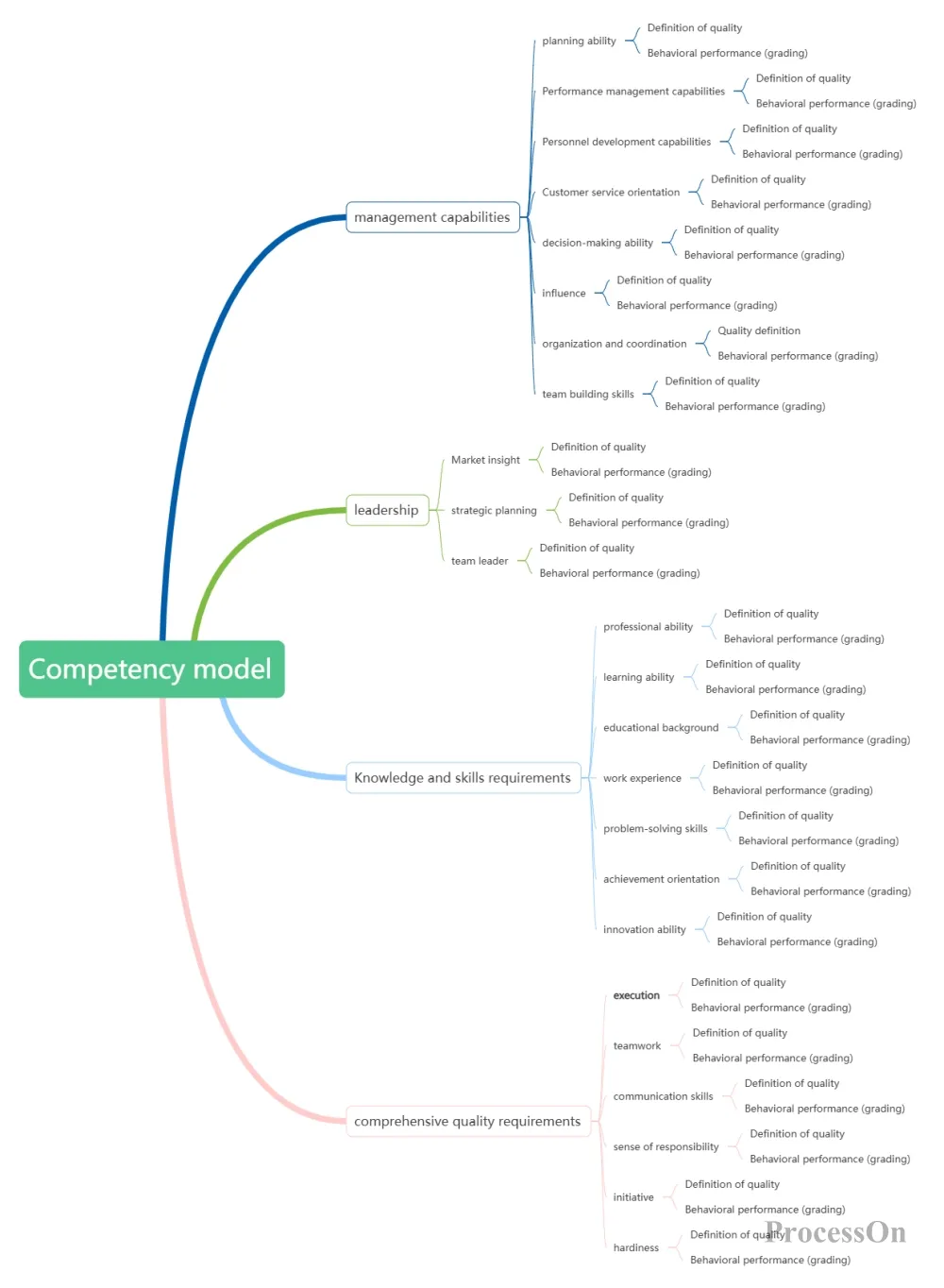
Management competence is a crucial component of a competency model, encompassing areas such as planning, personnel management, and task management. Each competence has corresponding quality definitions and behavioral examples, and is categorized into different levels. For instance, planning competence is divided into levels 1-5, ranging from simple task execution to complex strategic planning, with clear behavioral standards for each level. This tiered and detailed approach helps companies clearly assess employees' management competence levels, providing a clear path for employee promotion and development.
Leadership skills focus more on an employee's strategic vision and team influence, encompassing strategic planning and team management. Compared to management skills, leadership emphasizes foresight and impact, requiring employees to develop long-term strategic plans and motivate team members to achieve common goals. Similarly, leadership skills are categorized into different levels, from teamwork to strategic leadership, each with specific behavioral manifestations.
The knowledge and skills requirements section covers both professional knowledge and general skills. Professional knowledge refers to the specific domain knowledge required for the position, such as financial knowledge or technical knowledge; general skills are basic skills applicable to multiple positions, such as communication skills and data analysis skills. By clearly defining the knowledge and skills requirements, companies can provide clear direction for employee training and development, helping employees improve their job competency.
The job competency requirements section focuses on employees' intrinsic qualities, including a sense of responsibility, execution ability, and innovative thinking. While these qualities are not as easily quantifiable as knowledge and skills, they are key factors in determining employee performance. The template provides a detailed definition of each quality and offers behavioral examples at different levels to help companies more accurately assess employees' competency levels.
This tiered and detailed competency model is highly practical, helping companies transform abstract skills and qualities into concrete behavioral standards, providing a clear basis for talent recruitment, performance management, training and development, and other processes. When creating such mind maps using ProcessOn , we can select a suitable mind map template from the template library, and then modify and improve it according to the specific needs of the company, adding custom competency dimensions and behavioral standards.
Competency models are a core tool for corporate talent management. They help companies clearly define the competencies and qualities required for a position, providing clear standards and basis for talent recruitment, training, performance management, and other processes.
Visualization tools play a vital role in the construction and application of competency models. ProcessOn, as a professional online graphical representation tool, can help us quickly create various types of charts, transforming abstract competencies into intuitive graphical information.
Building a scientific competency model requires companies to consider multiple dimensions of skills and qualities, taking into account their strategic goals and job requirements, and refining the model into specific behavioral standards. In practical application, companies need to integrate the competency model with all aspects of talent management to ensure its effectiveness. This article aims to help companies better build and apply competency models, improve talent management efficiency, and provide strong talent support for their development.