Process Type
Graphical expression
Mind Type
Structured expression
Note Type
Efficient expression
Treemap
Bracket Diagram

Default Mode





"Sales is the hardest job in the world, and also the easiest job."
It's difficult because you'll face countless rejections; it's easy because once you master a systematic approach, closing deals becomes predictable. Many salespeople achieve mediocre results not because they lack effort, but because they lack a complete sales methodology—from finding customers to defining their role, from scheduling appointments to persuasion, from asking questions to closing the deal, each step offers reusable techniques and tools.
In this article, we break down the entire sales process and incorporate professional analytical models to help you build your own sales system.
Without customer resources, even the best sales skills are useless. Finding customers is the starting point of sales work and also the part that requires the most proactive approach.
Three core sources of customers:
1. Proactive Development. Acquire potential client lists in bulk through industry trade shows, industry associations, business directories, and recruitment websites. Tools like LinkedIn can help you quickly identify key contacts within target companies. While cold calling and in-person visits are arduous, they remain the most direct ways to acquire new clients.
2. Referrals. This is the highest quality source of customers. New customers referred by existing customers have low trust costs and a high conversion rate. The key is to proactively ask for referrals after each sale – "Do you have any friends who might also need our product?"
3. Content-driven lead generation. Continuously output industry insights and solutions on professional platforms to attract potential customers to actively seek you out. Although this "passive customer acquisition" method is slower to show results, it has high customer accuracy and a short conversion cycle.
Practical advice: Build your own customer base, spend a fixed time each day developing customers, and make "finding customers" a daily habit, instead of scrambling to do it at the last minute when performance pressure comes.
Many new salespeople see themselves as "salespeople"—meeting a customer and immediately reciting product specifications and touting price advantages. The result is that customers either listen politely and then refuse, or they interrupt with "I'll think about it some more."
Truly excellent salespeople position themselves as "expert consultants".
This role encompasses two core aspects:
First, master the profession. A qualified sales consultant needs to : master various professional knowledge in the industry, including competitor products, sales scripts, promotional plans, after-sales guarantees, and marketing strategies; and understand the situation of competitors, the characteristics and features of the company's products, and the characteristics and advantages of the external sales environment in the region. The deeper your understanding of the industry, the higher the level of trust your customers will have in you.
Second, become friends with your customers. Understand your customers and their needs—know their situation, specific requirements, and obstacles to purchasing. Put your needs first and help them save money and time—offer professional advice, consider their needs and financial capabilities, and understand the difficulties they face in buying. When customers feel you are helping them solve problems, rather than just selling them products, the sale will naturally follow.
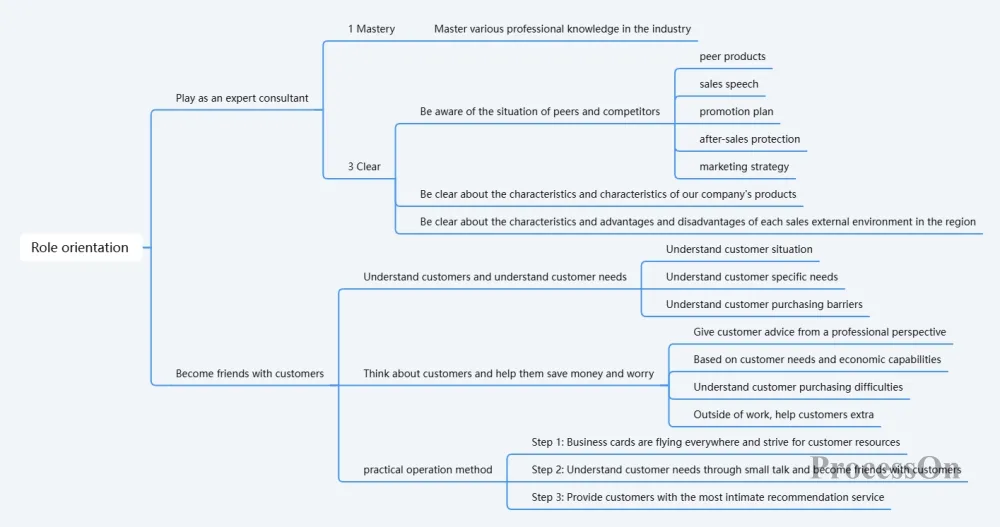
Sales Techniques - Role Positioning
Customers refusing to meet is one of the most common and frustrating problems in sales. How can you persuade a customer to make time to meet with you?
First, give the client a reason to meet with you. Don't just say, "I'd like to introduce our products to you," as that sounds like a waste of time. Instead, say something like, "I've recently been researching XXX trends in your industry and have discovered some information that might be helpful to you. I'd like to share it with you in person for 15 minutes."
Second, leverage existing strengths. Use competitors' actions or industry hot topics as a starting point—"Recently, competitor XX has been making adjustments to XXX, and many clients are paying attention to this issue. I have compiled some countermeasures and would like to discuss them with you in person."
Third, clearly identify the individuals to be contacted. Sales personnel need to understand the client's background information, such as decision-making authority and communication preferences, and focus on connecting with those who have decision-making power. Contact methods include telephone, written communication, in-person meetings, and appointments through authorized representatives. Finding the true decision-maker is crucial for improving meeting efficiency.
Fourth, master the "seven-second rule." Within the first seven seconds of a call connecting, a customer decides whether to give you a chance to continue speaking. Your opening remarks should be concise and impactful, directly stating your value and the benefits you can bring to the customer.
Many salespeople are eager to introduce their products, but they overlook the most important step—understanding what the customer really needs.
The well-known NEADS requirements formula provides a systematic method for requirements mining:
N (Focus on the Present): Start with the customer's existing products and understand their current usage. "Which company's products are you currently using?"
E (Enjoyment): Understand what customers are satisfied with regarding their current products. "What aspects of the current product do you find most convenient to use?"
A (Change): Understand what the client wants to change. "What aspects are you dissatisfied with and would like to see improved?"
D (Decision Maker): Find the person who can actually make the decision. "Who ultimately decides on this?"
S (Solution): Provide the best advice based on the client's needs. "Based on your situation, I suggest..."
NEADS' core logic is: start with existing products to uncover customer needs; use product advantages to satisfy customers' needs; understand what customers want to be different about and what they want to change; find the decision-makers to accurately uncover needs; and provide the best advice based on customer needs.
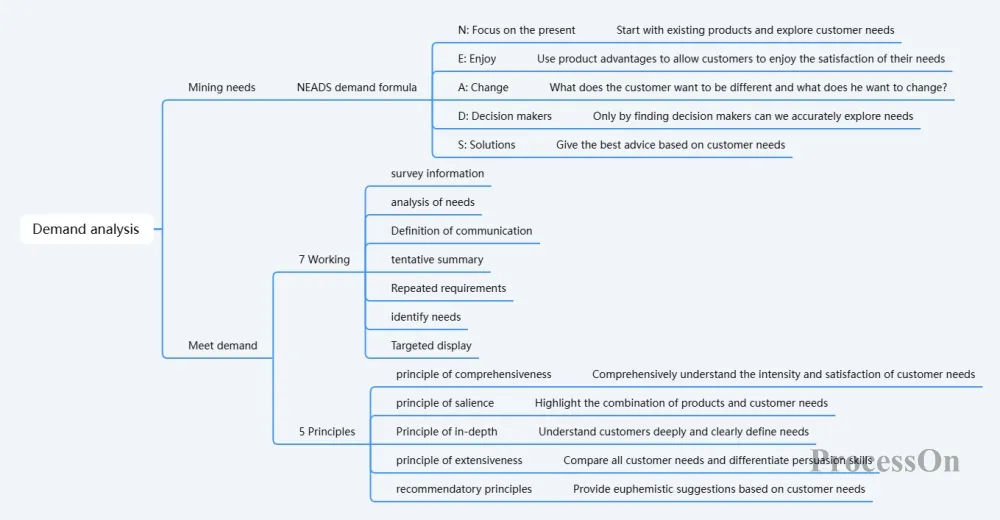
Sales Techniques - Needs Analysis
SWOT analysis is the most commonly used tool for competitive analysis.
S (Strengths): What makes our product stronger than the competition? Technology, service, brand?
W (Weaknesses): Where do our competitors excel compared to us? Why might a customer choose a competitor?
O (Opportunities): What opportunities are available in the market that we can take advantage of?
T (Threats): What are our competitors doing that could threaten our market share?
By conducting a SWOT analysis of competitors, sales personnel can determine their next goals, adjust design plans and pricing strategies , and be able to handle situations calmly when clients mention competitors.
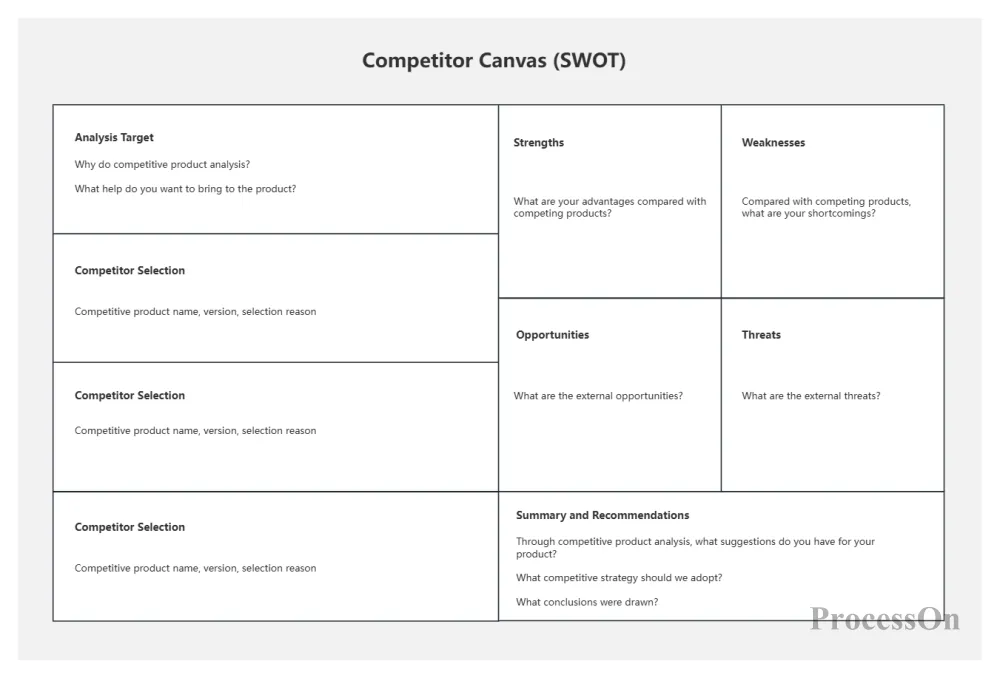
Competitive Analysis - SWOT Analysis
The biggest difference between top salespeople and average salespeople isn't who talks better, but who asks better questions. Through skillful questioning, you can understand what specific problems customers want to solve by using your product, and then use appropriate presentation to make them feel that your product perfectly meets their needs in those areas.
The SPIN questioning method is currently recognized as the most effective sales questioning tool. It uses four types of questions to uncover, clarify, and guide customer needs:
S (Situation): Understanding the client's background and current situation. "How are you currently handling this problem?" "What is the current size of your team?"
P (Problem): Uncover the difficulties and dissatisfactions faced by the client. "What's the biggest headache for you with the existing solutions?" "Which step takes up the most of your time?"
I (Implication): Amplify the impact and consequences of the problem. "What will be the consequences if this problem remains unresolved?" "How much damage will it cause to the business in the long run?"
N (Need-Payoff): Guiding clients to consider the value of the solution. "What benefits would you gain if this problem were solved?" "What would your ideal scenario be?"
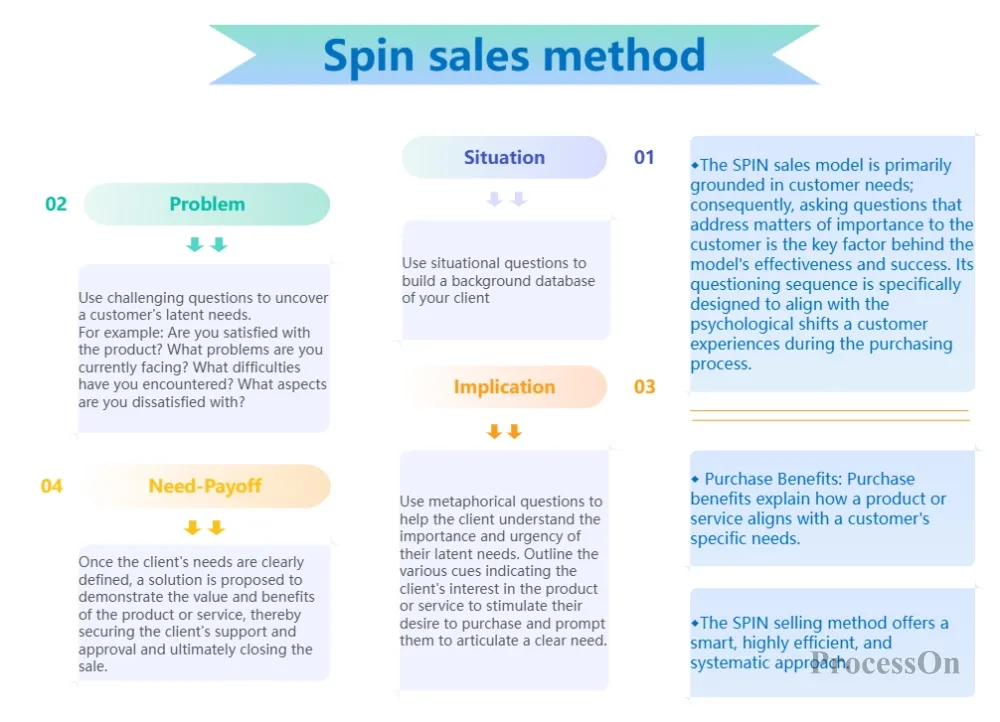
The key to the SPIN questioning technique lies in accurately grasping the psychological motivations of customers during the buying process, helping salespeople guide buyers to develop implicit needs into explicit needs. Asking questions may seem passive, but it is actually proactive—salespeople guide the direction of the conversation through questioning.
Once you understand the customer's needs, the next step is to persuade them with your product solutions. The FABE principle is the most classic tool in sales persuasion:
F (Features): What are the characteristics of the product? These are objective facts, such as "This software supports real-time collaboration among multiple users."
A (Advantages): What are the advantages of these features? How is it better than competitors? "3 times faster than traditional software, and requires no plugins."
B (Benefits): What do these benefits mean to the customer? This is the most crucial part of FABE. "Nobody cares about your product; they only care about their own interests." "This means your team can work synchronously anytime, anywhere, no longer restricted by office location."
E (Evidence): What proves that what you're saying is true? Customer case studies, data reports, third-party certifications. "Currently, over 5000 companies are using it, resulting in an average 40% increase in collaboration efficiency."
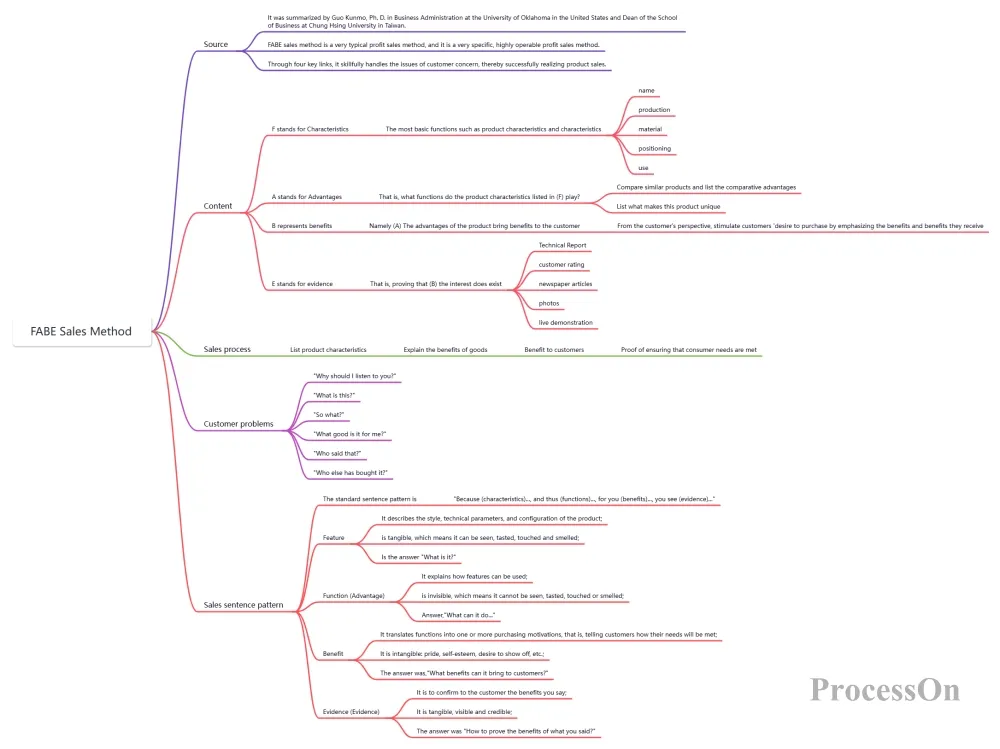
There are two points to note when using the FABE method: first, accurately identify customer needs before applying it; second, grasp the logical order of FABE. Introduce the features first, then elaborate on the advantages, giving the advantages supporting evidence and making them appear more authentic and credible.
Timing of persuasion (3W principle):
When: When to speak – after the customer has expressed a clear need, rather than immediately introducing the product.
What: What to say – Focus on the benefits that customers care about, not just product specifications.
Who: To whom to speak – tell decision-makers the key points, and tell users about the experience.
There's a golden rule in sales: people have one mouth and two ears, so listen more and talk less. The top 10% of salespeople talk the least.
Why is listening so important? Because understanding the other party's problems and true needs is a prerequisite for sales success. Only by understanding what the customer is saying and their true intentions can you provide targeted solutions.
Three levels of effective listening:
The first level: Listen with your ears. Listen to what the customer says—their needs, pain points, and objections. Focusing your attention is the foundation of effective listening.
The second layer: Observe with your eyes. Observe the customer's body language and facial expressions—which topics excite the customer and which make them hesitate.
The third level: Listen attentively. Understand what the customer doesn't say—the unspoken meaning, potential concerns, and true motives.
Three key actions when listening:
Take notes: Write down key points to facilitate communication and avoid omissions.
Nodding in response: "That's right!" "You're absolutely right!"—This makes the other person feel that you're on their side.
Put yourself in the customer's shoes: Think from the customer's perspective and understand the customer.
Closing the deal is the final step in the sales process and also the most challenging part. Many salespeople perform exceptionally well upfront, but hesitate to ask for the sale at the last minute.
Five key principles for closing a deal:
1. Recognize buying signals. When customers start asking questions like "Can the price be discounted?", "What are the after-sales guarantees?", and "When can it be delivered?", it means that the customer has already expressed their intention to buy, and at this point, you should decisively push for the sale.
2. Offer limited choices. Closed-ended questions like "Would you like to choose option A or option B?" have a much higher conversion rate than open-ended questions like "Would you like to consider this?"
3. Handle objections without getting bogged down. When a customer raises an objection, acknowledge it first before responding—"Your question is crucial, let me explain..." Don't dwell on the objection for too long; get to the point and quickly return to the sales process.
4. The Assumptive Closing Method. Saying things like, "Let's sign the contract today," or "I'll arrange the delivery time for you"—speaking in a tone that suggests a deal has already been made makes it easier for the customer to follow your lead.
5. Know when to remain silent. After making a closing offer, learn to remain silent. Whoever speaks first loses. Give the client space to think and make a decision.
Sales is not a talent, but a skill. All sales techniques can be learned; the more you practice, the more composed, confident, and proactive you become.
From finding customers to defining your role, from scheduling meetings to asking questions, from persuasion to closing the deal, there are established methodologies and tools for each step. Mastering these methods will transform you from a salesperson who relies on luck into a systematic one.
Drawing these methodologies into mind maps and flowcharts is the best way to help yourself organize your thoughts and accumulate experience.