Process Type
Graphical expression
Mind Type
Structured expression
Note Type
Efficient expression
Treemap
Bracket Diagram

Default Mode





In today's increasingly competitive manufacturing industry, product quality has become a core competitive advantage for enterprises to survive and thrive. How to systematically plan quality control from the early stages of product development to avoid costly quality problems later on has become a crucial issue that all manufacturing companies must consider. APQP (Advanced Product Quality Planning) is an effective tool for addressing this challenge. Through structured process design, it integrates quality control into the entire product development lifecycle.
This article will comprehensively analyze the core logic and implementation methods of APQP from five dimensions: basic concepts, practical value, advantages and limitations, application scenarios, and best practices, helping enterprises truly master this powerful quality control tool. Meanwhile, these professional APQP charts can be easily created using tools such as ProcessOn , which supports various chart types including flowcharts and mind maps, helping users quickly organize their thoughts, visualize complex information, and significantly improve cross-departmental communication efficiency.
APQP is a structured product quality planning methodology. Its core objective is to identify and resolve potential quality issues early in product development, ensuring that products consistently meet customer requirements during mass production. It is not an isolated tool, but rather complements other quality tools such as FMEA (Failure Mode and Effects Analysis), PPAP (Production Part Approval Process), and SPC (Statistical Process Control), together forming a complete quality control system.
From its core principles, APQP follows a "prevention-first" quality management philosophy. By integrating quality planning activities into all stages of product development, it avoids the reactive "firefighting" approach of traditional methods. Its core logic can be summarized as a cyclical progression of five stages: planning and defining the project, product design and development, process design and development, product and process validation, feedback evaluation, and corrective action. These five stages are not strictly linear but overlap, reflecting the iterative nature of quality planning.
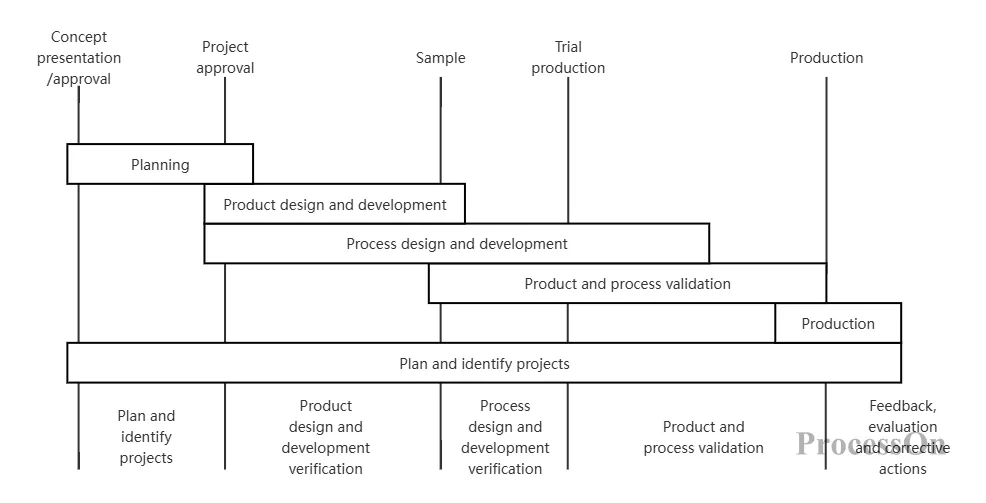
The development of APQP can be traced back to the American automotive industry in the 1980s, when automakers such as Ford and GM jointly developed this standardized quality planning process to improve supply chain quality. Over the decades, APQP has expanded from the automotive industry to multiple manufacturing sectors, including electronics, machinery, and aerospace, becoming a globally recognized quality control standard in the manufacturing industry.
Compared to traditional quality control models, the biggest difference of APQP lies in its "proactive" and "systematic" nature. Traditional models often only take corrective measures after quality problems occur in the product, while APQP conducts quality planning and risk assessment at every stage of product development; traditional quality control is often limited to the production process, while APQP covers the entire lifecycle from concept design to mass production feedback.
To understand the core principles of APQP, three key elements need to be grasped: First, it is customer-demand oriented, with all quality planning activities revolving around meeting customer needs; second, it involves cross-departmental collaboration, requiring the joint participation of multiple departments such as design, engineering, production, quality, and purchasing; and third, it involves continuous improvement, achieving closed-loop management of quality control through feedback evaluation and corrective action phases. These professional process logics can be quickly visualized through ProcessOn 's template library. Users simply need to visit the official website, register an account, and select a suitable APQP template to directly reuse or modify it, significantly saving time in process streamlining.
For manufacturing companies , APQP is more than just a quality control process; it's a strategic tool for enhancing core competitiveness. Through systematic quality planning, it can create value for businesses on multiple levels.
First, APQP can effectively reduce product development costs. Statistics show that the product development phase determines 80% of the product cost, while quality problems in traditional models often only surface during mass production, at which point the rectification costs are more than 100 times higher than those in the development phase. APQP avoids costly design changes and rework later by identifying and resolving potential problems early in development. For example, identifying potential failure modes through FMEA analysis during the product design phase and optimizing the design in advance can prevent batch quality problems from occurring during mass production.
Secondly, APQP can improve product quality stability. Through structured process design, APQP ensures that every stage of product development has clear quality requirements and verification standards. From raw material procurement to production process control, from product testing to packaging and transportation, every step is incorporated into the quality control system. This end-to-end quality control can effectively improve product consistency and reliability, and reduce after-sales quality issues.
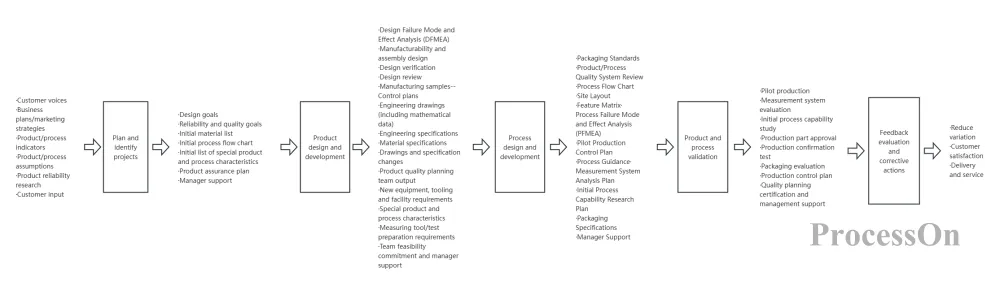
APQP Input and Output Models at Each Stage
Third, APQP can improve customer satisfaction. In today's increasingly competitive market, customers have higher and higher requirements for product quality. APQP is customer-demand oriented, translating customer needs into specific quality requirements and continuously validating them during the development process to ensure that the final product meets or even exceeds customer expectations. This customer-centric quality planning can effectively improve customer satisfaction and loyalty, helping companies win more market share.
Fourth, APQP promotes cross-departmental collaboration. Product development is a complex system engineering project that requires the cooperation of multiple departments. By clarifying the responsibilities and tasks of each department at different stages, APQP breaks down departmental barriers and promotes information sharing and collaborative work. For example, in the process design phase, the production department needs to participate in advance to ensure that the design is manufacturable; the quality department needs to simultaneously develop inspection standards to ensure that product quality meets requirements.
Finally, APQP can improve a company's compliance. In many industries, especially automotive and aerospace, customers require suppliers to conduct product development through the APQP process. Implementing APQP helps companies meet customer compliance requirements and enhance supply chain competitiveness. At the same time, the APQP implementation process also helps companies obtain quality management system certifications such as IS/TS 16949.
In practical applications, companies can visualize the value of APQP through the ProcessOn tool. It supports team collaboration, allowing members from different departments to edit and comment in real time on the same canvas, significantly improving cross-departmental communication efficiency. Simultaneously, ProcessOn supports multi-format export, facilitating the sharing of APQP process documents with customers and suppliers.
As a mature quality control tool, APQP has significant advantages, but it also has certain limitations. When implementing APQP, companies need to rationally assess its strengths and weaknesses, avoiding blindly following trends or over-reliance on it.
The main advantages of APQP are reflected in the following aspects:
First, there's the structured process design. APQP provides clear phase divisions and task requirements, enabling even inexperienced teams to conduct quality planning activities according to the process. This standardized process design ensures the integrity and consistency of quality planning, avoiding the omission of key steps.
Secondly, it emphasizes prevention. APQP places quality control in the early stages of product development, using risk identification and preventative measures to avoid quality problems later on. This proactive quality management model significantly reduces quality costs compared to the traditional reactive model.
Thirdly, there is the cross-departmental collaboration mechanism. APQP clarifies the responsibilities and tasks of each department at different stages, promoting information sharing and collaborative work. This cross-departmental collaboration mechanism can effectively improve product development efficiency and reduce communication barriers between departments.
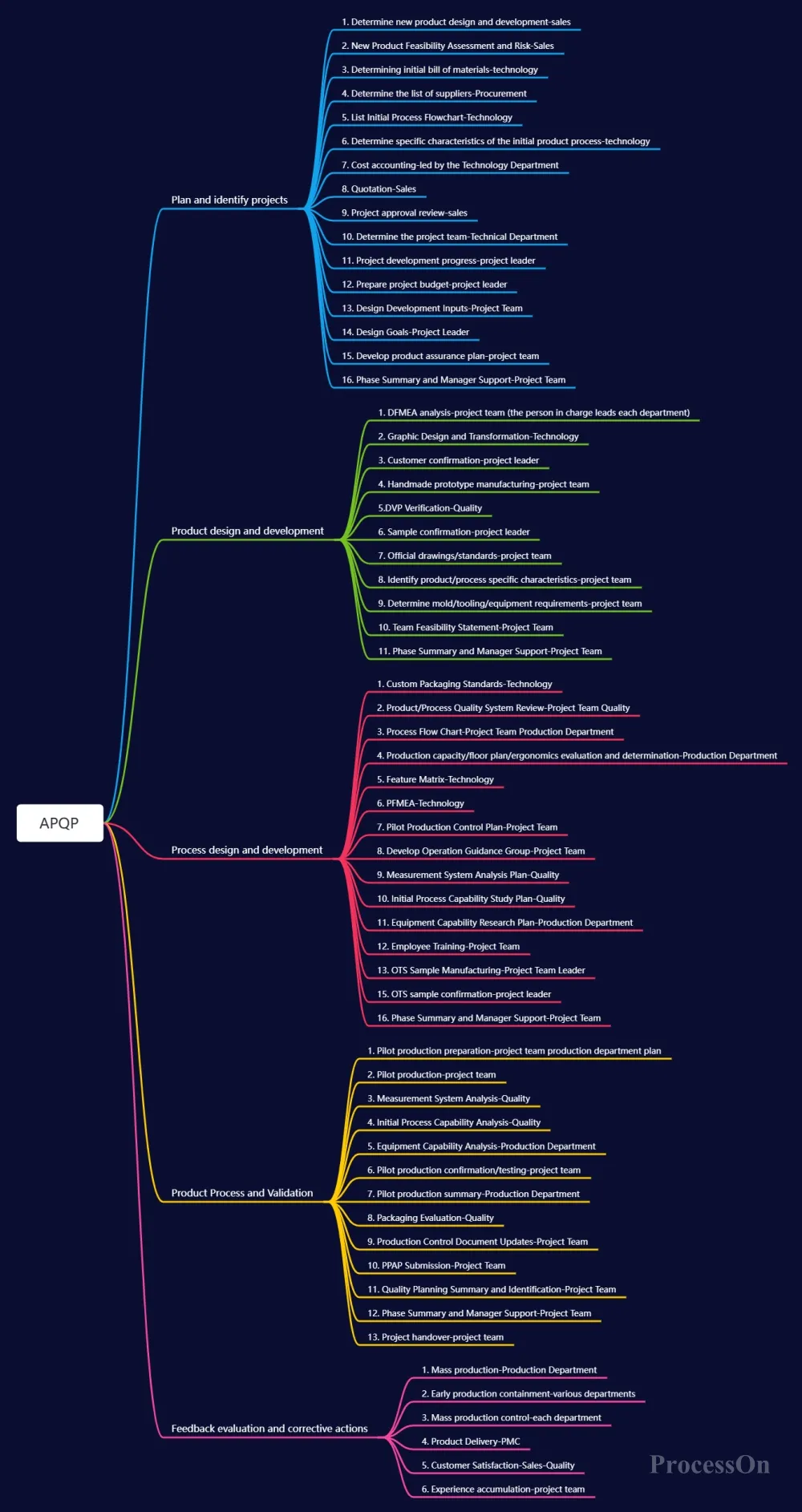
Fourth, it features closed-loop management for continuous improvement. APQP achieves closed-loop quality control through feedback assessment and corrective action phases. This continuous improvement mechanism helps companies continuously improve product quality and management levels.
However, APQP also has certain limitations:
First, the implementation cost is relatively high. APQP requires a significant investment of human, material, and time resources, which may pose a challenge for small and medium-sized enterprises (SMEs) due to resource constraints. Furthermore, implementing APQP necessitates that employees possess certain professional knowledge and skills, requiring companies to conduct corresponding training and capacity building.
Secondly, the process lacks flexibility. APQP is a standardized process, which may be too rigid for some highly customized products or projects. Enterprises need to adjust and optimize the APQP process appropriately according to their own actual situation, avoiding simply copying it blindly.
Third, there is an over-reliance on documentation. APQP requires extensive documentation, including various plans, reports, and validation documents. If companies focus too much on the form of documentation while neglecting its actual effectiveness, they may fall into the trap of "documentation for the sake of documentation," which ultimately reduces work efficiency.
Fourth, supplier management is challenging. APQP requires not only internal collaboration but also supplier cooperation. If a supplier's quality management level is low, it may negatively impact the effectiveness of the entire APQP process. Companies need to establish effective supplier management mechanisms to ensure that suppliers conduct quality planning activities in accordance with APQP requirements.
To avoid the limitations of APQP, companies need to take the following measures: First, adjust the APQP process flexibly according to their own actual situation to avoid over-standardization; second, focus on practical results and avoid formalism; third, strengthen supplier management and improve the overall quality level of the supply chain; and fourth, continuously optimize the APQP process and improve quality planning methods in combination with the company's development stage and market demand.
APQP originated in the automotive industry, but after decades of development, it has been widely applied in various manufacturing fields such as electronics, machinery, aerospace, and medical devices. While the application scenarios of APQP differ across industries, the core logic remains largely the same.
In the automotive industry, Advanced Quality Practice (APQP) is a core requirement of supply chain management. OEMs require all suppliers to conduct product development through the APQP process to ensure that component quality meets vehicle requirements. APQP applications in the automotive industry typically include the following scenarios:
New vehicle development: During the development of a new vehicle, OEMs and suppliers need to jointly carry out APQP activities, from concept design to mass production verification, to ensure that the overall vehicle quality meets design requirements.
Component changes: When there are changes to the design or production process of a component, it is necessary to re-verify it through the APQP process to ensure that the changes do not affect product quality.
Supplier Development: During the development of new suppliers, OEMs need to assess the suppliers’ APQP capabilities to ensure that the suppliers have the corresponding quality control level.
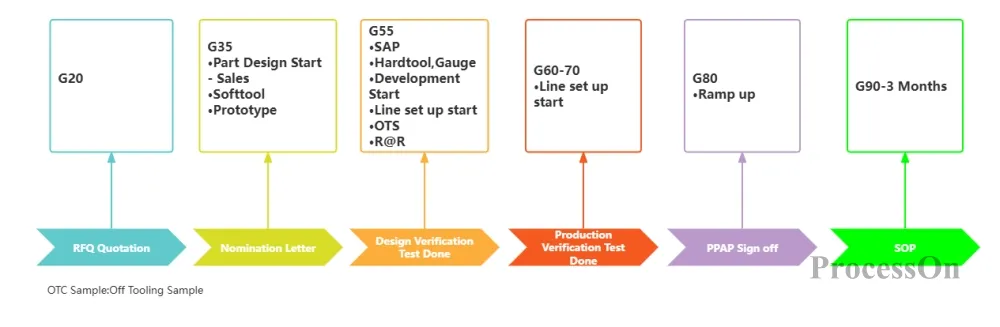
In the electronics industry, Advanced Quality Practice (APQP) is primarily used for new product development and process optimization. The electronics industry has a rapid product turnover rate and high quality requirements; APQP helps companies quickly launch high-quality products. Typical application scenarios include:
Consumer electronics product development: In the development of consumer electronics products such as mobile phones and computers, APQP can ensure that the products meet market demands in terms of performance, reliability and compatibility.
Automotive electronic component development: Automotive electronic components have extremely high requirements for safety and reliability, and APQP can help companies meet the stringent quality standards of the automotive industry.
Process optimization: During the production process, potential problems in the process are identified through the APQP process, production processes are optimized, and product quality stability is improved.
In the medical device industry, Advanced Quality Practice (APQP) is a crucial means of ensuring product safety and effectiveness. Medical devices are directly related to patient safety, therefore, the requirements for quality control are extremely stringent. APQP applications include:
New Medical Device Development: In the process of developing new medical devices, APQP can ensure that the products meet regulatory requirements and clinical needs.
Product registration application: APQP documents are an important part of medical device registration application, which can prove that the product's quality control process complies with regulatory requirements.
Production process validation: The stability and reliability of the production process are validated through the APQP process to ensure consistent product quality.
In practice, companies need to adjust the implementation focus of APQP based on industry characteristics and product features. For example, in the automotive industry, more emphasis needs to be placed on supply chain collaboration and PPAP validation; in the medical device industry, more emphasis needs to be placed on regulatory compliance and clinical validation; and in the electronics industry, more emphasis needs to be placed on rapid iteration and process optimization.
APQP, as a structured product quality planning methodology, has become a globally recognized quality control standard in the manufacturing industry. By placing quality control upstream throughout the entire product development lifecycle, it effectively reduces quality costs, improves product quality stability, and enhances a company's core competitiveness.
For manufacturing companies, APQP is not just a quality control process, but a strategic choice. In today's increasingly competitive market, implementing APQP can help companies establish a quality advantage from the early stages of product development, win customer trust, and achieve sustainable development. Companies can try using ProcessOn to create their own APQP charts, select appropriate templates from the template library, quickly streamline the quality planning process, and improve work efficiency and management level.