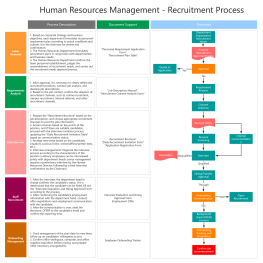
Process Type
Graphical expression
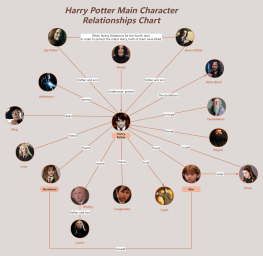
Mind Type
Structured expression
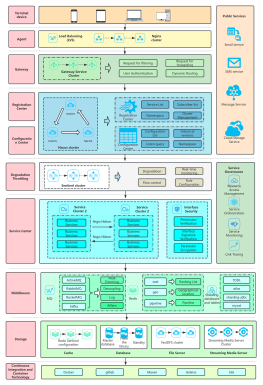
Note Type
Efficient expression
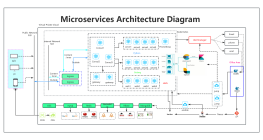
Treemap
Bracket Diagram

Default Mode





In the face of fierce market competition, why do some companies consistently generate profits while others struggle in price wars? The answer often lies within the company's internal activities. Michael Porter's "Value Chain Model," proposed in 1985, is a classic tool that helps companies systematically analyze their internal activities and identify sources of competitive advantage.
Porter argues that a company's competitive advantage does not stem from a single activity, but rather from a combination of activities including design, production, marketing, delivery, and support. These activities are like links in a chain, interconnected and working together to create value. By analyzing the value chain, companies can find breakthroughs in reducing costs, enhancing differentiation, and strengthening overall competitiveness.
Today, we'll delve into the core concepts of Porter's value chain model and how to use it to build a competitive advantage for your business. More importantly, we'll show you how to visualize the value chain using charting tools (such as ProcessOn), making it clear to the team and providing a solid foundation for strategy implementation.
Porter's value chain model divides a company's business activities into two main categories: primary activities and support activities.
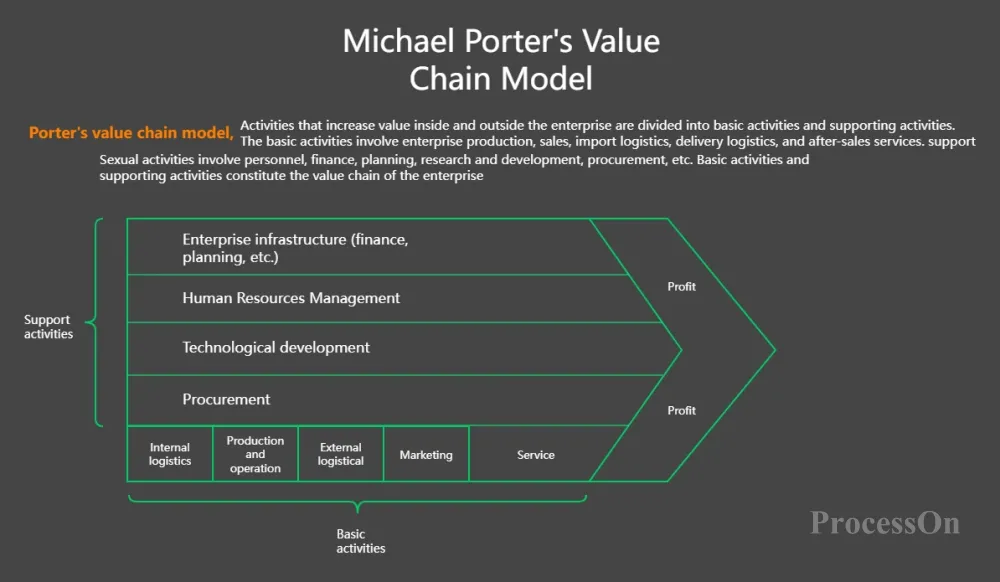
Michael Porter's value chain model
Basic activities: Activities directly related to the creation, sale, delivery, and after-sales service of products. These include: internal logistics, production operations, external logistics, marketing and sales, and service.
Supporting activities: Activities that provide infrastructure and resources for basic activities. These include: procurement, technology development, human resource management, and enterprise infrastructure.
A company's profit is the difference between its total value (the price customers are willing to pay) and the cost of all its activities. By optimizing each step, a company can gain a competitive advantage by either reducing costs (cost leadership strategy) or creating uniqueness (differentiation strategy).
Basic activities form the backbone of a company's value chain, directly impacting the physical flow of products and customer experience.
This refers to activities related to receiving, storing, managing, and handling raw materials. For example, Toyota's Just-In-Time (JIT) inventory system has significantly reduced warehousing costs, becoming a key part of its cost leadership strategy.
Optimization directions: reduce inventory turnover days, optimize supplier delivery frequency, and use automated warehousing equipment.
This refers to activities that transform raw materials into final products, such as machining, packaging, assembly, and equipment maintenance. The efficiency of production operations directly determines product quality, cost, and production cycle.
Optimization directions: Introduce lean production, improve overall equipment efficiency (OEE), and implement quality control circles.
This refers to the activities of getting products from the production line to the customer, including order processing, finished goods inventory, transportation, and delivery. Amazon's "one-day delivery" is a differentiated advantage built on its powerful external logistics system.
Optimization directions: optimize delivery routes, use third-party logistics price comparison systems, and establish regional warehousing centers.
This refers to activities that help customers understand a product and encourage them to buy it, such as advertising, promotions, pricing, channel management, and sales team management. Coca-Cola's brand marketing capabilities have enabled it to maintain its leading position in the carbonated beverage market for a long time.
Optimization areas: accurate customer profiling, digital marketing channels, and sales incentive policies.
Activities that enhance or maintain product value include installation, maintenance, training, spare parts supply, and customer consultation. Haidilao's exceptional service has set it apart in the highly competitive restaurant industry, with customers willing to pay a premium for the experience.
Optimization directions: Establish a closed loop for customer feedback, provide 24-hour online customer service, and extend the warranty period.
Supporting activities do not directly participate in product production, but they provide the necessary conditions for basic activities, and thus also affect competitive advantage.
This refers to the purchase of inputs used in a company's value chain, such as raw materials, equipment, and office supplies. Establishing long-term strategic partnerships with suppliers can reduce costs and ensure quality. For example, Dell has significantly reduced procurement costs by directly sourcing components and adopting a zero-inventory model.
Optimization areas: supplier evaluation and classification, centralized procurement, and electronic bidding system.
This refers to technological improvements and innovations related to products, processes, and equipment. It's not just the responsibility of the R&D department; it also includes minor tweaks and improvements in production. Apple has built a strong competitive advantage through continuous technological development (iOS ecosystem, M1 chip, etc.).
Optimization directions: Establish a technology innovation reward mechanism, build a knowledge management system, and track cutting-edge technology patents.
This refers to activities such as recruitment, training, motivation, and performance appraisal. Google's human resources management is known for its data-driven approach and employee well-being, attracting top talent globally and driving continuous innovation.
Optimization directions: Establish a competency model, implement OKR performance management, and design a dual career development path.
4. Firm Infrastructure
This refers to the systems and activities that support the operation of the entire value chain, including general management, finance, legal affairs, quality management, and strategic planning. For example, Walmart's global satellite information system enables it to manage its supply chain far more efficiently than its competitors.
Optimization areas: Promote digital transformation, establish a shared service center, and optimize approval processes.
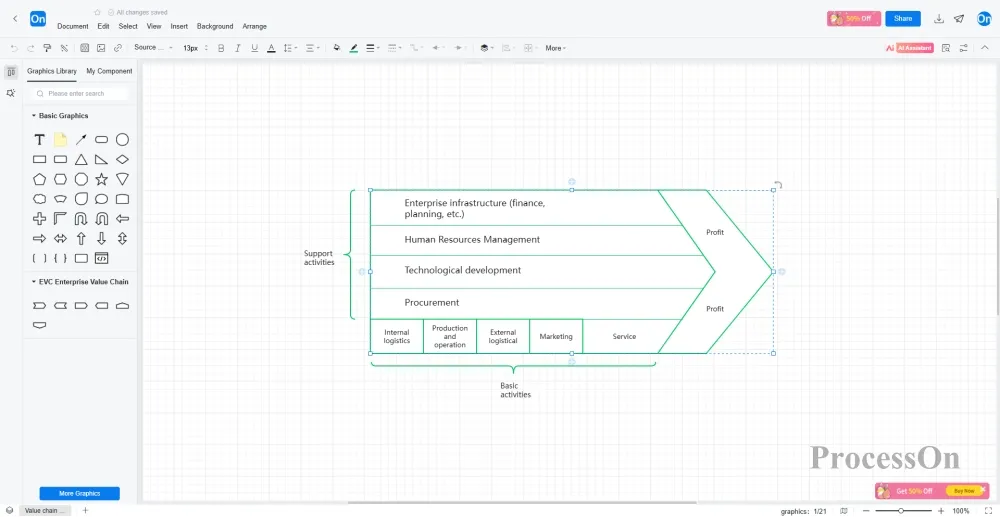
Organize all of your company's activities according to Porter's nine categories. You can use mind mapping or flowchart tools to draw the complete value chain from raw materials to after-sales service. ProcessOn offers ready-made value chain templates that can be easily dragged and dropped for modification.
Key points for drawing:
Arrange the basic activities from left to right (internal logistics → operations → external logistics → marketing → service).
Arrange the support activities from top to bottom.
Next to each activity, indicate its current cost percentage, key performance indicators (KPIs), or existing problems.
For each activity, ask two questions:
Does this activity create unique value that customers are willing to pay? (Would customers churn if it were removed?)
Is the cost of this activity higher than the industry average? (Is there any room for cost reduction?)
A commonly used analytical tool is the cost-value matrix. The horizontal axis represents cost levels, and the vertical axis represents revenue contribution levels, placing activities into four quadrants:
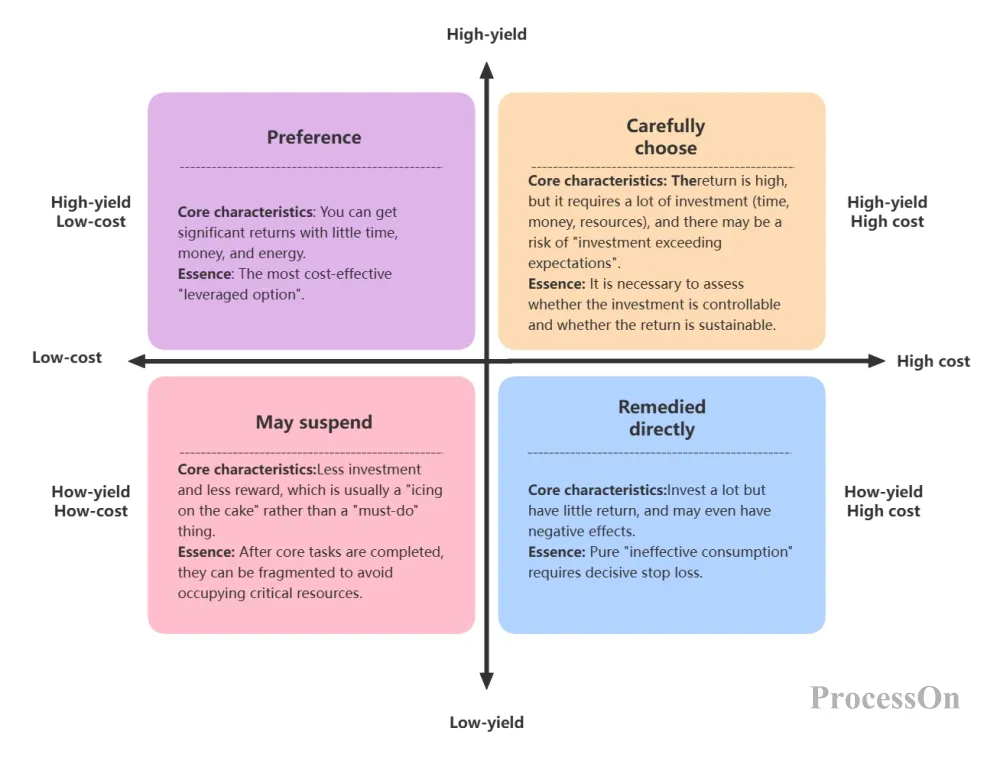
High returns + low cost: Maintain and strengthen
High returns + high costs: Optimize efficiency or find cheaper alternatives.
Low returns + low costs: Consider outsourcing or simplification
Low returns + high costs: Restructure or cancel immediately
Porter points out that competitive advantage stems from two basic strategies: cost leadership and differentiation.
Cost leadership: Lowering the total cost of each activity to be lower than competitors. For example, an airline can significantly reduce operating costs by simplifying services (excluding meals, using a standardized aircraft type), thereby achieving low-priced tickets.
Differentiation: Creating uniqueness in certain activities to make customers willing to pay a premium. For example, Dyson prices its vacuum cleaners and hair dryers far higher than its competitors through leading motor technology and design aesthetics.
Companies can choose to focus on one strategy, or pursue differentiation in some areas and low cost in others. But the worst thing is to be "sandwiched"—having neither a cost advantage nor uniqueness.
Based on the above analysis, an improvement plan is formulated. Common measures include:
Cut back: Eliminate activities that do not create value (such as excessive approval processes).
Consolidation: Combining disparate activities (such as merging multiple warehouses into a single regional distribution center).
Outsourcing: entrusting non-core activities to more specialized third parties (such as outsourcing logistics and delivery to third parties).
Automation: Replacing human labor with technology (such as customer service robots).
Collaboration: Sharing information with upstream and downstream partners (such as Vendor Managed Inventory, VMI).
Porter's value chain model involves multiple activities, relationships, and metrics, which can easily become confusing when described in words alone. ProcessOn offers a wealth of templates to help you create visual value chain diagrams, and multiple users can edit the diagrams simultaneously. All modification history is traceable, ensuring strategic implementation. Search for "value chain" or "Porter's value chain" in the template library to directly access classic templates, reuse them with one click, and quickly start your strategic analysis.
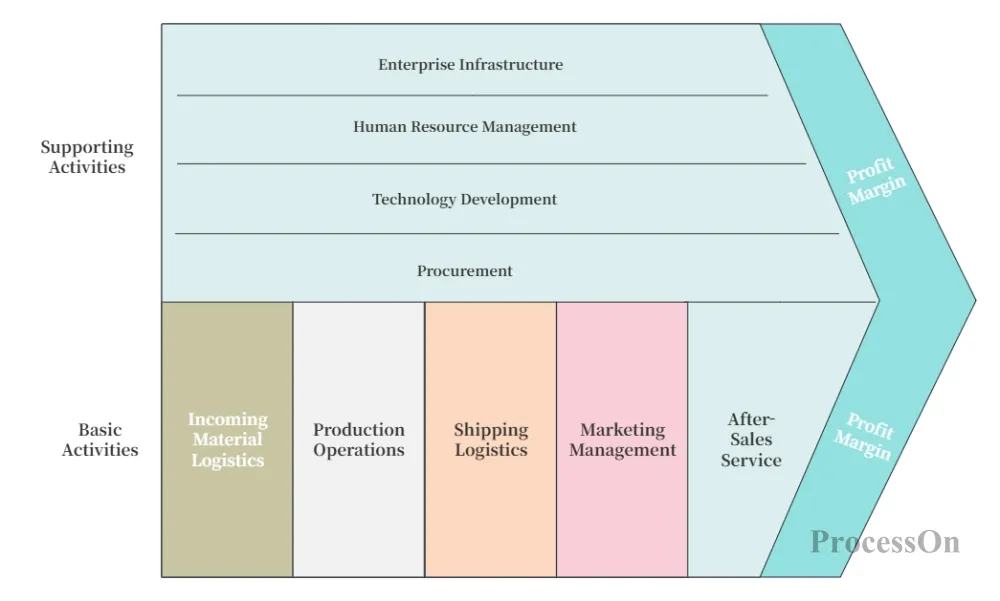
Enterprise Value Chain Model Template
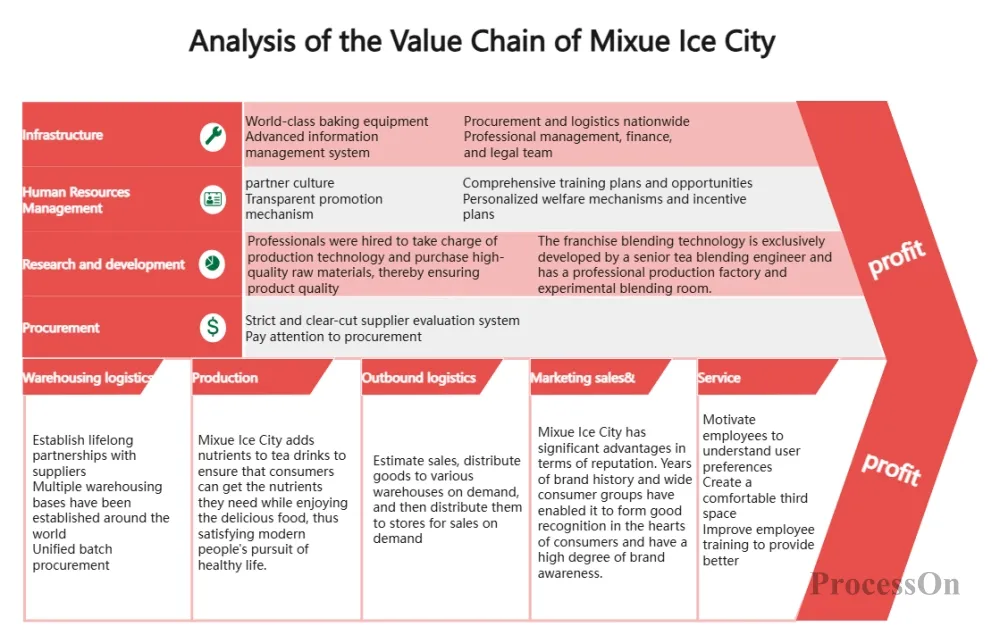
Mixue Ice Cream Value Chain Model
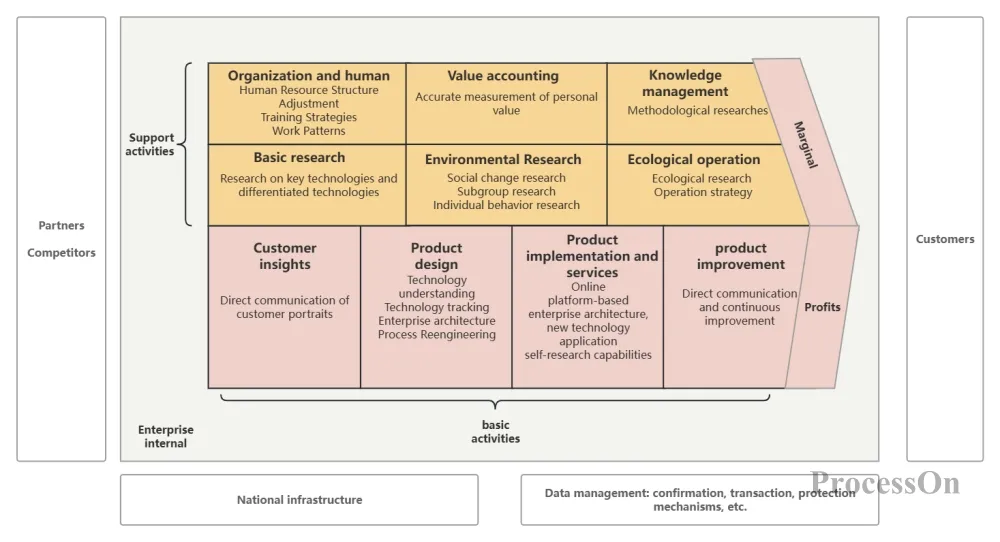
Many business managers fall into the misconception that competitive advantage comes from a single "magical" point (such as a core technology, a blockbuster product, or a successful marketing campaign). However, Porter's value chain model tells us that true competitive advantage is the sum of countless subtle optimizations along the entire value chain.
When your procurement is 1% cheaper than your competitors, your production efficiency is 2% higher, your logistics losses are 3% lower, and your marketing conversion rate is 4% higher... these seemingly small differences, when combined, will form a huge moat.
Therefore, stop blindly chasing "hot trends." Calm down, draw up your value chain, find the optimization potential in each link, and then take action to fill it. This is precisely why Porter's model is still considered a classic after more than 30 years—it provides a timeless analytical framework that makes competitive advantage diagnosable, manageable, and improveable.