Process Type
Graphical expression
Mind Type
Structured expression
Note Type
Efficient expression
Treemap
Bracket Diagram

Default Mode





Marketing is the lifeline of a business, but many companies often fall into the trap of "doing whatever comes to mind" when formulating marketing strategies: today they follow the trend of live streaming, tomorrow they imitate competitors' price reductions, and the day after tomorrow they invest in information flow ads... They invest a lot of resources, but the results are hard to sustain.
Is there a classic theoretical framework that can help companies systematically examine their marketing mix and find a breakthrough for optimization? The answer is: the 4P theory.
The 4Ps are the most fundamental and practical analytical tool in marketing. They summarize complex marketing activities into four core elements: product, price, place (distribution), and promotion. Whether you are a startup or an established brand, you can use the 4Ps to analyze the current situation, identify problems, and develop strategies.
Today, we'll discuss how to optimize corporate marketing strategies using the 4P theory. More importantly, we'll show you how to visualize 4P analysis using charting tools, making it clear to the team and providing a basis for decision-making.
The 4Ps theory, proposed by American scholar E. Jerome McCarthy in the 1960s, is the core framework of the marketing mix. The four Ps represent:
Product: Tangible goods or intangible services that a company provides to its target market.
Price: The amount a customer pays to obtain a product.
Place (channel): The path a product travels from producer to consumer.
Promotion: All activities that communicate with customers and deliver value.
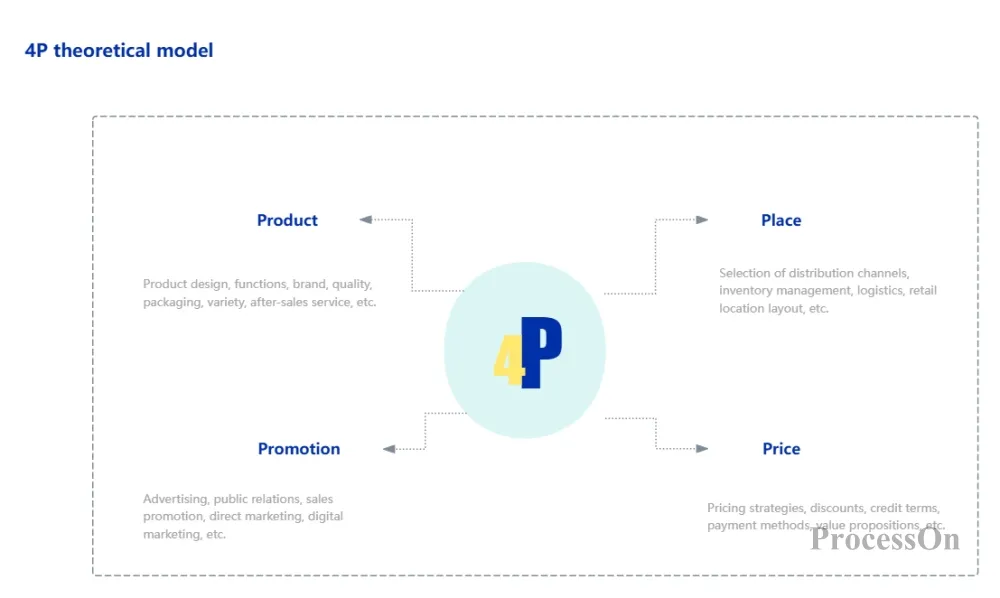
These four elements influence and constrain each other. A successful marketing strategy requires the 4Ps to work together synergistically, rather than operating independently.
Why is the 4P still valid today?
Although new theories such as 4C (Customer, Cost, Convenience, Communication) and 4R (Relevance, Response, Relationship, Return) have emerged since then, the 4P framework remains the preferred framework for businesses to formulate marketing strategies due to its simplicity and practicality. It takes a business perspective, covers all key aspects of marketing decision-making, and each P can be quantified and evaluated.
For small and medium-sized enterprises or startups, the 4Ps are a lifeline—they force you to think: What problem does your product actually solve? Is the pricing reasonable? Have the channels reached the target users? Is the promotional message compelling?
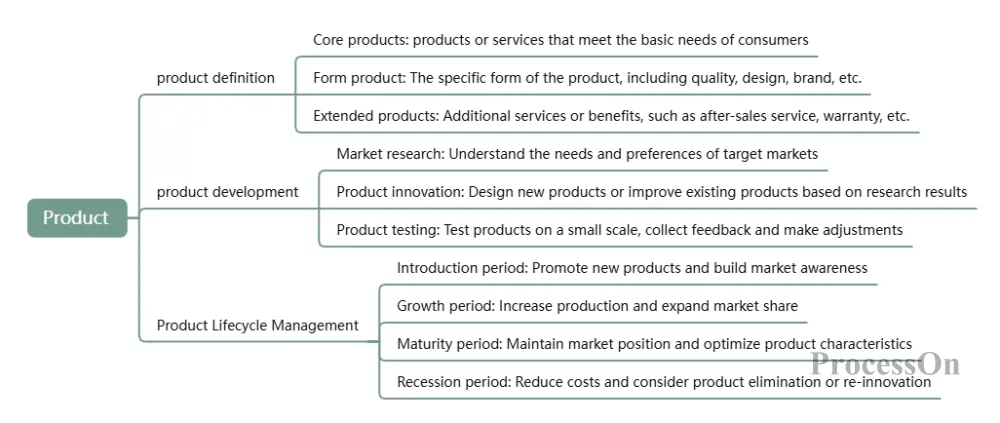
Product is the cornerstone of marketing. Without a good product, even the most powerful promotion is just a castle in the air. Optimizing product strategy can be approached from the following aspects:
Product positioning: Which group of people does your product target? What pain points does it solve? What are the differentiators compared to competitors? You can use a "product positioning map" to visualize this – the horizontal axis is price, and the vertical axis is function/quality. Mark your competitors and your own products on the map to see any untapped opportunities at a glance.
Product portfolio: A single product has limited resilience; a product matrix can be considered. For example, "traffic-driving" products attract new users, "profit-generating" products generate revenue, and "image-enhancing" products elevate brand image. The Boston Consulting Group (BCG) matrix (four quadrants) can be used to categorize products based on "market growth rate" and "relative market share," determining which products to focus on and which to phase out gradually.
Product lifecycle: Every product goes through introduction, growth, maturity, and decline. Different strategies are needed for each stage: the introduction stage focuses on educating the market; the growth stage involves rapidly gaining market share; the maturity stage seeks new application scenarios; and the decline stage considers exiting the market or repositioning. A product lifecycle curve can visually indicate the current stage.
Product experience: In addition to functionality, pay attention to packaging, instructions for use, after-sales service, and the closed loop of user feedback. User journey mapping can help you identify pain points and opportunities during product use.
Practical Application of the 4P Marketing Theory
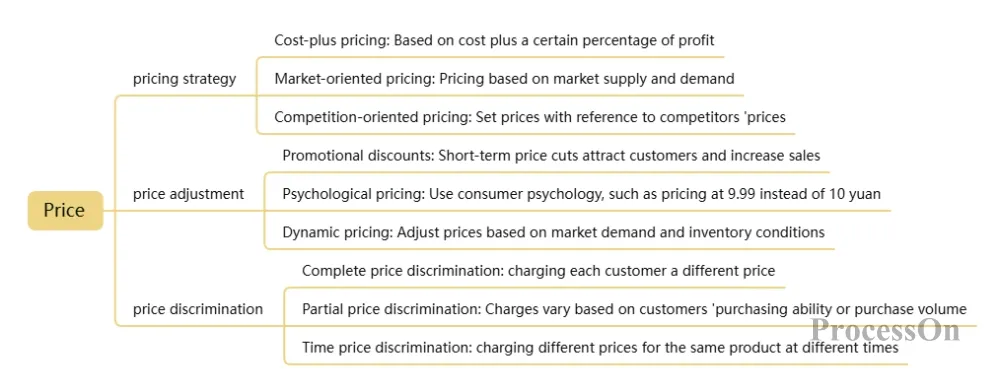
Price is the only factor that directly generates revenue, and it's also the most difficult to decide. To optimize pricing strategies, the following models can be considered:
Cost-plus pricing: cost plus reasonable profit. Simple, but prone to overlooking market acceptance.
Market-oriented pricing: Pricing based on market supply and demand. For example, if software can save a company 1 million yuan in costs each year, users will still feel it's a good deal if it's sold for 100,000 yuan a year.
Competition-driven pricing: referencing competitor prices. This can involve low-price penetration, high-price skimming, or following the lead of competitors.
Dynamic pricing: Adjusted in real time based on supply and demand, such as for air tickets, hotels, and ride-hailing apps.
Psychological pricing: 99 yuan vs. 100 yuan, package price vs. single item price, anchoring effect, etc.
In the charting tools, you can use price comparison tables to list the prices, features, and cost-effectiveness of different competing products, helping your team make pricing decisions. You can also use demand-price curves to analyze the impact of price changes on sales volume.
Practical Application of the 4P Marketing Theory
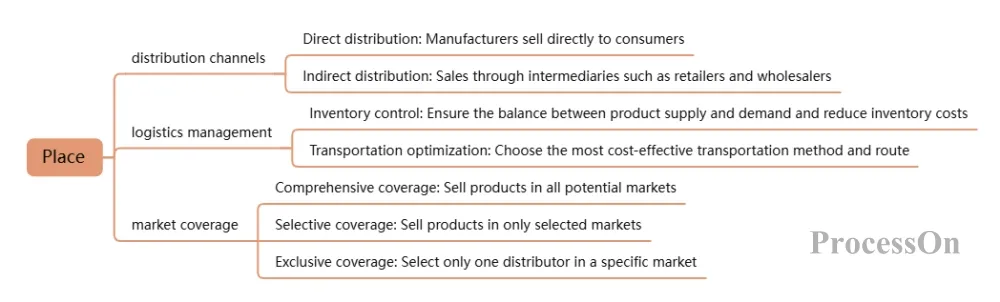
Channel strategy determines how a product reaches its target users. The choice of channels directly affects sales and brand image.
Channel type:
Direct selling: official website, self-operated stores, private domain communities
Distribution: Agents, Distributors, Retailers
E-commerce platforms: Tmall, JD.com, Amazon
Content channels: TikTok、YouTube(content is also a channel)
Channel evaluation metrics include: coverage, cost to reach, conversion rate, and brand image alignment. Channel funnel charts can be used to compare the conversion rate from exposure to sales across different channels.
Channel conflict management: Issues such as inconsistent online and offline pricing and distributors competing for orders necessitate the design of channel policies. Channel flowcharts can clearly illustrate the roles and profit distribution of each channel.
Omnichannel integration: Users may jump between different channels, such as seeing an ad on TikTok, checking details on the official website, and finally placing an order on JD.com. It's crucial to ensure consistent information and a seamless experience across all channels. User journey maps can be used to trace the user's cross-channel behavioral paths.
Practical Application of the 4P Marketing Theory
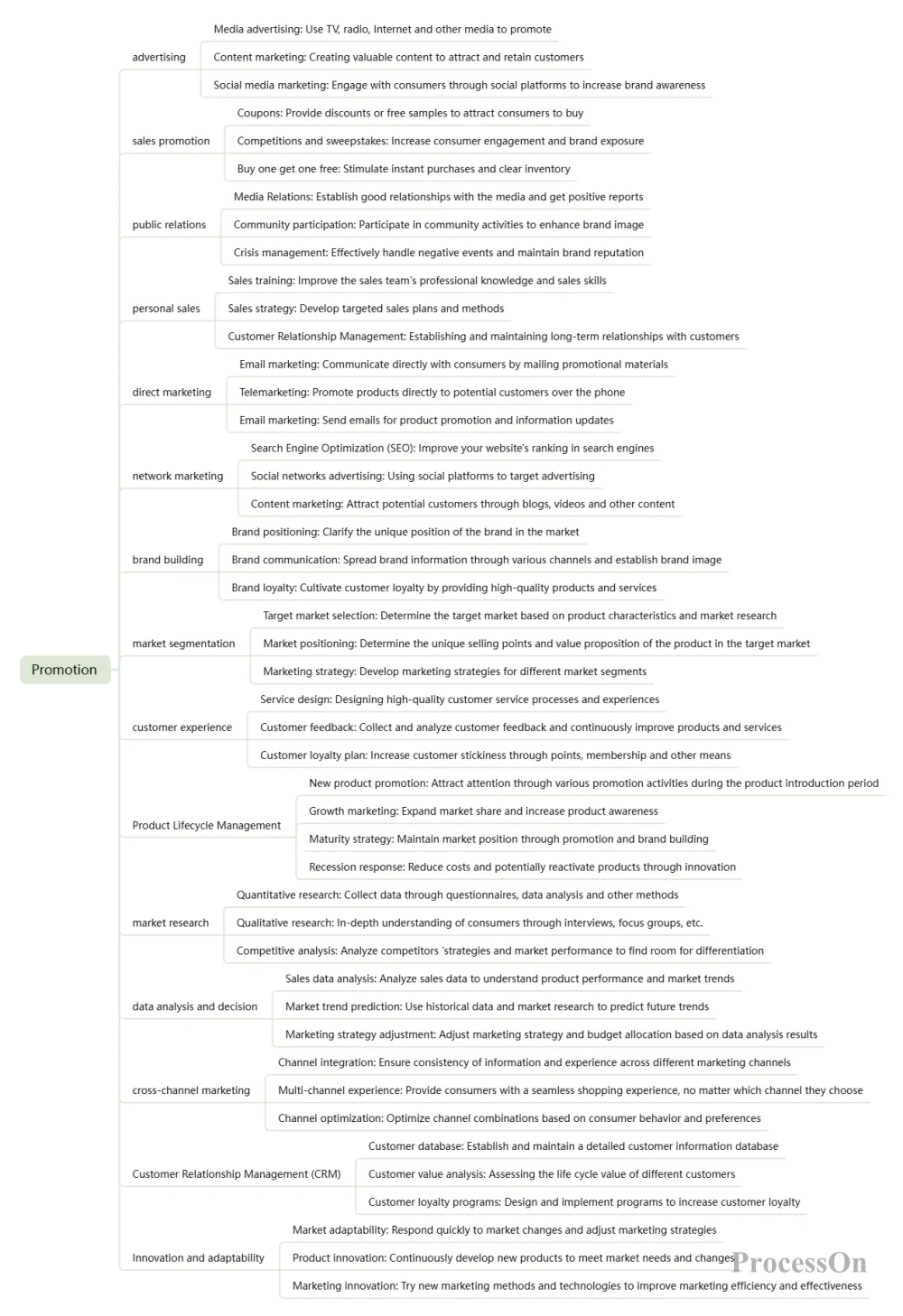
Promotions are not just about discounts; they encompass all activities that communicate with users: advertising, public relations, content marketing, promotional events, word-of-mouth marketing, and more.
AIDA Model: Any promotional activity should follow the logic of "Attention → Interest → Desire → Action". A funnel chart can be used to show the conversion rate at each stage and identify weaknesses.
Promotional tool mix:
Advertising: Online (search, social media, news feeds), Offline (outdoor, television)
Public Relations: Press Releases, Media Interviews, Event Marketing
Content marketing: WeChat official accounts, short videos, live streaming, and popular science.
Sales promotions: coupons, discounts, gifts, limited-time offers, membership points
Personal selling: sales team, customer service, community operations
Promotion effectiveness evaluation: Return on investment (ROI), customer acquisition cost (CAC), conversion rate, and repurchase rate. Monitor key metrics in real time using data dashboards.
Integrated marketing communications: ensuring consistent and complementary promotional messages across different channels and stages. Gantt charts can be used to plan the timeline of promotional activities throughout the year, avoiding internal resource conflicts.
Practical Application of the 4P Marketing Theory
No amount of theoretical explanation can compare to a visual representation. The following three charts can help you apply the 4P analysis to team collaboration.
Divide the canvas into four areas, labeled with product, price, channel, and promotion respectively. In each area, list the current core strategies, existing problems, and areas for improvement. This "one-page overview" approach is suitable for kickoff meetings or project presentations.
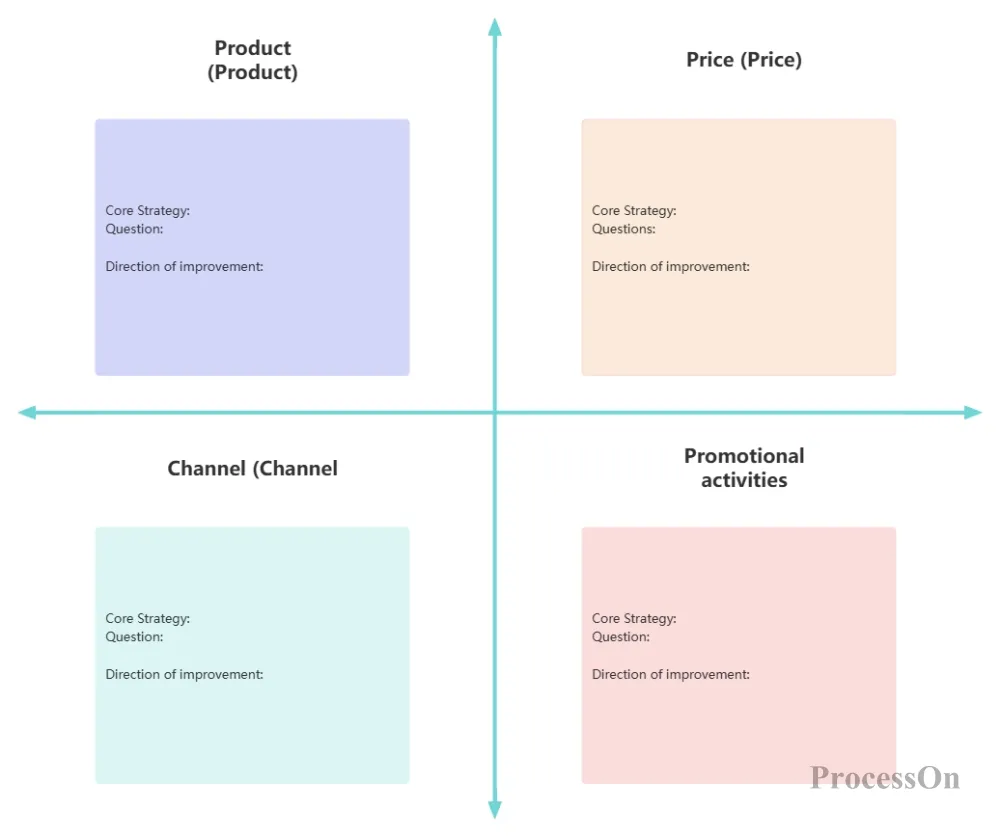
In ProcessOn: Select the "Matrix Chart" template, customize the four quadrant titles, fill the content with sticky note-style cards, and support real-time editing by multiple users.
The horizontal axis represents relative market share (high or low), and the vertical axis represents market growth rate (high or low). Product lines are divided into four categories: Stars, Cash Cows, Question Marks, and Dogs, each corresponding to a different resource allocation strategy.
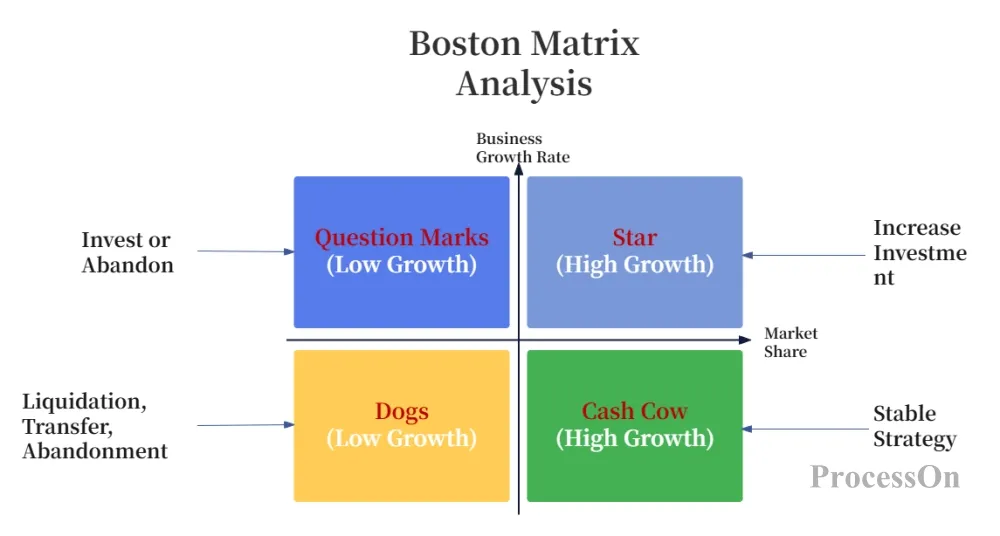
In ProcessOn: Select the "Boston Matrix" template and directly modify the text and icon positions.
The results are displayed from top to bottom: website visitors → number of people adding items to cart → number of people placing orders → successful payments → number of successful transactions. The conversion rate at each step is clearly visible, allowing for priority optimization of any step (link) with significant conversion losses.
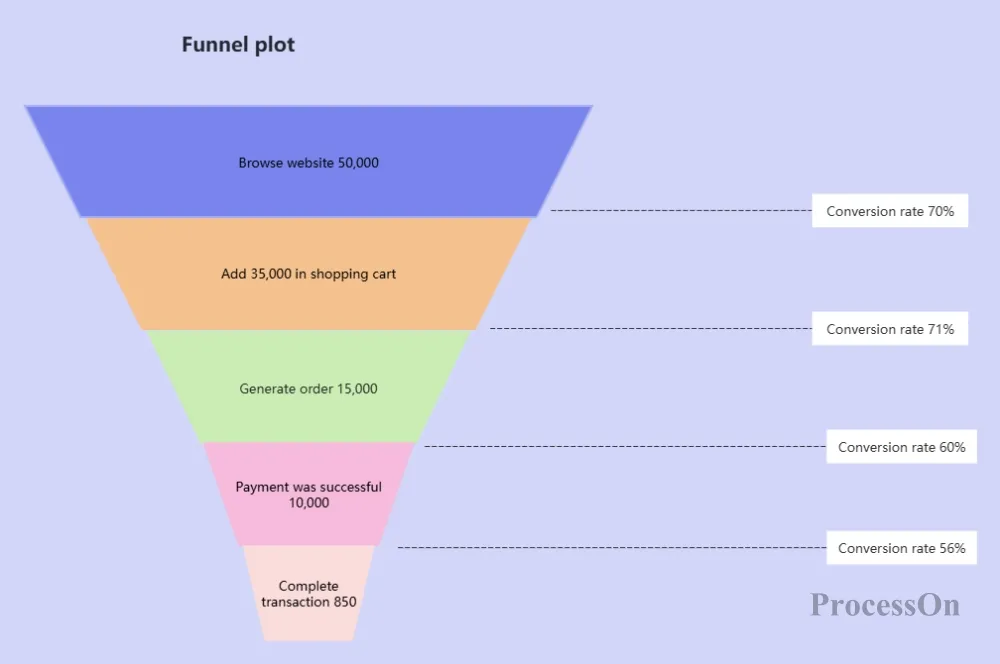
In ProcessOn: Use the "funnel chart" template, fill in the data for each stage, and automatically generate a cone-shaped scale chart.
Arrange annual or quarterly promotional activities on a timeline, noting the goals, channels, budget, and responsible person for each activity. This avoids overlapping activities or resource conflicts and facilitates comparison between planning and execution during post-mortem reviews.
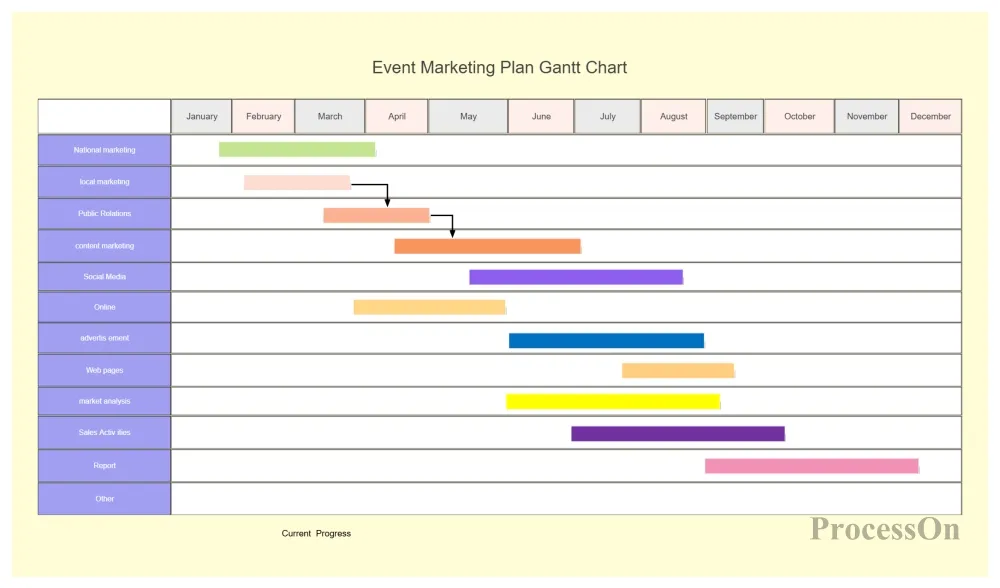
Event Marketing Plan Gantt Chart
In ProcessOn: Use the Gantt chart template to set the task start and end times, dependencies, and completion progress.
Let's say there's a niche brand specializing in "premium drip coffee," primarily selling online, with a relatively high average order value and a moderate repurchase rate. Let's see how to optimize it using the 4Ps.
Product: The coffee beans are of high quality, but the packaging is ordinary and the brewing instructions are unclear.
Price: 15 yuan per packet, more expensive than instant coffee but cheaper than specialty coffee shops, its positioning is awkward.
Channel: Only Taobao store, and it ranks low in search results.
Promotions: Occasionally offer discounts for purchases over a certain amount, but the impact on users is not strong.
product:
The packaging has been redesigned to highlight the concepts of "direct sourcing from the origin" and "premium beans".
Add a brewing guide card (text and images + QR code video).
Introducing the "Flavor Exploration" series (containing sample packs of 3 different beans) to lower the barrier to trying new flavors.
price:
The price per pack remains at 15 yuan, but a subscription model is introduced: 4 boxes per month (10 packs per box) priced at 168 yuan, reducing the price per pack to 14 yuan, thus securing repeat purchases.
A "new user trial pack" (5 packs of different flavors) priced at 49 yuan has been added to attract new users.
channel:
Besides Taobao, we also offer stores on Xiaohongshu and Douyin (TikTok) to drive traffic through content.
Talking about partnerships with office coffee corners and boutique supermarkets to set up offline experience points.
Establish private WeChat groups and offer exclusive member benefits.
Promotion:
Xiaohongshu (Little Red Book): Invited coffee enthusiasts to conduct real reviews, emphasizing the product as an "office energy booster."
TikTok: Shoot 30-second brewing videos, using "freshly ground taste in 10 seconds" as a selling point, and run them as in-feed ads.
Limited-time offer: Free customized coffee mug with your first order; encourage users to share their purchase online.
Membership system: Points redemption for rare beans, birthday discounts
The 4P theory is over half a century old, but it's not outdated. What's truly outdated is mechanically applying it without considering the user value behind each P.
Optimizing your marketing strategy isn't about using the 4Ps for the sake of using the 4Ps, but about using this framework to force yourself to ask the right questions:
Does the product truly solve users' pain points?
Does the price match the value perceived by the user?
Are the channels located where users need them most?
Does the promotional information resonate with users?
Once the answers to these four questions are clear, your marketing strategy will naturally have direction. The value of chart tools lies in visualizing your thought process, enabling the team to share insights, and making decisions more scientific.
In ProcessOn, we've prepared a complete set of templates for you, including the 4P Strategy Canvas, Boston Matrix, Funnel Chart, Gantt Chart, and more. You don't need to start from scratch; you can simply focus on analysis and decision-making.
Go create your first 4P strategy diagram now. Good marketing starts with a clear diagram.