Process Type
Graphical expression
Mind Type
Structured expression
Note Type
Efficient expression
Treemap
Bracket Diagram

Default Mode





In today's business environment, marketing is no longer simply about "selling things," but a complex undertaking requiring meticulous analysis, systematic planning, and scientific execution. To stand out in a highly competitive market, businesses must master proven marketing strategy models. Among these, STP, SWOT, PEST, and the 4Ps are commonly used marketing models . They respectively build a complete bridge from strategy to tactics for businesses across four dimensions: market segmentation and positioning, internal and external competitive environment, macro-environmental scanning, and marketing mix implementation.
This article will analyze these four strategies in depth, explaining their core logic, operational steps, practical examples, and how they work together.
STP is an acronym for Segmentation, Targeting, and Positioning. It was first proposed by marketing scholar Wendell Smith and later popularized by Philip Kotler. The core idea of STP is that businesses cannot serve everyone; they must select the most profitable customer groups where they can best leverage their strengths and build unique brand recognition around them.
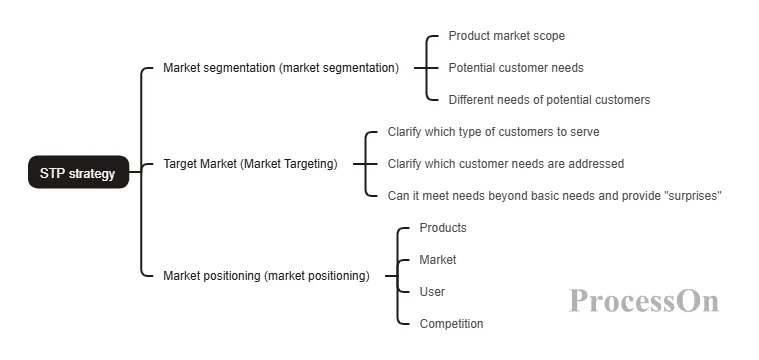
Market segmentation is based on multiple dimensions, which, according to the mind map you provided, mainly include:
Demographic factors: size, age, distribution, ethnicity, income, etc. For example, maternal and infant product companies focus on young parents aged 25-35.
Cultural environment: religious beliefs, education level, and acceptance of cultural norms. For example, in Muslim-majority areas, food companies need to obtain halal certification.
Potential customer needs and differentiated needs: For the same type of product, different customers may have different pain points. For example, some mobile phone buyers value photography, while others value battery life.
In practice, companies often use multi-dimensional segmentation to create "user profiles." For example, a new energy vehicle company might segment its users into "high-income tech enthusiasts in first-tier cities" and "economical family users in second- and third-tier cities."
Within a segmented market, companies need to assess the attractiveness of each sub-market (size, growth potential, competitive intensity) and their own capabilities (resources, technology, brand), and then select one or more as target markets. There are three common strategies:
Undifferentiated marketing: Using one product to cover all markets, such as Coca-Cola in its early days.
Differentiated marketing: Designing different products for different market segments, such as the multiple shampoo brands under Procter & Gamble.
Concentrated marketing: Focus on a niche market, such as Rolls-Royce's focus on ultra-luxury cars.
The mind map specifically emphasizes "clearly defining which customer needs are being addressed" and "whether it can meet needs beyond basic requirements and provide 'surprise'." This means that in target market selection, one should go beyond functional value and pursue emotional and experiential value. For example, Starbucks not only sells coffee but also provides a "third place" social experience.
Positioning is the final output of STP (Strategic Planning), determining all subsequent actions a company takes, including product selection, pricing, distribution channels, and promotions. Positioning can be expanded across multiple dimensions:
Product: Quality, Packaging, Function
Brand: Image, Culture, Personality
Users: Symbol of identity, sense of belonging to a community
Competition: Better, cheaper, and more convenient than competitors.
Price: High-end, Mid-range, Value for Money
For example, Walmart positions itself as offering "everyday low prices," while Apple positions itself as providing "innovation and the ultimate experience." Furthermore, positioning must be based on a company's genuine strengths, not on mere imagination.
The practical significance of STP: Many companies fail not because their products are bad, but because "everyone wants it," and ultimately no one buys it. STP forces companies to simplify, focus resources, and thus build a moat in a niche market.
SWOT analysis is one of the most commonly used tools in corporate strategic planning. It systematically assesses a company's current situation from four dimensions: internal factors (strengths and weaknesses) and external factors (opportunities and threats).

Advantages: technological patents, brand reputation, cost control, channel network, team capabilities, etc. For example, Huawei holds a large number of patents in the 5G field.
Disadvantages include: capital shortage, aging brand, talent loss, and fragile supply chain. For example, some traditional retail companies are clearly lacking in e-commerce capabilities.
The mind map specifically mentions "the development of core competitiveness," which means that advantages are not static and need to be continuously strengthened. Meanwhile, "internal improvement" corresponds to directions for improving weaknesses.
Opportunities include policy support, emerging markets, technological breakthroughs, and changing consumption trends. For example, carbon neutrality policies present significant opportunities for the new energy industry.
Threats include new entrants, substitutes, increased customer negotiating power, rising raw material prices, and negative public opinion. For example, the impact of short video platforms on traditional long video platforms.
The true value of SWOT analysis lies in its cross-analysis to formulate action plans:
SO strategy (Strengths + Opportunities): Maximize the use of internal strengths and external opportunities. For example, pharmaceutical companies with strong R&D capabilities can capitalize on the aging population trend to accelerate the launch of innovative drugs.
ST Strategy (Strengths + Threats): Leveraging strengths to counter threats. For example, high-end restaurant brands use membership systems and service barriers to combat the impact of food delivery platforms.
WO Strategy (Weaknesses + Opportunities): Leveraging external opportunities to compensate for internal weaknesses. For example, a technologically backward manufacturing company can upgrade its production lines by introducing a government-subsidized intelligent transformation project.
WT strategy (Weakness + Threat): Retreat defensively to avoid losses. For example, physical bookstores, facing the impact of e-commerce, close unprofitable stores and shift to experiential bookstores.
Practical advice for SWOT analysis: Many teams tend to treat SWOT analysis as a mere formality, listing numerous vague items. The correct approach is to ensure that each item is specific and verifiable, and to ultimately deliver a concrete action plan, rather than simply drawing a four-quadrant diagram . I recommend using a matrix diagram or fishbone diagram in conjunction with SWOT analysis to clearly identify the intersection of strengths and opportunities.
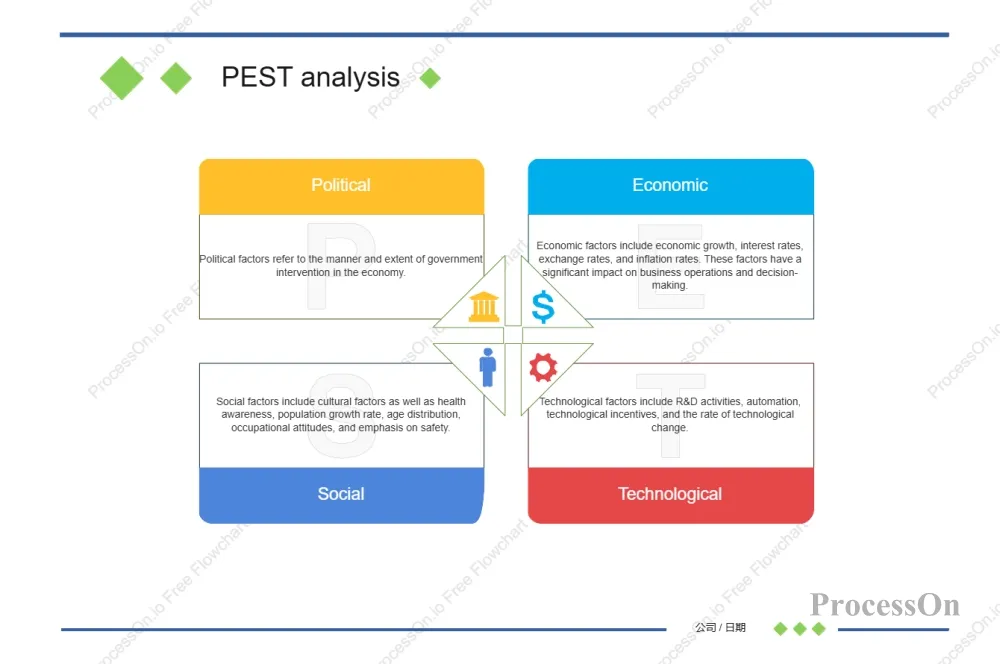
PEST analysis helps businesses scan the external environment from a macro perspective, identifying long-term trends and systemic risks. It is divided into four dimensions: Political, Economic, Social, and Technological. Some extended models also incorporate Legal and Environmental dimensions, but the core remains PEST.
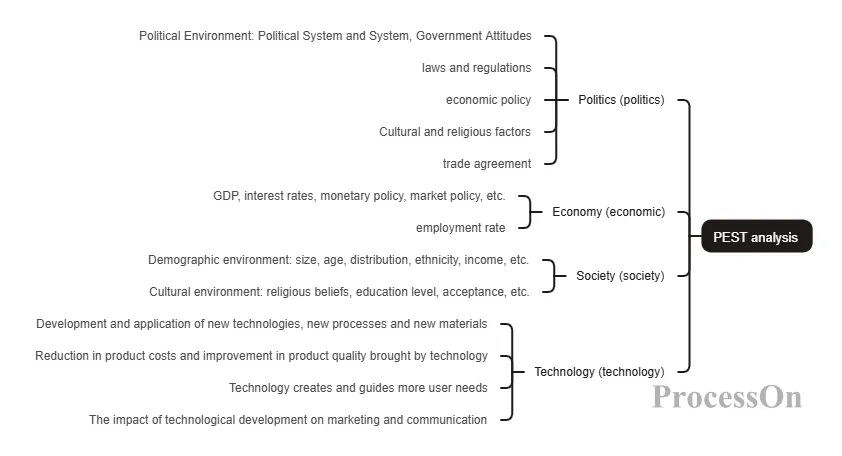
This includes political systems and institutions, government attitudes, laws and regulations, and trade agreements. For example:
Government subsidies or restrictions on a particular industry (such as subsidies for new energy vehicles, or the "double reduction" policy for the education and training industry) ;
Tariff changes resulting from international trade frictions ;
Enterprises must closely monitor policy trends to avoid compliance risks, while making good use of policy benefits.
It covers GDP growth rate, interest rates, monetary policy, market policy, employment rate, inflation, etc. For example:
Rising interest rates will increase corporate financing costs and dampen investment .
High unemployment rates may lead to a decline in consumption, with lower-priced products becoming more popular ;
Currency devaluation benefits export-oriented enterprises but harms enterprises that import raw materials .
Economic cycles directly affect aggregate market demand, and businesses should adjust their production capacity and inventory accordingly.
This includes population size, age structure, ethnic distribution, income distribution, culture and religion, education level, and consumption habits. For example:
Population aging is driving the silver economy: health monitoring equipment, age-friendly homes, and elderly care finance.
With higher levels of education, consumers are paying more attention to product ingredients, environmental protection, and social responsibility.
Social change is usually slow, but once a trend is formed, it can last for many years, making it worthwhile for companies to plan for the long term.
The development and application of new technologies, processes, and materials, as well as the impact of technology on cost, quality, and marketing communication.
Technology brings about reduced product costs and improved product quality: for example, automated production lines and AI-based quality inspection significantly reduce defect rates.
The impact of technological development on marketing and communication: algorithm recommendations, KOL live streaming, and social e-commerce have completely changed the way we reach users.
Technology is both an opportunity and a threat. Kodak invented the digital camera but went bankrupt because it stuck with film, and Nokia fell behind in the smartphone era. These are painful lessons from ignoring the technological environment.
Practical tips for PEST analysis: With numerous macroeconomic factors at play, companies should select key variables based on their industry. For example, luxury retailers focus on the size of the high-income population and consumer confidence (economic + social), while chip design companies focus on export control policies (political) and advancements in lithography technology (technological). Furthermore, PEST is often combined with SWOT analysis: the output of PEST serves as the input for the "Opportunities and Threats" section of SWOT.
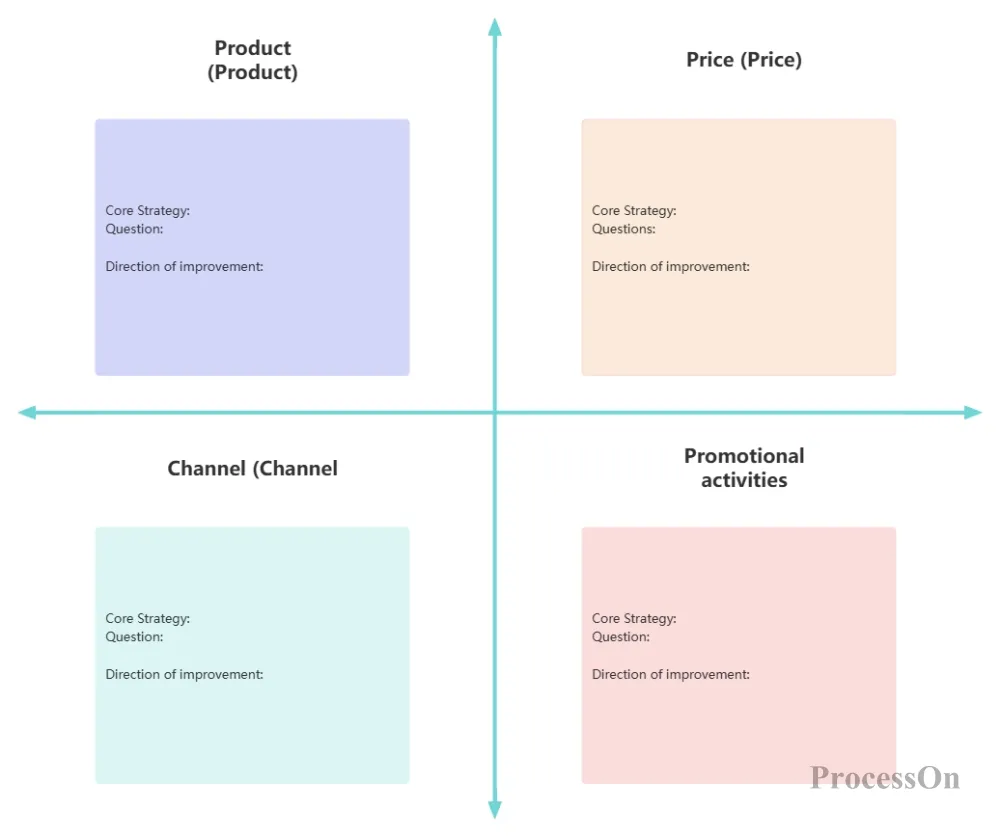
The 4Ps theory, proposed by McCarthy in 1960, is the most classic framework for marketing tactics. It breaks down marketing activities into four controllable variables: Product, Price, Place, and Promotion. Later, modified models such as the 4Cs (Customer, Cost, Convenience, Communication) were proposed, but the 4Ps, due to their simplicity and completeness, remain the foundation for companies to develop marketing plans.
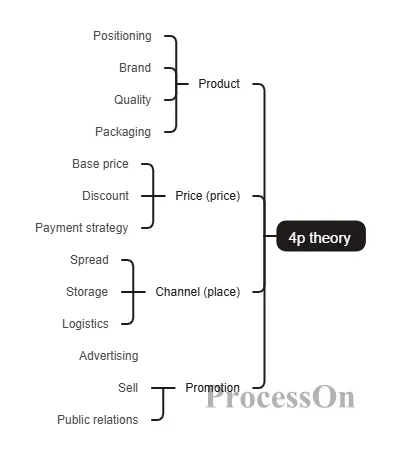
The product is the core of marketing. The mind map mentions:
Quality, packaging, and brand: these are the fundamental elements of a product. Good packaging enhances the unboxing experience, while a brand carries emotional value.
Can it meet needs beyond basic requirements and provide "surprises"? For example, the Dyson hair dryer not only dries hair (a basic requirement), but also brings the surprise of "technological aesthetics" through its high-speed digital motor and design .
Technology creates and drives more user demand: Apple's touchscreens and App Store ecosystem create demand for mobile applications and a vast amount of content.
Product strategy also includes product portfolio, product lifecycle management, and new product development. Companies should regularly review: Do existing products still match the target market? Do they need to be iterated or phased out?
Price directly affects sales volume and profits.
Base price: also known as the listed price, reflects the brand's positioning. The base price of luxury goods is much higher than the cost, while that of fast-moving consumer goods is close to the cost.
Discounts: Promotional discounts, seasonal discounts, quantity discounts, etc. Discounts can stimulate short-term sales, but overuse can damage brand value.
Payment strategies include installment payments, subscriptions, and try-before-you-buy. For example, the software industry commonly uses the SaaS subscription model, which lowers the barrier to entry for users making a one-time payment.
Pricing methods include cost-oriented (cost-plus pricing), competition-oriented (following competitors), and value-oriented (based on perceived value).
Channels (or "locations") include storage, logistics, and distribution networks. In the era of online-offline integration, supply chain efficiency has become a core competitive advantage.
Traditional channels: distributors, retailers, and directly operated stores.
Digital channels: e-commerce platforms (Tmall, Amazon), social e-commerce ( Douyin, Xiaohongshu ).
Channel selection depends on product characteristics, target customer habits, and cost structure. For example, fresh produce requires cold chain logistics and short-term delivery, making it suitable for a forward warehouse model; while standardized electronic products can be widely distributed both online and offline.
Promotions are not simply "discounts" in the narrow sense, but rather all activities that convey value to a target audience and persuade them to buy. This includes :
Advertising: Brand advertising (enhancing brand awareness), performance advertising (direct conversion).
Sales promotion: Personal selling, applicable to B2B or high-value products (such as industrial equipment, real estate).
Public Relations: Press releases, charitable activities, crisis management, and brand image building.
Communication: Social media content, KOL collaborations, and user word-of-mouth. Many companies now treat "communication" as a separate module because the interactivity and precision of digital communication far surpass that of traditional advertising.
A good promotional strategy requires integrating multiple tools to create a synergistic effect. For example, before launching a new product, public relations can generate buzz, followed by short video ads to generate attention, while e-commerce platforms offer limited-time discounts, and offline pop-up stores enhance the experience.
The 4Ps integrated approach: The 4Ps are not isolated; adjusting any one P will affect the others. For example, if a product is positioned as high-end, then the price should be high, the distribution channels should be carefully selected (excluding discount stores), and promotions should emphasize quality rather than low prices. Maintaining consistency across the 4Ps is key to effective marketing execution.
Many beginners tend to treat these four models as independent tools, but in reality, they form a progressive system:
The PEST analysis is conducted first to identify long-term trends and potential opportunities/threats in the macro environment.
SWOT analysis, combined with the findings of PEST analysis and internal capability assessment, clarifies the company's current strengths, weaknesses, opportunities, and threats.
The STP strategy is based on the results of SWOT analysis and selects the most suitable target market and positioning for the enterprise.
The 4P combination translates the positioning determined by STP into concrete implementation through product, price, place, and promotion.
The four models described above would be abstract if presented in plain text; however, using ProcessOn charting tools such as matrix diagrams and SWOT charts, the team can understand them more quickly and execute them more accurately. Below are some marketing chart templates from the ProcessOn template community that you can directly clone and use.
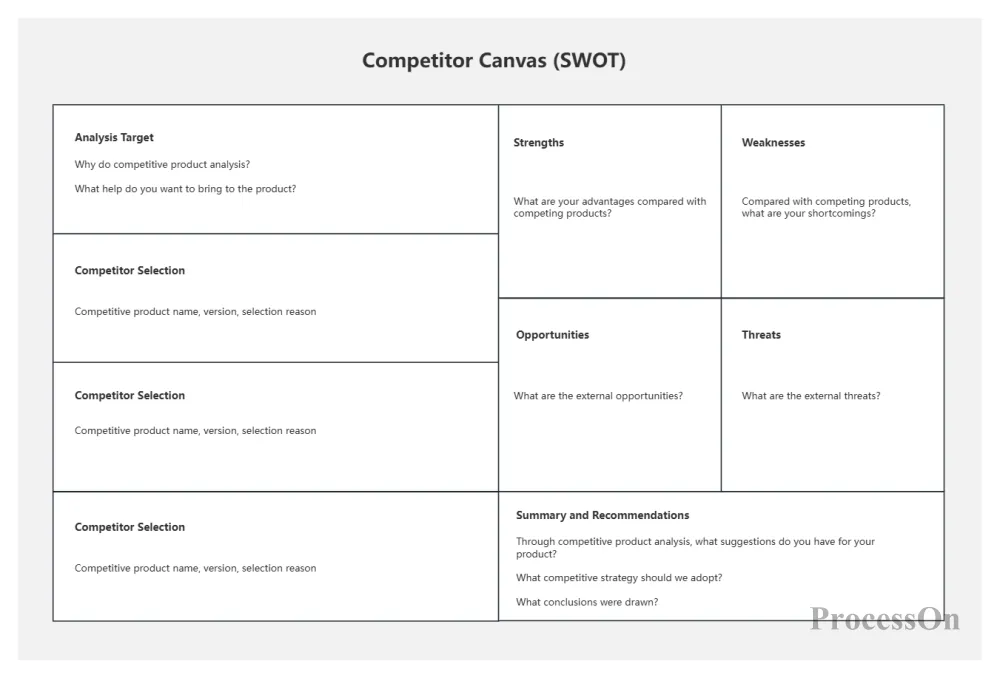
Competitive Analysis - SWOT Analysis
Whether you're a startup or an established brand, whether you sell physical products or digital services, you can start with these four models to build your own marketing strategy system. Hopefully, this article provides you with a clear roadmap. In your future work, try using charting tools to visualize and implement these models, truly translating your strategies into growth.