Register
Process Type
Graphical expression
Mind Type
Structured expression
Note Type
Efficient expression
Home Page Blog UML Diagram
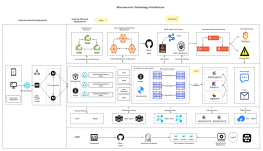
6 types of charts that backend developers must master
In backend development, code solves the "how" problem, while diagrams solve the "what" and "why" problems. This article addresses the unique pain points of backend development by outlining six types of diagrams that truly solve these problems : microservice topology diagrams, sequence diagrams, deployment diagrams, ER diagrams, data flow diagrams, and architecture diagrams.
Essential charts for front-end software development : From requirements to deployment
In front-end development, coding only accounts for one-third of the workload—the remaining two-thirds involve understanding requirements, designing architecture, aligning solutions, and troubleshooting. This article takes a practical approach, outlining eight essential chart types to master throughout the entire front-end development process , from requirements analysis to architecture design, from code modeling to deployment and maintenance .
AI-generated professional-grade UML class diagrams - generated in 10 seconds, with continuous optimization.
A class diagram is the most important static structural diagram in UML (Unified Modeling Language). It is used to describe the classes, interfaces, and static relationships between them in a system. Whether you are designing a system, writing technical documentation, or aligning architectural ideas with your team, you cannot avoid it. Today, I will share how to use ProcessOn AI to generate a complete and accurate UML class diagram in just a few seconds.
Generate professional-grade UML sequence diagrams quickly using AI in three simple steps.
Sequence diagrams, also known as sequence diagrams, are a type of interaction diagram in UML (Unified Modeling Language). They are primarily used to illustrate the process of messages being passed between objects in chronological order. ProcessOn AI recently upgraded its sequence diagram generation capabilities, allowing you to directly input your requirements and have AI instantly generate professional-grade sequence diagrams, letting you truly focus your energy on the design of sequence diagrams themselves.
A must-read for beginners: UML Introduction
UML (Unified Modeling Language) is a universal visual modeling language standard used to describe, visualize, construct and document software system artifacts. This article will explain UML from the perspective of its concept, meaning, and composition. Through this basic introduction, I believe that you will not only be able to deeply understand the historical context of UML, but also master its wide application in demand analysis, system design, and documentation.
How to draw UML Activity Diagrams? Tutorials and examples in software development
Activity diagram is an important behavior modeling tool in UML . It is mainly used to describe a series of activities or operations in a system or business process . It emphasizes the control flow between objects, can clearly show how a series of activities or operations are executed in a specific order, and supports the representation of concurrency and synchronization. This article will mainly explain the practical application and drawing tutorial of UML activity diagram in software development.
How to create a UML use case diagram? Tutorial and examples
UML use case diagram is one of the commonly used diagrams for product managers and technicians . It is the product of demand analysis and is widely used in the demand analysis stage of software development. It describes the functions of the system and the interaction between the user and the system in a graphical way . With the help of the use case diagram, participants can discuss the problem in a visual way, which can reduce a lot of communication barriers. Next, we will discuss and learn the use case diagram in combination with the use case diagram example in ProcessOn .
UML use case diagram beginner's guide - concepts, components and examples
The UML use case diagram is a view used to describe system functions, consisting of actors, use cases, and the relationships between them. It is a model of system functions that can be observed by external users called actors. Figure. Use case diagrams are often used in the requirements analysis phase. This article will explain the purpose and composition of use case diagrams in detail.
2025-03-07
What is a UML sequence diagram? Attached tutorial and examples
A sequence diagram is a UML interaction diagram. It shows the dynamic collaboration between multiple objects by describing the time sequence of messages sent between objects. It is widely used in almost all industries to sort out business processes and make the business look clear and easy to understand. This article will explain the definition of UML sequence diagram, drawing tutorials and case sharing.
UML diagram complete guide: Master 14 types of UML diagrams in 10 minutes
This article uses the ProcessOn drawing tool to quickly and comprehensively explain what a UML diagram is? UML diagrams are divided into types and the conceptual uses of each diagram. Learn to use this tool efficiently to improve development efficiency and quality.
2025-03-03
1 2