

Money and Monetary System
1 Report
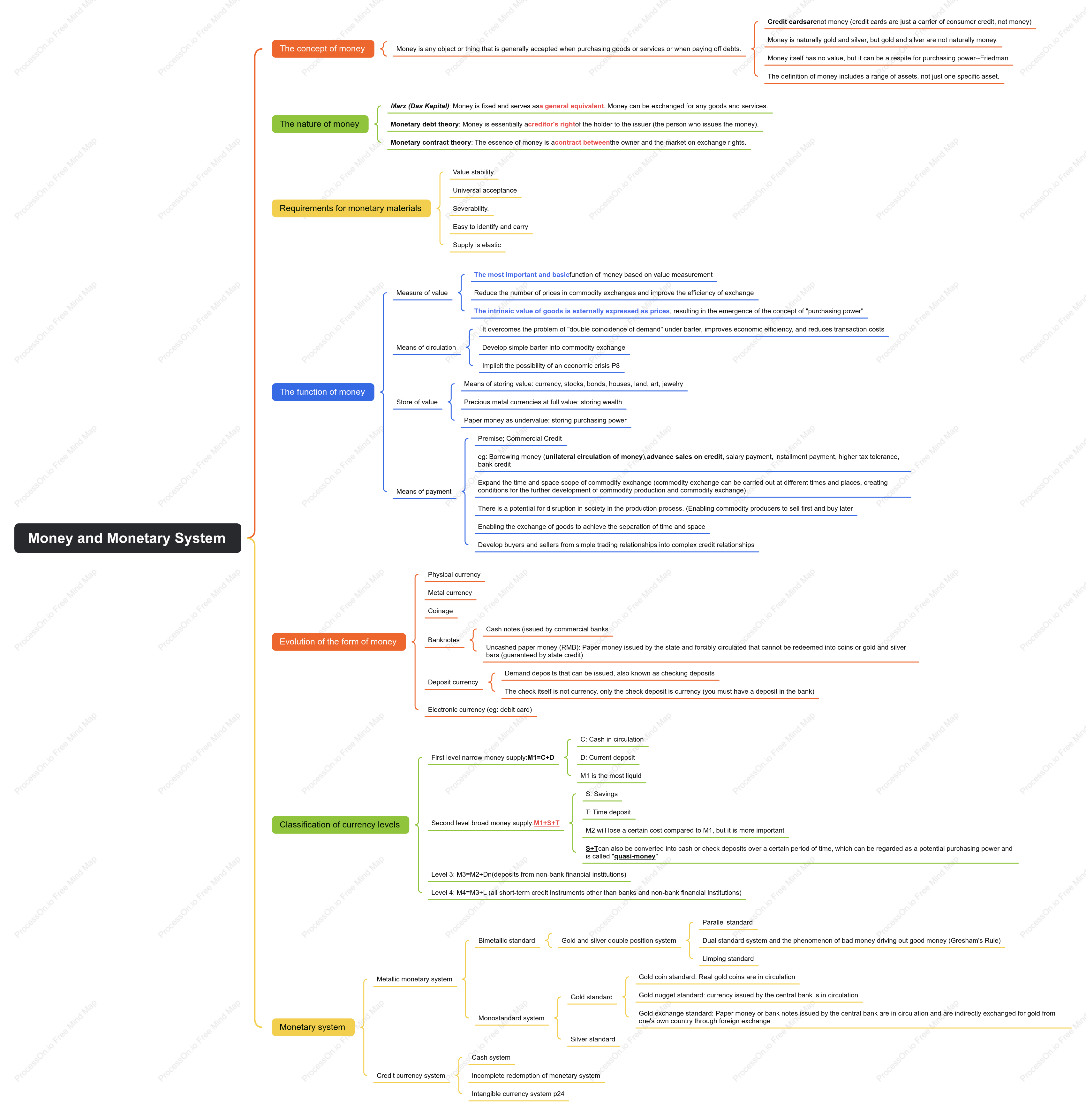
This mind map outlines the origin, essence, and functions of money, as well as the evolution of monetary systems. It covers the evolution of money from commodity money and metallic money to credit money, focusing on the five basic functions of money (measure of value, medium of exchange, store of value, means of payment, and world money), and the core components of a monetary system (monetary metal, monetary unit, standard coin and subsidiary coin, issuance reserves, and free convertibility). The map also systematically demonstrates the complete evolution from the silver standard, bimetallic standard, gold standard (gold coin standard, gold bullion standard, gold exchange standard) to the modern credit money system, facilitating an understanding of the internal logic and historical development of monetary systems.
Related Recommendations
Other works by the author
Outline/Content
See more
The concept of money
Money is any object or thing that is generally accepted when purchasing goods or services or when paying off debts.
Credit cardsarenot money (credit cards are just a carrier of consumer credit, not money)
Money is naturally gold and silver, but gold and silver are not naturally money.
Money itself has no value, but it can be a respite for purchasing power--Friedman
The definition of money includes a range of assets, not just one specific asset.
The nature of money
Marx (Das Kapital): Money is fixed and serves asa general equivalent. Money can be exchanged for any goods and services.
Monetary debt theory: Money is essentially acreditor's rightof the holder to the issuer (the person who issues the money).
Monetary contract theory: The essence of money is acontract betweenthe owner and the market on exchange rights.
Requirements for monetary materials
Value stability
Universal acceptance
Severability.
Easy to identify and carry
Supply is elastic
The function of money
Measure of value
The most important and basicfunction of money based on value measurement
Reduce the number of prices in commodity exchanges and improve the efficiency of exchange
The intrinsic value of goods is externally expressed as prices, resulting in the emergence of the concept of "purchasing power"
Means of circulation
It overcomes the problem of "double coincidence of demand" under barter, improves economic efficiency, and reduces transaction costs
Develop simple barter into commodity exchange
Implicit the possibility of an economic crisis P8
Store of value
Means of storing value: currency, stocks, bonds, houses, land, art, jewelry
Precious metal currencies at full value: storing wealth
Paper money as undervalue: storing purchasing power
Means of payment
Premise; Commercial Credit
eg: Borrowing money (unilateral circulation of money),advance sales on credit, salary payment, installment payment, higher tax tolerance, bank credit
Expand the time and space scope of commodity exchange (commodity exchange can be carried out at different times and places, creating conditions for the further development of commodity production and commodity exchange)
There is a potential for disruption in society in the production process. (Enabling commodity producers to sell first and buy later
Enabling the exchange of goods to achieve the separation of time and space
Develop buyers and sellers from simple trading relationships into complex credit relationships
Evolution of the form of money
Physical currency
Metal currency
Coinage
Banknotes
Cash notes (issued by commercial banks
Uncashed paper money (RMB): Paper money issued by the state and forcibly circulated that cannot be redeemed into coins or gold and silver bars (guaranteed by state credit)
Deposit currency
Demand deposits that can be issued, also known as checking deposits
The check itself is not currency, only the check deposit is currency (you must have a deposit in the bank)
Electronic currency (eg: debit card)
Classification of currency levels
First level narrow money supply:M1=C+D
C: Cash in circulation
D: Current deposit
M1 is the most liquid
Second level broad money supply:M1+S+T
S: Savings
T: Time deposit
M2 will lose a certain cost compared to M1, but it is more important
S+Tcan also be converted into cash or check deposits over a certain period of time, which can be regarded as a potential purchasing power and is called "quasi-money"
Level 3: M3=M2+Dn(deposits from non-bank financial institutions)
Level 4: M4=M3+L (all short-term credit instruments other than banks and non-bank financial institutions)
Monetary system
Metallic monetary system
Bimetallic standard
Gold and silver double position system
Parallel standard
Dual standard system and the phenomenon of bad money driving out good money (Gresham's Rule)
Limping standard
Monostandard system
Gold standard
Gold coin standard: Real gold coins are in circulation
Gold nugget standard: currency issued by the central bank is in circulation
Gold exchange standard: Paper money or bank notes issued by the central bank are in circulation and are indirectly exchanged for gold from one's own country through foreign exchange
Silver standard
Credit currency system
Cash system
Incomplete redemption of monetary system
Intangible currency system p24
Collect
Collect
Collect

Collect

0 Comments
Next Page