
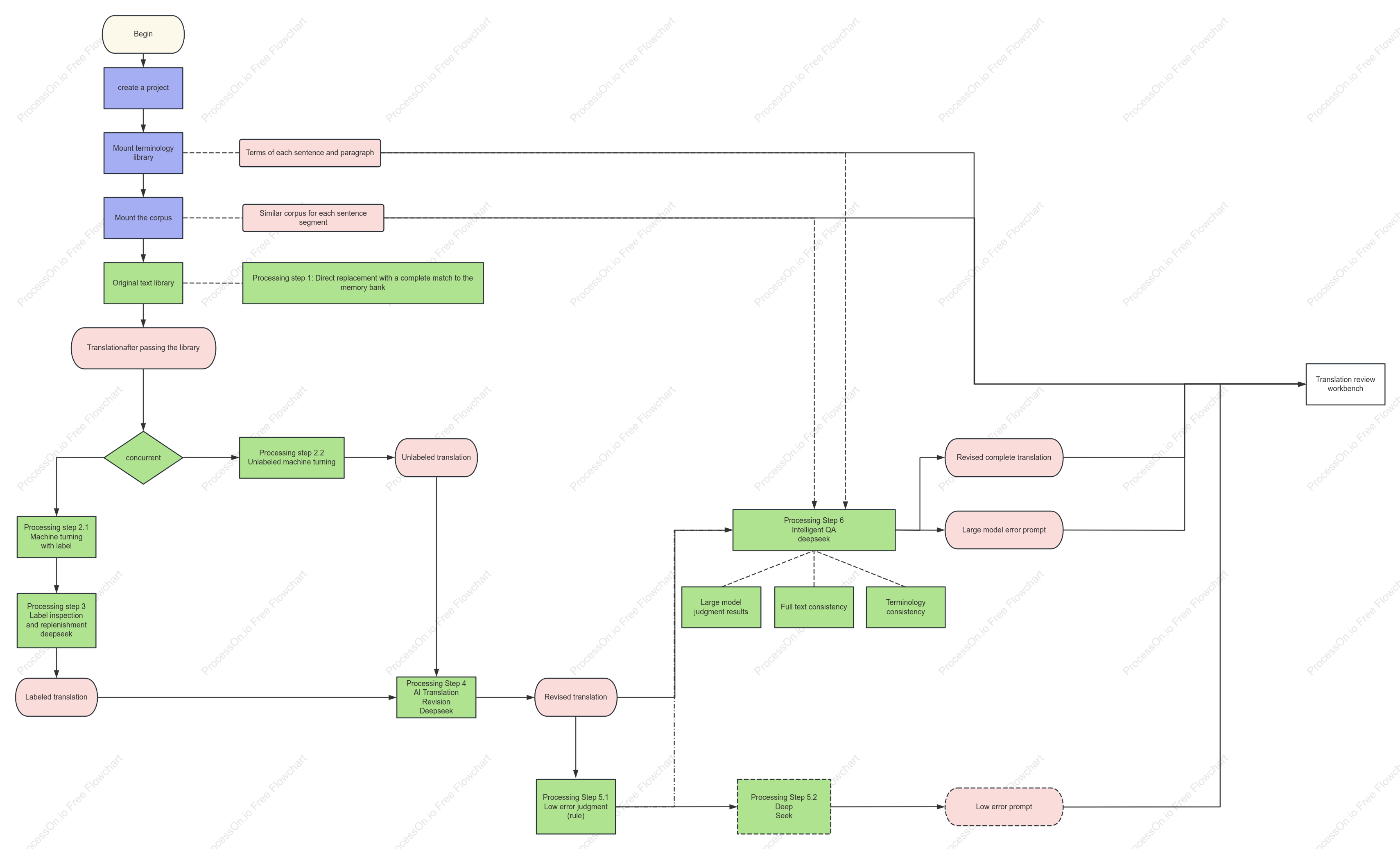

Intelligent Translation Workflow: Small Model Translation with Large Model Review
0 Report
This diagram illustrates an intelligent translation workflow featuring "small model translation and large model review." The process begins with project creation and source material acquisition, followed by an initial translation generated by a small model. A quality assessment ensues: if the output meets standards, a standard initial draft is produced; otherwise, the text undergoes a refinement phase. The core of the system lies in the large model (DeepSeek) polishing stage, which integrates contextual elements—such as project-specific system prompts, full-text information, and translation memory—to generate a polished translation. Finally, the text undergoes another quality assessment; if it passes, the final draft is generated, whereas any remaining issues trigger a loop back to the polishing stage for further iteration. This approach leverages the large model's deep comprehension capabilities to significantly enhance the accuracy of the small model's initial translation.
Related Recommendations
Other works by the author
Outline/Content
See more
create a project
Unlabeled translation
Terms of each sentence and paragraph
Similar corpus for each sentence segment
Processing step 2.1Machine turning with label
Translation review workbench
Processing step 2.2Unlabeled machine turning
Large model judgment results
Full text consistency
Processing Step 4AI Translation RevisionDeepseek
Revised translation
Low error prompt
Processing step 1: Direct replacement with a complete match to the memory bank
Mount terminology library
Processing Step 5.2DeepSeek
Processing step 3Label inspection and replenishmentdeepseek
Original text library
Terminology consistency
Large model error prompt
Mount the corpus
Processing Step 5.1Low error judgment(rule)
Revised complete translation
concurrent
Begin
Translationafter passing the library
Labeled translation
Processing Step 6Intelligent QAdeepseek
Collect
Collect
Collect
Collect
Collect
Collect
Collect

0 Comments
Next Page