
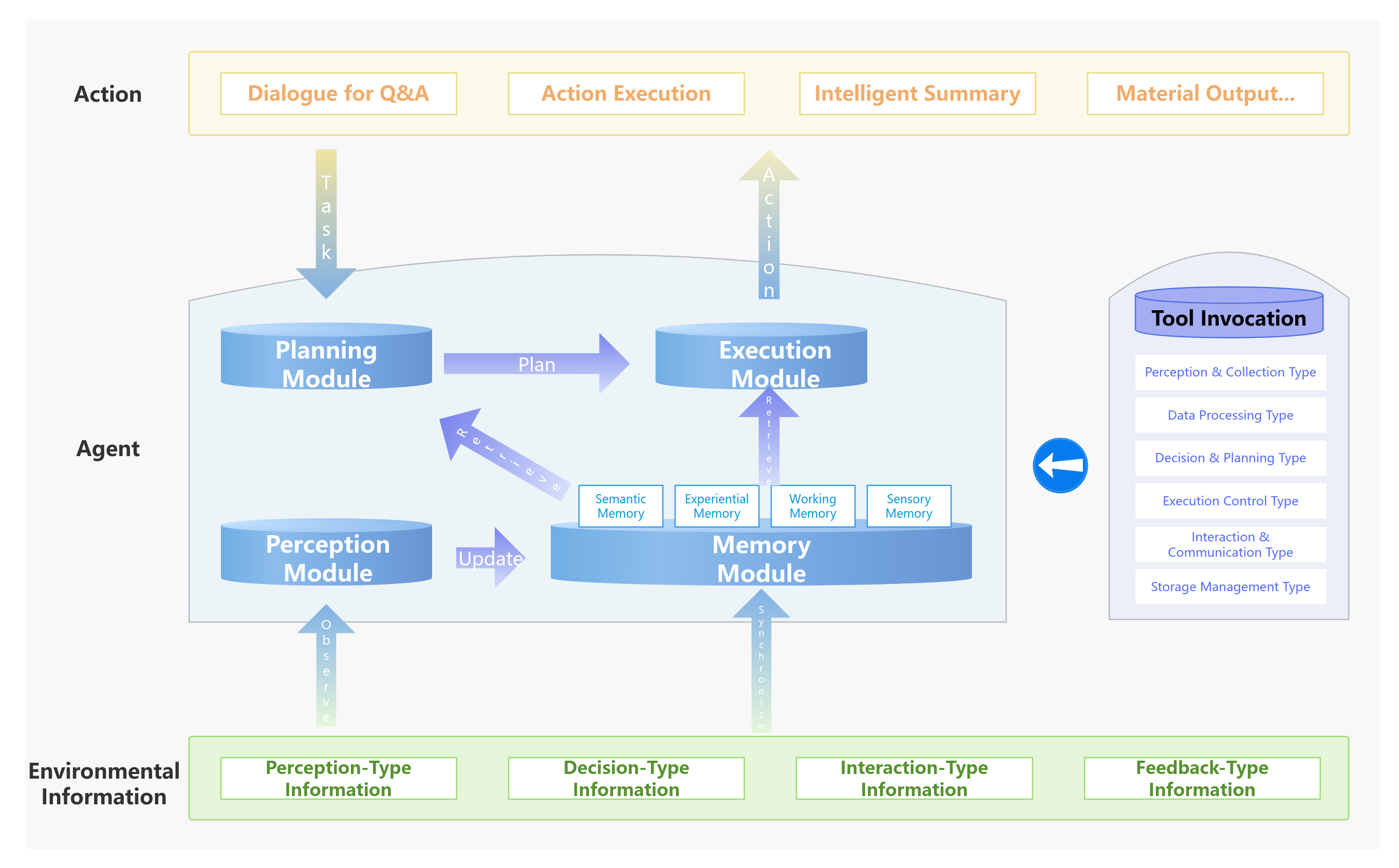

Intelligent agent architecture diagram
2 Report
This diagram illustrates the core operational architecture of the intelligent agent, divided into three main layers and one tool support area: 1. Action Layer: Contains specific task directions such as question-and-answer dialogue and action execution, issuing tasks to the intelligent agent; 2. Core Layer of the Intelligent Agent: The planning module receives tasks and formulates plans, the execution module executes actions based on the plans (combined with the retrieved content from the memory module); the perception module observes environmental information and synchronously updates the memory module, which also provides perception support for the planning module; 3. Environmental Information Layer: Provides perception, decision-making, interaction, and feedback information as the input source for the intelligent agent; 4. Tool Invocation Area: Contains tools for perception acquisition, data processing, etc., interacting with the intelligent agent and supporting the operation of its various modules.
Related Recommendations
Other works by the author
Outline/Content
See more
Agent
Interaction & Communication Type
Perception-Type Information
Intelligent Summary
Observe
Memory Module
Dialogue for Q&A
Storage Management Type
Synchronize
Action
Experiential Memory
Feedback-Type Information
Perception & Collection Type
Retrieve
Working Memory
Environmental Information
Data Processing Type
Sensory Memory
Perception Module
Semantic Memory
Action Execution
Decision-Type Information
Plan
Interaction-Type Information
Material Output...
Decision & Planning Type
Planning Module
Task
Execution Control Type
Tool Invocation
Execution Module
Update
Collect
Collect
Collect
Collect
Collect

0 Comments
Next Page