
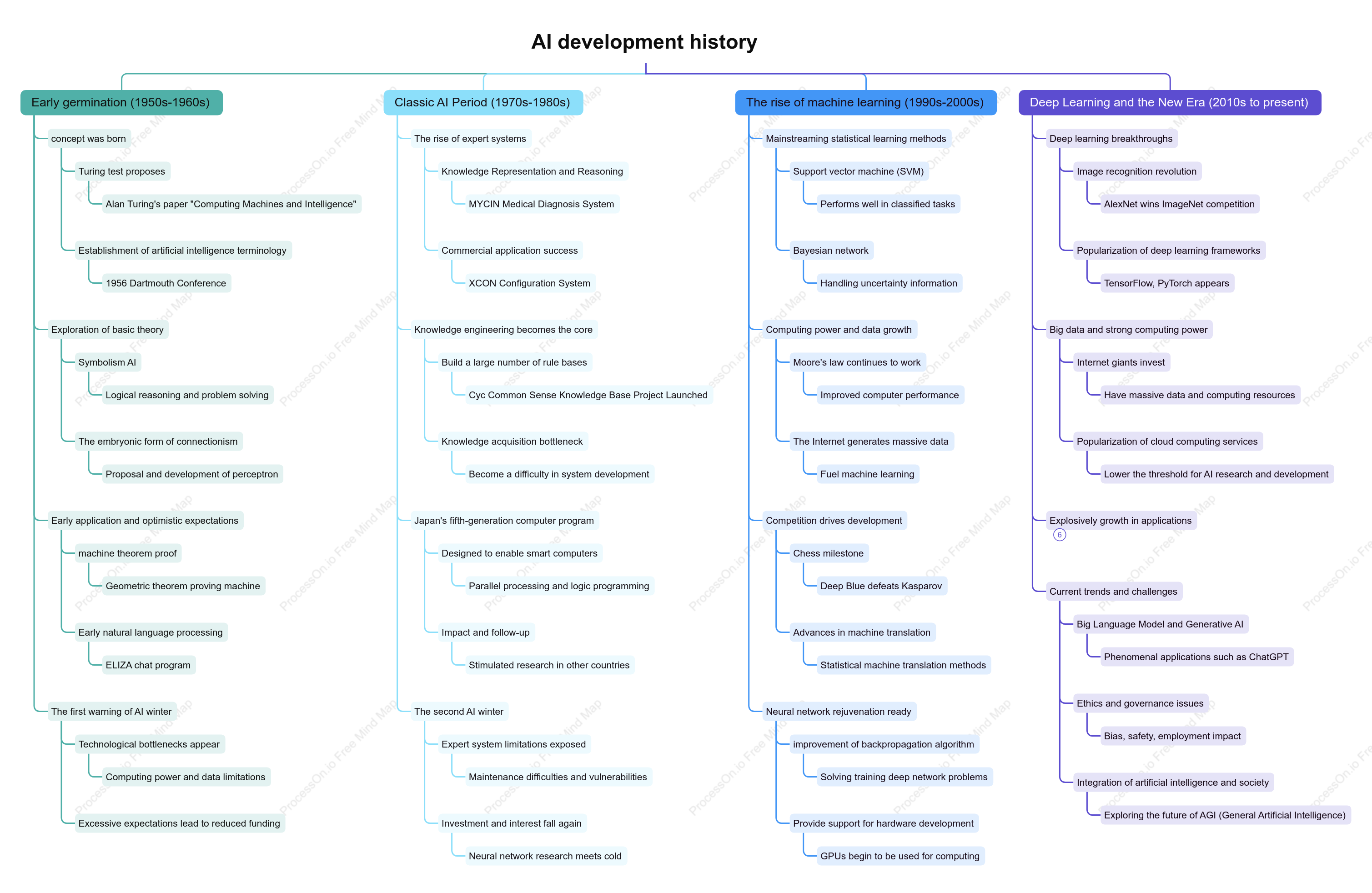

AI development history
0 Report
This template systematically outlines the complete evolution of artificial intelligence from its theoretical inception to its current flourishing development, aiming to help learners, researchers, and practitioners quickly grasp the iterative trajectory, key breakthroughs, and future trends of AI technology. The template uses a timeline as its main framework, dividing development into several important stages (such as symbolism, expert systems, machine learning, deep learning, and generative AI). Each stage covers key dimensions such as core technologies, landmark events, key figures, application results, and limitations. Through this structured framework, it ensures a clear, focused, and causal overview of AI development history, avoiding fragmented or subjective chronological summaries and providing a solid historical perspective for technological understanding, academic research, and industry judgment.
Related Recommendations
Other works by the author
Outline/Content
See more
Early germination (1950s-1960s)
concept was born
Turing test proposes
Alan Turing's paper "Computing Machines and Intelligence"
Establishment of artificial intelligence terminology
1956 Dartmouth Conference
Exploration of basic theory
Symbolism AI
Logical reasoning and problem solving
The embryonic form of connectionism
Proposal and development of perceptron
Early application and optimistic expectations
machine theorem proof
Geometric theorem proving machine
Early natural language processing
ELIZA chat program
The first warning of AI winter
Technological bottlenecks appear
Computing power and data limitations
Excessive expectations lead to reduced funding
Classic AI Period (1970s-1980s)
The rise of expert systems
Knowledge Representation and Reasoning
MYCIN Medical Diagnosis System
Commercial application success
XCON Configuration System
Knowledge engineering becomes the core
Build a large number of rule bases
Cyc Common Sense Knowledge Base Project Launched
Knowledge acquisition bottleneck
Become a difficulty in system development
Japan's fifth-generation computer program
Designed to enable smart computers
Parallel processing and logic programming
Impact and follow-up
Stimulated research in other countries
The second AI winter
Expert system limitations exposed
Maintenance difficulties and vulnerabilities
Investment and interest fall again
Neural network research meets cold
The rise of machine learning (1990s-2000s)
Mainstreaming statistical learning methods
Support vector machine (SVM)
Performs well in classified tasks
Bayesian network
Handling uncertainty information
Computing power and data growth
Moore's law continues to work
Improved computer performance
The Internet generates massive data
Fuel machine learning
Competition drives development
Chess milestone
Deep Blue defeats Kasparov
Advances in machine translation
Statistical machine translation methods
Neural network rejuvenation ready
improvement of backpropagation algorithm
Solving training deep network problems
Provide support for hardware development
GPUs begin to be used for computing
Deep Learning and the New Era (2010s to present)
Deep learning breakthroughs
Image recognition revolution
AlexNet wins ImageNet competition
Popularization of deep learning frameworks
TensorFlow, PyTorch appears
Big data and strong computing power
Internet giants invest
Have massive data and computing resources
Popularization of cloud computing services
Lower the threshold for AI research and development
Explosively growth in applications
自然语言处理飞跃
Transformer模型与BERT, GPT
计算机视觉无处不在
人脸识别、自动驾驶
AI走出实验室
推荐系统、智能助手
Current trends and challenges
Big Language Model and Generative AI
Phenomenal applications such as ChatGPT
Ethics and governance issues
Bias, safety, employment impact
Integration of artificial intelligence and society
Exploring the future of AGI (General Artificial Intelligence)
Collect
Collect
Collect
Collect
Collect
Collect

0 Comments
Next Page