
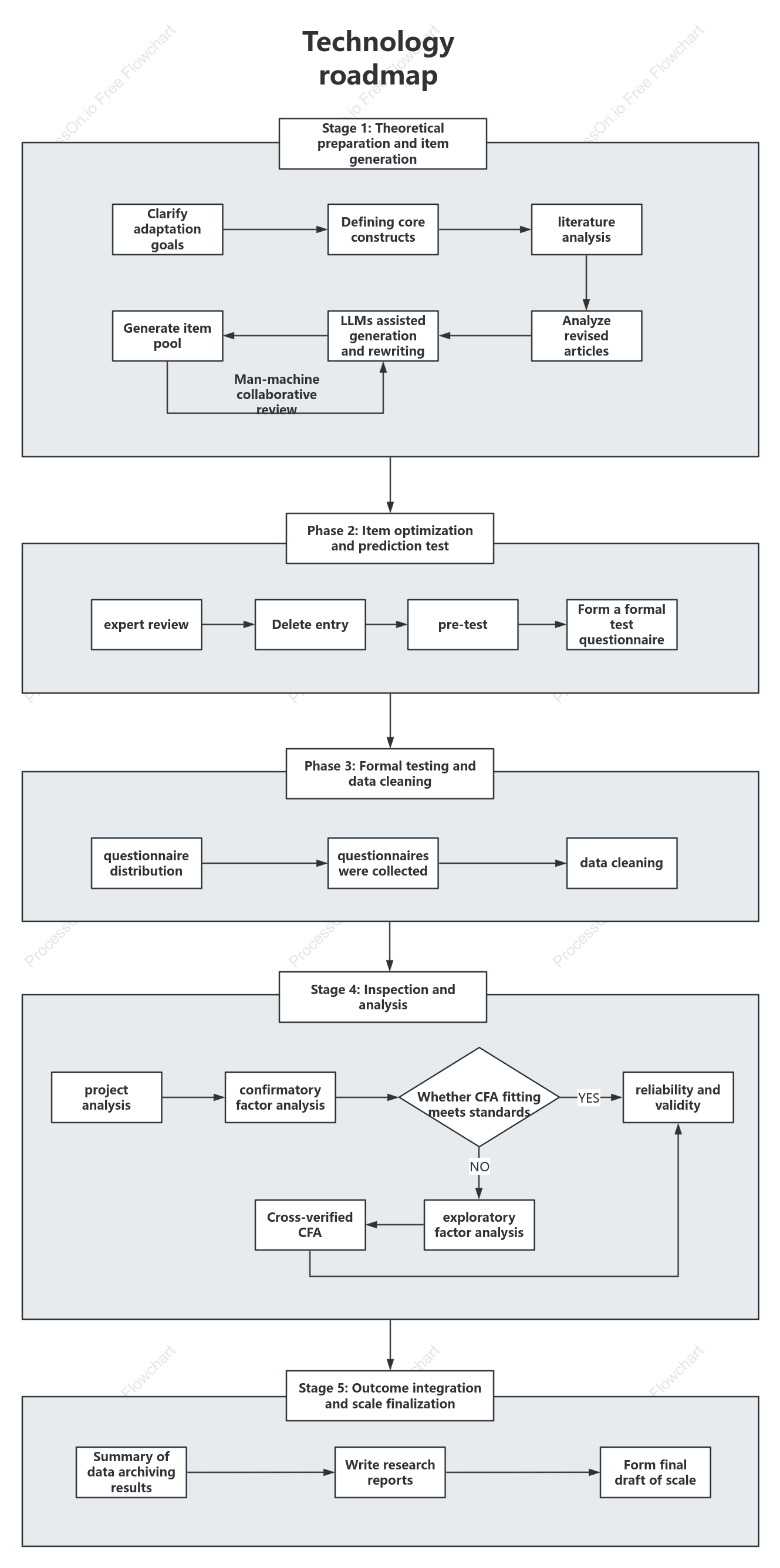

Psychological Test Development and Validation Workflow
0 Report
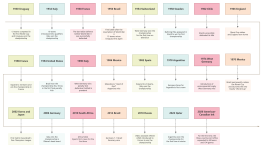
This flowchart outlines the technical roadmap for developing and validating a psychological test, with the process rigorously divided into four stages. The first stage involves theoretical preparation and item generation: core concepts are defined through literature analysis, items are generated and refined with the assistance of LLAG, and an item pool is established through human-AI collaborative review. The second stage focuses on item optimization and pre-testing: items undergo expert review and revision before a small-scale pre-test is conducted to finalize the questionnaire for formal administration. The third stage covers formal administration and data cleaning, encompassing the distribution and collection of questionnaires as well as data processing. The fourth stage entails testing and analysis: item analysis and confirmatory factor analysis (CFA) are performed sequentially; if CFA fit indices do not meet standards, exploratory factor analysis and cross-validation CFA are conducted until the model meets the criteria, followed by final reliability and validity testing to ensure the test's scientific rigor and reliability.
Related Recommendations
Other works by the author
Outline/Content
See more
project analysis
Summary ofdata archiving results
Phase 3: Formal testing and data cleaning
Delete entry
Clarify adaptation goals
expert review
data cleaning
Defining core constructs
Form a formal test questionnaire
Stage 5: Outcome integration and scale finalization
pre-test
Man-machine collaborative review
Form final draft of scale
Stage 4: Inspection and analysis
LLMs assisted generation and rewriting
exploratory factor analysis
Technology roadmap
Generate item pool
questionnaire distribution
Cross-verified CFA
NO
YES
Write research reports
Analyze revised articles
reliability and validity
questionnaires were collected
Whether CFA fitting meets standards
confirmatory factor analysis
Phase 2: Item optimization and prediction test
literature analysis
Stage 1: Theoretical preparation and item generation
Collect
Collect
Collect
Collect
Collect
Collect
Collect

0 Comments
Next Page