

Japanese Parts of Speech
0 Report
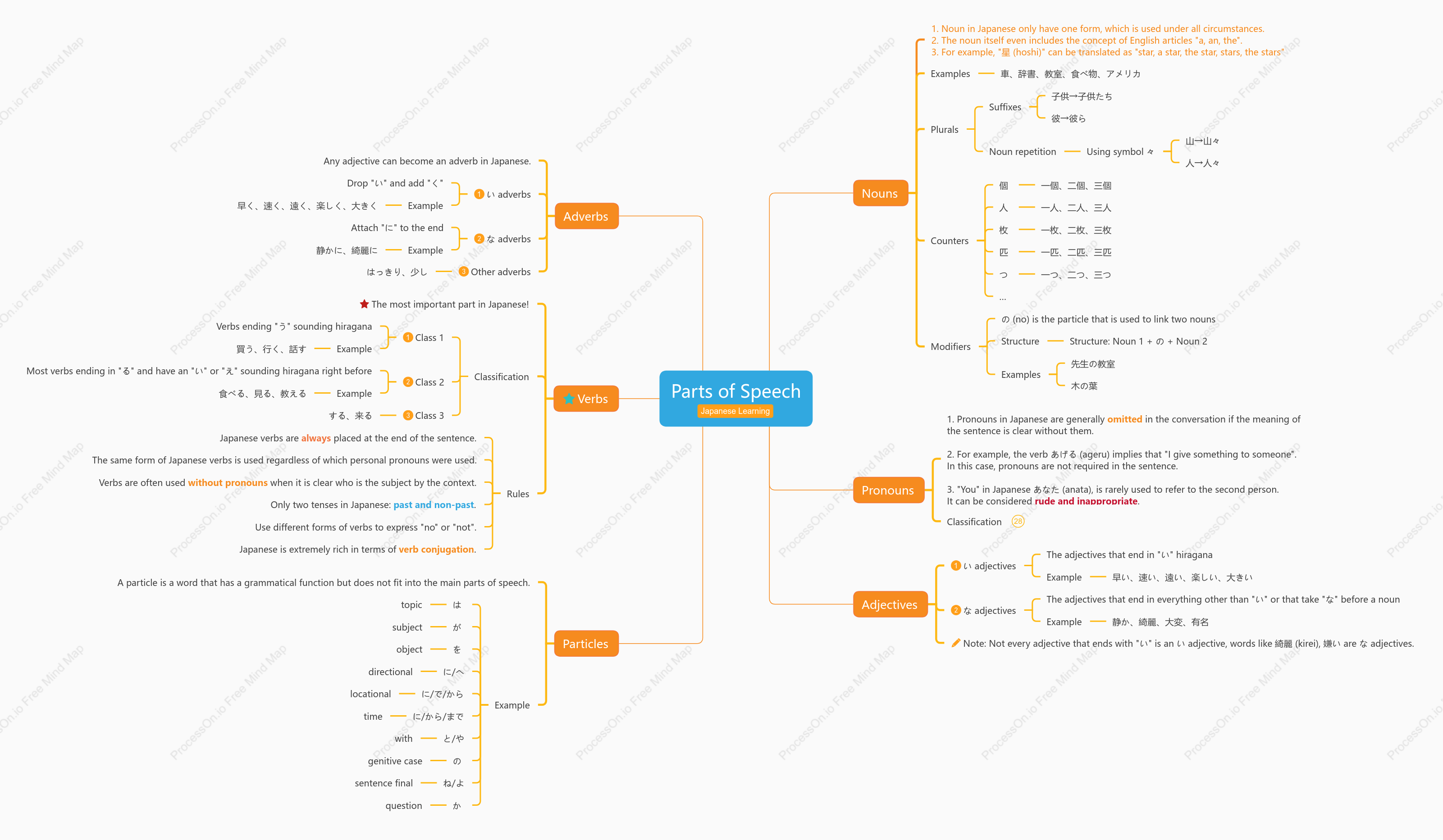
Japanese words are typically categorized into 10 to 12 parts of speech, mainly divided into independent words (words with actual meaning that can function as a separate part of speech) and adjunctive words (words without independent meaning that are attached to other words). The core parts of speech include nouns, verbs, adjectives (い形), adjectival verbs (な形), adverbs, attributive words, conjunctions, interjections, auxiliary verbs, and particles.
Related Recommendations
Other works by the author
Outline/Content
See more
Nouns
- Noun in Japanese only have one form, which is used under all circumstances.
- The noun itself even includes the concept of English articles "a, an, the".
- For example, "星 (hoshi)" can be translated as "star, a star, the star, stars, the stars"
Examples
車、辞書、教室、食べ物、アメリカ
Plurals
Suffixes
子供→子供たち
彼→彼ら
Noun repetition
Using symbol 々
山→山々
人→人々
Counters
個
一個、二個、三個
人
一人、二人、三人
枚
一枚、二枚、三枚
匹
一匹、二匹、三匹
つ
一つ、二つ、三つ
…
Modifiers
の (no) is the particle that is used to link two nouns
Structure
Structure: Noun 1 + の + Noun 2
Examples
先生の教室
木の葉
Pronouns
1. Pronouns in Japanese are generally omitted in the conversation if the meaning of
the sentence is clear without them.
2. For example, the verb あげる (ageru) implies that "I give something to someone".
In this case, pronouns are not required in the sentence.
3. "You" in Japanese あなた (anata), is rarely used to refer to the second person.
It can be considered rude and inappropriate.
the sentence is clear without them.
2. For example, the verb あげる (ageru) implies that "I give something to someone".
In this case, pronouns are not required in the sentence.
3. "You" in Japanese あなた (anata), is rarely used to refer to the second person.
It can be considered rude and inappropriate.
Classification
Subject Pronouns
I
私 (watashi)
私 (watakushi)
僕
俺
あたし
You
貴方
君
He
彼
She
彼女
We
私たち
我々
我ら
They
彼ら
Note: No translation of "it" in Japanese
Objective Pronouns
Subject pronouns and object pronouns in Japanese are the same.
"私" means both "I" and "me"; "彼" means both "he" and "him"
Possessive Pronouns
Possessive pronouns are formed simply by placing the particle "の" after the pronouns.
Structure
Subject/Object Pronoun + の
Adjectives
い adjectives
The adjectives that end in "い" hiragana
Example
早い、速い、遠い、楽しい、大きい
な adjectives
The adjectives that end in everything other than "い" or that take "な" before a noun
Example
静か、綺麗、大変、有名
Note: Not every adjective that ends with "い" is an い adjective, words like 綺麗 (kirei), 嫌い are な adjectives.
Adverbs
Any adjective can become an adverb in Japanese.
い adverbs
Drop "い" and add "く"
Example
早く、速く、遠く、楽しく、大きく
な adverbs
Attach "に" to the end
Example
静かに、綺麗に
Other adverbs
はっきり、少し
Verbs
The most important part in Japanese!
Classification
Class 1
Verbs ending "う" sounding hiragana
Example
買う、行く、話す
Class 2
Most verbs ending in "る" and have an "い" or "え" sounding hiragana right before
Example
食べる、見る、教える
Class 3
する、来る
Rules
Japanese verbs are always placed at the end of the sentence.
The same form of Japanese verbs is used regardless of which personal pronouns were used.
Verbs are often used without pronouns when it is clear who is the subject by the context.
Only two tenses in Japanese: past and non-past.
Use different forms of verbs to express "no" or "not".
Japanese is extremely rich in terms of verb conjugation.
Particles
A particle is a word that has a grammatical function but does not fit into the main parts of speech.
Example
は
topic
が
subject
を
object
に/へ
directional
に/で/から
locational
に/から/まで
time
と/や
with
の
genitive case
ね/よ
sentence final
か
question



0 Comments
Next Page