

Summer Reading List Suggestions
0 Report
Summer Reading List Suggestions
Related Recommendations
Other works by the author
Outline/Content
See more
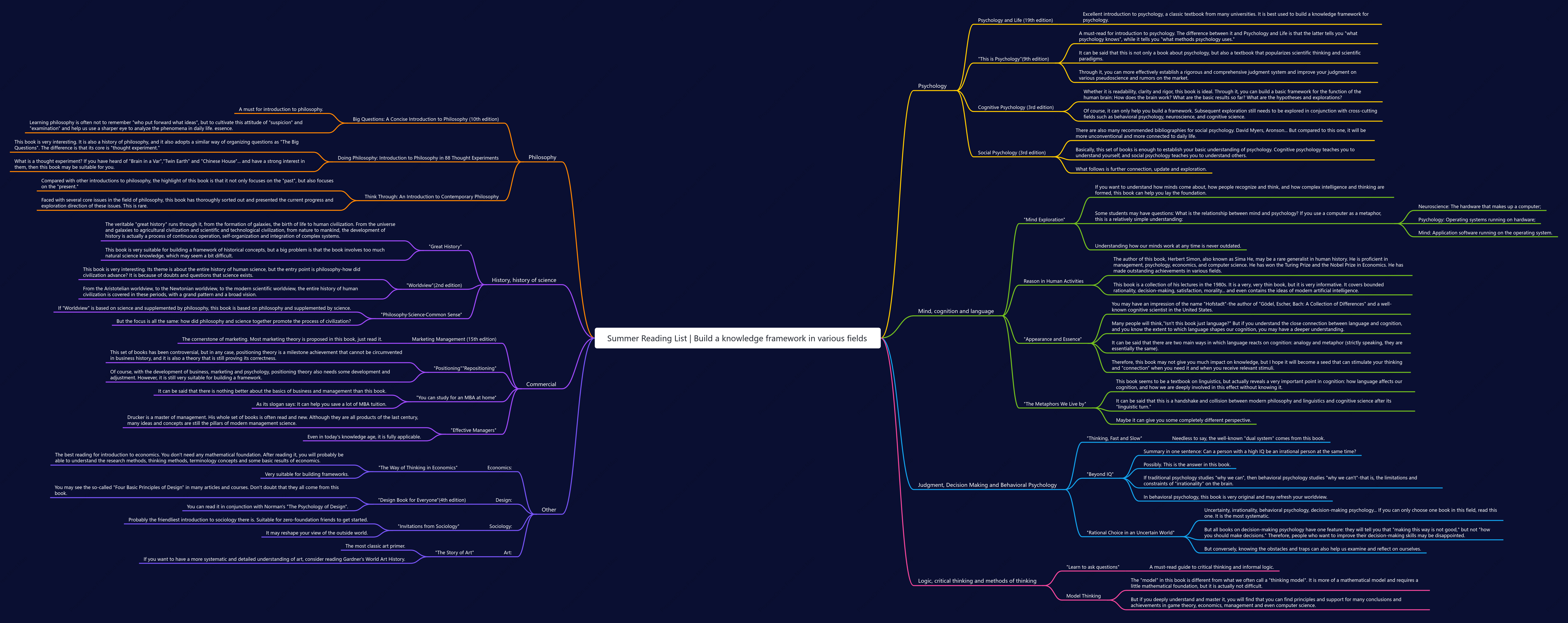
Psychology
Psychology and Life (19th edition)
Excellent introduction to psychology, a classic textbook from many universities. It is best used to build a knowledge framework for psychology.
"This is Psychology"(9th edition)
A must-read for introduction to psychology. The difference between it and Psychology and Life is that the latter tells you "what psychology knows", while it tells you "what methods psychology uses."
It can be said that this is not only a book about psychology, but also a textbook that popularizes scientific thinking and scientific paradigms.
Through it, you can more effectively establish a rigorous and comprehensive judgment system and improve your judgment on various pseudoscience and rumors on the market.
Cognitive Psychology (3rd edition)
Whether it is readability, clarity and rigor, this book is ideal. Through it, you can build a basic framework for the function of the human brain: How does the brain work? What are the basic results so far? What are the hypotheses and explorations?
Of course, it can only help you build a framework. Subsequent exploration still needs to be explored in conjunction with cross-cutting fields such as behavioral psychology, neuroscience, and cognitive science.
Social Psychology (3rd edition)
There are also many recommended bibliographies for social psychology. David Myers, Aronson... But compared to this one, it will be more unconventional and more connected to daily life.
Basically, this set of books is enough to establish your basic understanding of psychology. Cognitive psychology teaches you to understand yourself, and social psychology teaches you to understand others.
What follows is further connection, update and exploration.
Mind, cognition and language
"Mind Exploration"
If you want to understand how minds come about, how people recognize and think, and how complex intelligence and thinking are formed, this book can help you lay the foundation.
Some students may have questions: What is the relationship between mind and psychology? If you use a computer as a metaphor, this is a relatively simple understanding:
Neuroscience: The hardware that makes up a computer;
Psychology: Operating systems running on hardware;
Mind: Application software running on the operating system.
Understanding how our minds work at any time is never outdated.
Reason in Human Activities
The author of this book, Herbert Simon, also known as Sima He, may be a rare generalist in human history. He is proficient in management, psychology, economics, and computer science. He has won the Turing Prize and the Nobel Prize in Economics. He has made outstanding achievements in various fields.
This book is a collection of his lectures in the 1980s. It is a very, very thin book, but it is very informative. It covers bounded rationality, decision-making, satisfaction, morality... and even contains the ideas of modern artificial intelligence.
"Appearance and Essence"
You may have an impression of the name "Hofstadt"-the author of "Gödel, Escher, Bach: A Collection of Differences" and a well-known cognitive scientist in the United States.
Many people will think,"Isn't this book just language?" But if you understand the close connection between language and cognition, and you know the extent to which language shapes our cognition, you may have a deeper understanding.
It can be said that there are two main ways in which language reacts on cognition: analogy and metaphor (strictly speaking, they are essentially the same).
Therefore, this book may not give you much impact on knowledge, but I hope it will become a seed that can stimulate your thinking and "connection" when you need it and when you receive relevant stimuli.
"The Metaphors We Live by"
This book seems to be a textbook on linguistics, but actually reveals a very important point in cognition: how language affects our cognition, and how we are deeply involved in this effect without knowing it.
It can be said that this is a handshake and collision between modern philosophy and linguistics and cognitive science after its "linguistic turn."
Maybe it can give you some completely different perspective.
Judgment, Decision Making and Behavioral Psychology
"Thinking, Fast and Slow"
Needless to say, the well-known "dual system" comes from this book.
"Beyond IQ"
Summary in one sentence: Can a person with a high IQ be an irrational person at the same time?
Possibly. This is the answer in this book.
If traditional psychology studies "why we can", then behavioral psychology studies "why we can't"-that is, the limitations and constraints of "irrationality" on the brain.
In behavioral psychology, this book is very original and may refresh your worldview.
"Rational Choice in an Uncertain World"
Uncertainty, irrationality, behavioral psychology, decision-making psychology... If you can only choose one book in this field, read this one. It is the most systematic.
But all books on decision-making psychology have one feature: they will tell you that "making this way is not good," but not "how you should make decisions." Therefore, people who want to improve their decision-making skills may be disappointed.
But conversely, knowing the obstacles and traps can also help us examine and reflect on ourselves.
Logic, critical thinking and methods of thinking
"Learn to ask questions"
A must-read guide to critical thinking and informal logic.
Model Thinking
The "model" in this book is different from what we often call a "thinking model". It is more of a mathematical model and requires a little mathematical foundation, but it is actually not difficult.
But if you deeply understand and master it, you will find that you can find principles and support for many conclusions and achievements in game theory, economics, management and even computer science.
Philosophy
Big Questions: A Concise Introduction to Philosophy (10th edition)
A must for introduction to philosophy.
Learning philosophy is often not to remember "who put forward what ideas", but to cultivate this attitude of "suspicion" and "examination" and help us use a sharper eye to analyze the phenomena in daily life. essence.
Doing Philosophy: Introduction to Philosophy in 88 Thought Experiments
This book is very interesting. It is also a history of philosophy, and it also adopts a similar way of organizing questions as "The Big Questions". The difference is that its core is "thought experiment."
What is a thought experiment? If you have heard of "Brain in a Var","Twin Earth" and "Chinese House"... and have a strong interest in them, then this book may be suitable for you.
Think Through: An Introduction to Contemporary Philosophy
Compared with other introductions to philosophy, the highlight of this book is that it not only focuses on the "past", but also focuses on the "present."
Faced with several core issues in the field of philosophy, this book has thoroughly sorted out and presented the current progress and exploration direction of these issues. This is rare.
History, history of science
"Great History"
The veritable "great history" runs through it, from the formation of galaxies, the birth of life to human civilization. From the universe and galaxies to agricultural civilization and scientific and technological civilization, from nature to mankind, the development of history is actually a process of continuous operation, self-organization and integration of complex systems.
This book is very suitable for building a framework of historical concepts, but a big problem is that the book involves too much natural science knowledge, which may seem a bit difficult.
"Worldview"(2nd edition)
This book is very interesting. Its theme is about the entire history of human science, but the entry point is philosophy-how did civilization advance? It is because of doubts and questions that science exists.
From the Aristotelian worldview, to the Newtonian worldview, to the modern scientific worldview, the entire history of human civilization is covered in these periods, with a grand pattern and a broad vision.
"Philosophy·Science·Common Sense"
If "Worldview" is based on science and supplemented by philosophy, this book is based on philosophy and supplemented by science.
But the focus is all the same: how did philosophy and science together promote the process of civilization?
Commercial
Marketing Management (15th edition)
The cornerstone of marketing. Most marketing theory is proposed in this book, just read it.
"Positioning""Repositioning"
This set of books has been controversial, but in any case, positioning theory is a milestone achievement that cannot be circumvented in business history, and it is also a theory that is still proving its correctness.
Of course, with the development of business, marketing and psychology, positioning theory also needs some development and adjustment. However, it is still very suitable for building a framework.
"You can study for an MBA at home"
It can be said that there is nothing better about the basics of business and management than this book.
As its slogan says: It can help you save a lot of MBA tuition.
"Effective Managers"
Drucker is a master of management. His whole set of books is often read and new. Although they are all products of the last century, many ideas and concepts are still the pillars of modern management science.
Even in today's knowledge age, it is fully applicable.
Other
Economics:
"The Way of Thinking in Economics"
The best reading for introduction to economics. You don't need any mathematical foundation. After reading it, you will probably be able to understand the research methods, thinking methods, terminology concepts and some basic results of economics.
Very suitable for building frameworks.
Design:
"Design Book for Everyone"(4th edition)
You may see the so-called "Four Basic Principles of Design" in many articles and courses. Don't doubt that they all come from this book.
You can read it in conjunction with Norman's "The Psychology of Design".
Sociology:
"Invitations from Sociology"
Probably the friendliest introduction to sociology there is. Suitable for zero-foundation friends to get started.
It may reshape your view of the outside world.
Art:
"The Story of Art"
The most classic art primer.
If you want to have a more systematic and detailed understanding of art, consider reading Gardner's World Art History.
Collect
Collect
Collect
Collect


0 Comments
Next Page