
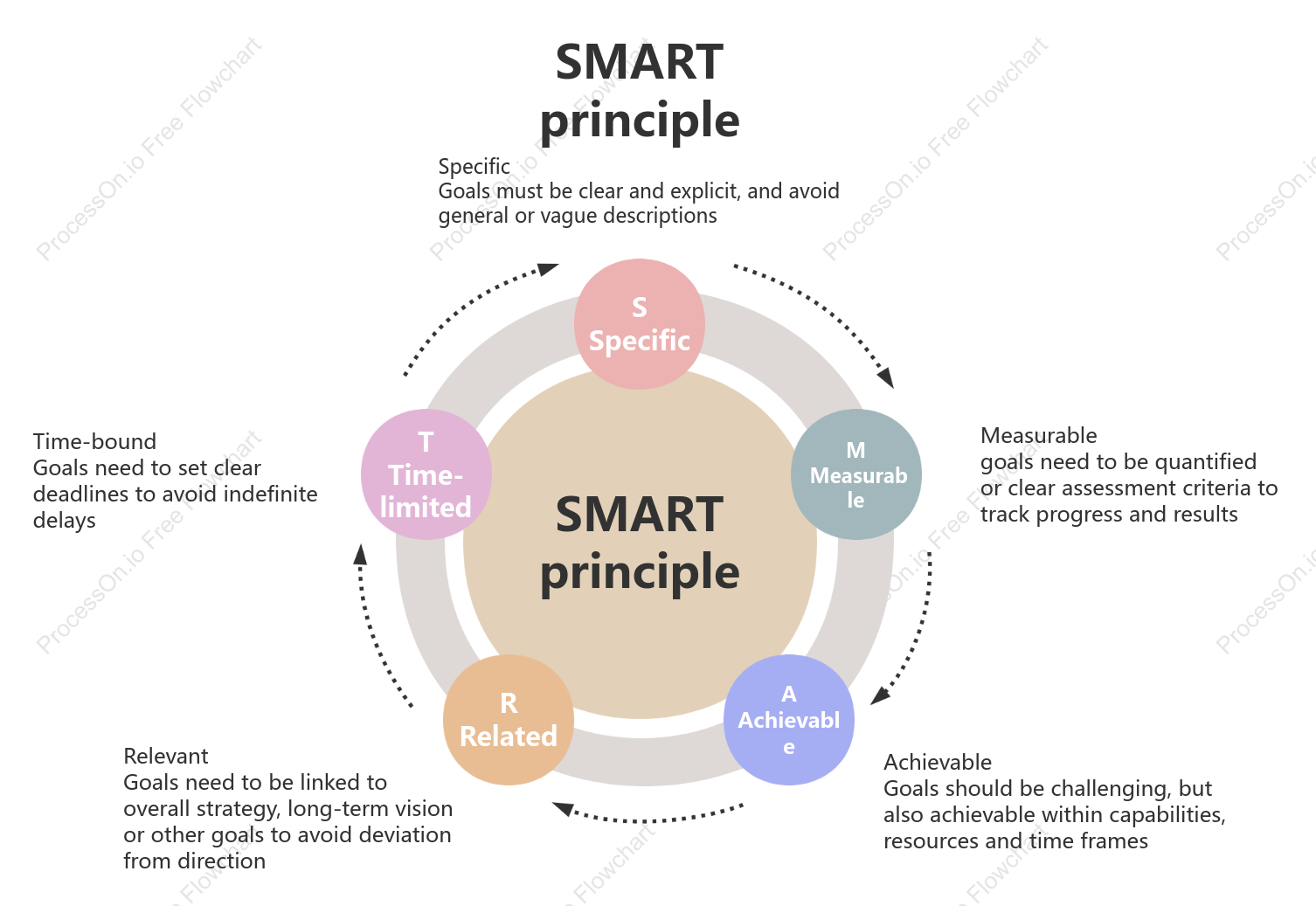

SMART principle
1 Report
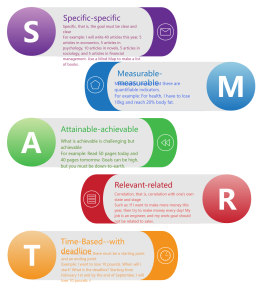
This diagram illustrates the SMART principle framework for goal management and planning. As the gold standard for goal setting, SMART requires that every clearly defined goal simultaneously meet five core criteria: S (Specific) – Goals must be specific and clear, avoiding vagueness and generality; M (Measurable) – Goals must be measurable, with quantifiable indicators or observable evidence of achievement; A (Attainable) – Goals must be achievable, feasible within existing resources and capabilities; R (Relevant) – Goals must be linked to the overall strategy or higher-level objectives, ensuring alignment; T (Time-bound) – Goals must have clear deadlines, creating schedule constraints and a sense of urgency. This principle is applicable to diverse scenarios such as team performance management, project planning, and personal growth, helping to transform abstract visions into clear, actionable, and traceable action paths.
Related Recommendations
Other works by the author
Outline/Content
See more
RRelated
Time-boundGoals need to set clear deadlines to avoid indefinite delays
SMARTprinciple
AAchievable
Measurablegoals need to be quantified or clear assessment criteria to track progress and results
TTime-limited
SMART principle
M Measurable
SSpecific
Collect
Collect
Collect
Collect
Collect

Collect

Collect

0 Comments
Next Page