
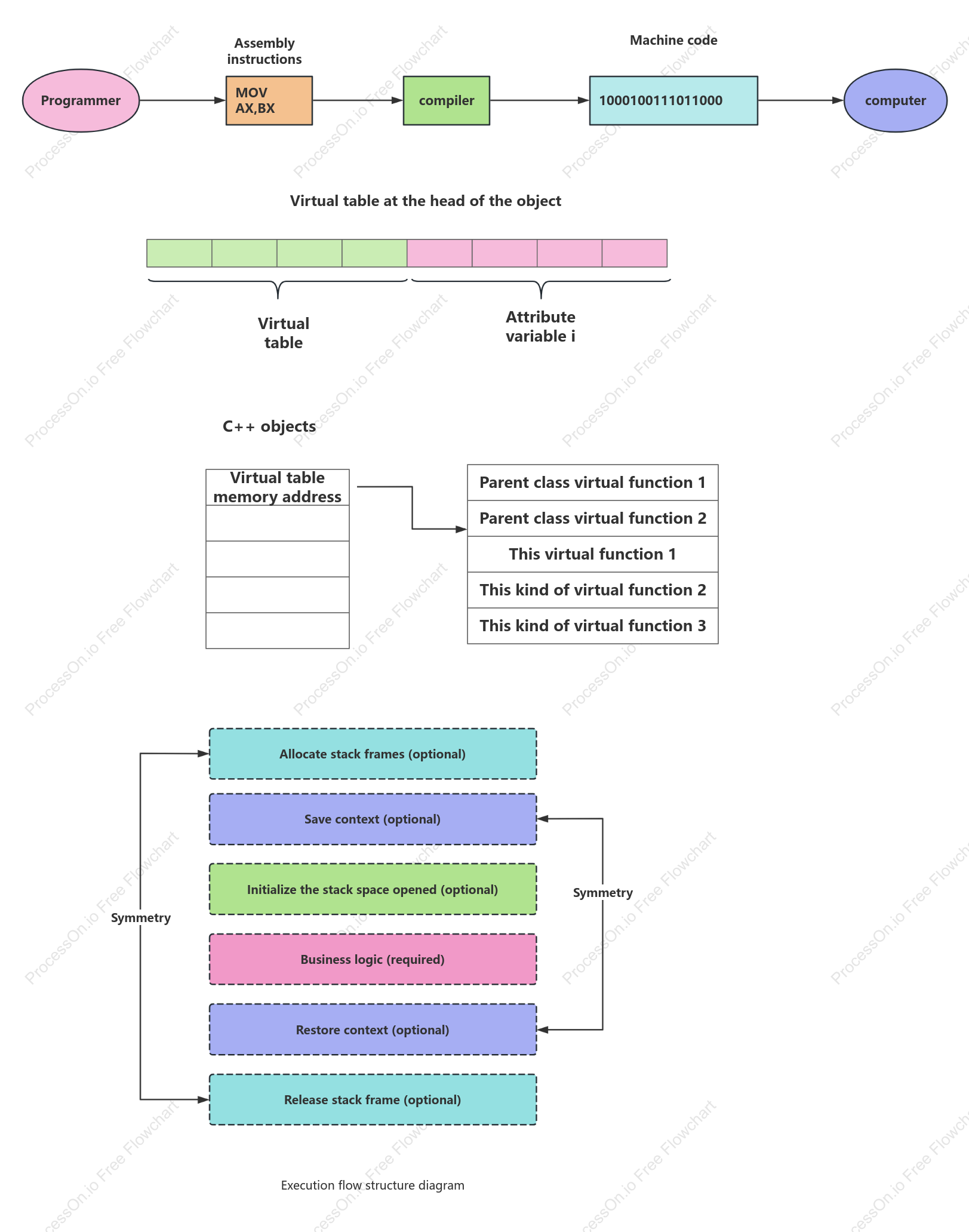

In-depth understanding of assembly_C language draft diagram
0 Report
This flowchart provides an in-depth understanding of the assembly C language, focusing on the intricate relationship between virtual tables and business logic. It outlines key components such as virtual table memory addresses, assembly instructions, and the execution flow structure. The diagram highlights the role of virtual functions within parent and derived classes, as well as the significance of symmetry in compiler operations. It also touches on the optional processes of stack frame allocation and context management. This comprehensive diagram is designed to aid programmers in navigating the complexities of C++ objects and machine code execution.
Related Recommendations
Other works by the author
Outline/Content
See more
Virtual table
Business logic (required)
Virtual table memory address
Assembly instructions
Parent class virtual function 1
Parent class virtual function 2
This virtual function 1
This kind of virtual function 2
This kind of virtual function 3
Virtual table at the head of the object
Attribute variable i
Symmetry
compiler
Release stack frame (optional)
Programmer
C++ objects
Machine code
Save context (optional)
computer
Execution flow structure diagram
Restore context (optional)
1000100111011000
Allocate stack frames (optional)
Initialize the stack space opened (optional)
Collect
Collect
Collect
Collect
Collect
Collect
Collect

0 Comments
Next Page