

How to Read a Book
0 Report
How to Read a Book
Related Recommendations
Other works by the author
Outline/Content
See more
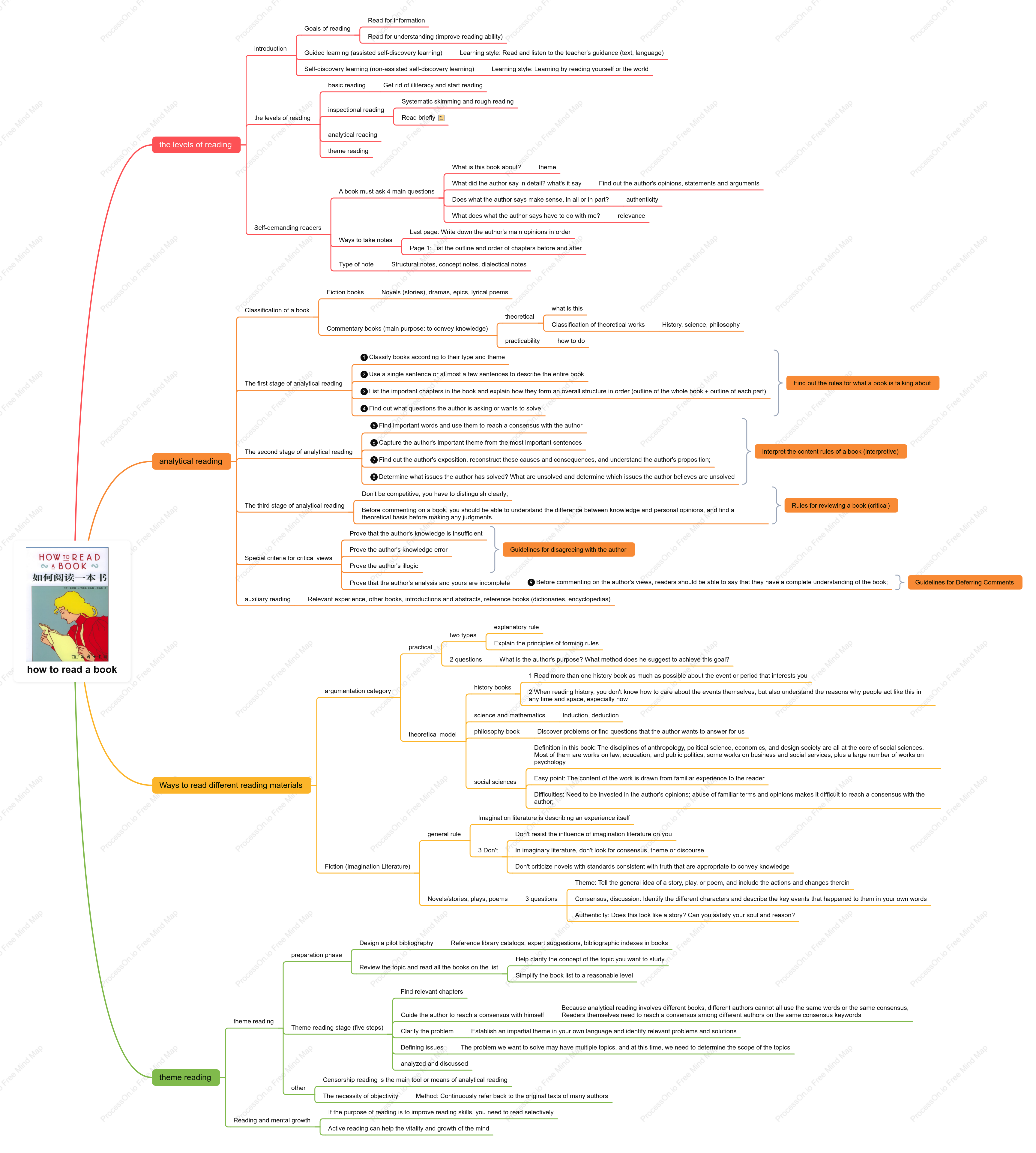
the levels of reading
introduction
Goals of reading
Read for information
Read for understanding (improve reading ability)
Guided learning (assisted self-discovery learning)
Learning style: Read and listen to the teacher's guidance (text, language)
Self-discovery learning (non-assisted self-discovery learning)
Learning style: Learning by reading yourself or the world
the levels of reading
basic reading
Get rid of illiteracy and start reading
inspectional reading
Systematic skimming and rough reading
Read briefly
analytical reading
theme reading
Self-demanding readers
A book must ask 4 main questions
What is this book about?
theme
What did the author say in detail? what's it say
Find out the author's opinions, statements and arguments
Does what the author says make sense, in all or in part?
authenticity
What does what the author says have to do with me?
relevance
Ways to take notes
Last page: Write down the author's main opinions in order
Page 1: List the outline and order of chapters before and after
Type of note
Structural notes, concept notes, dialectical notes
analytical reading
Classification of a book
Fiction books
Novels (stories), dramas, epics, lyrical poems
Commentary books (main purpose: to convey knowledge)
theoretical
what is this
Classification of theoretical works
History, science, philosophy
practicability
how to do
The first stage of analytical reading
Classify books according to their type and theme
Use a single sentence or at most a few sentences to describe the entire book
List the important chapters in the book and explain how they form an overall structure in order (outline of the whole book + outline of each part)
Find out what questions the author is asking or wants to solve
The second stage of analytical reading
Find important words and use them to reach a consensus with the author
Capture the author's important theme from the most important sentences
Find out the author's exposition, reconstruct these causes and consequences, and understand the author's proposition;
Determine what issues the author has solved? What are unsolved and determine which issues the author believes are unsolved
The third stage of analytical reading
Don't be competitive, you have to distinguish clearly;
Before commenting on a book, you should be able to understand the difference between knowledge and personal opinions, and find a theoretical basis before making any judgments.
Special criteria for critical views
Prove that the author's knowledge is insufficient
Prove the author's knowledge error
Prove the author's illogic
Prove that the author's analysis and yours are incomplete
Before commenting on the author's views, readers should be able to say that they have a complete understanding of the book;
auxiliary reading
Relevant experience, other books, introductions and abstracts, reference books (dictionaries, encyclopedias)
Ways to read different reading materials
argumentation category
practical
two types
explanatory rule
Explain the principles of forming rules
2 questions
What is the author's purpose? What method does he suggest to achieve this goal?
theoretical model
history books
1 Read more than one history book as much as possible about the event or period that interests you
2 When reading history, you don't know how to care about the events themselves, but also understand the reasons why people act like this in any time and space, especially now
science and mathematics
Induction, deduction
philosophy book
Discover problems or find questions that the author wants to answer for us
social sciences
Definition in this book: The disciplines of anthropology, political science, economics, and design society are all at the core of social sciences.
Most of them are works on law, education, and public politics, some works on business and social services, plus a large number of works on psychology
Most of them are works on law, education, and public politics, some works on business and social services, plus a large number of works on psychology
Easy point: The content of the work is drawn from familiar experience to the reader
Difficulties: Need to be invested in the author's opinions; abuse of familiar terms and opinions makes it difficult to reach a consensus with the author;
Fiction (Imagination Literature)
general rule
Imagination literature is describing an experience itself
3 Don't
Don't resist the influence of imagination literature on you
In imaginary literature, don't look for consensus, theme or discourse
Don't criticize novels with standards consistent with truth that are appropriate to convey knowledge
Novels/stories, plays, poems
3 questions
Theme: Tell the general idea of a story, play, or poem, and include the actions and changes therein
Consensus, discussion: Identify the different characters and describe the key events that happened to them in your own words
Authenticity: Does this look like a story? Can you satisfy your soul and reason?
theme reading
theme reading
preparation phase
Design a pilot bibliography
Reference library catalogs, expert suggestions, bibliographic indexes in books
Review the topic and read all the books on the list
Help clarify the concept of the topic you want to study
Simplify the book list to a reasonable level
Theme reading stage (five steps)
Find relevant chapters
Guide the author to reach a consensus with himself
Because analytical reading involves different books, different authors cannot all use the same words or the same consensus,
Readers themselves need to reach a consensus among different authors on the same consensus keywords
Readers themselves need to reach a consensus among different authors on the same consensus keywords
Clarify the problem
Establish an impartial theme in your own language and identify relevant problems and solutions
Defining issues
The problem we want to solve may have multiple topics, and at this time, we need to determine the scope of the topics
analyzed and discussed
other
Censorship reading is the main tool or means of analytical reading
The necessity of objectivity
Method: Continuously refer back to the original texts of many authors
Reading and mental growth
If the purpose of reading is to improve reading skills, you need to read selectively
Active reading can help the vitality and growth of the mind
Collect
Collect
Collect
Collect
Collect
Collect

0 Comments
Next Page