
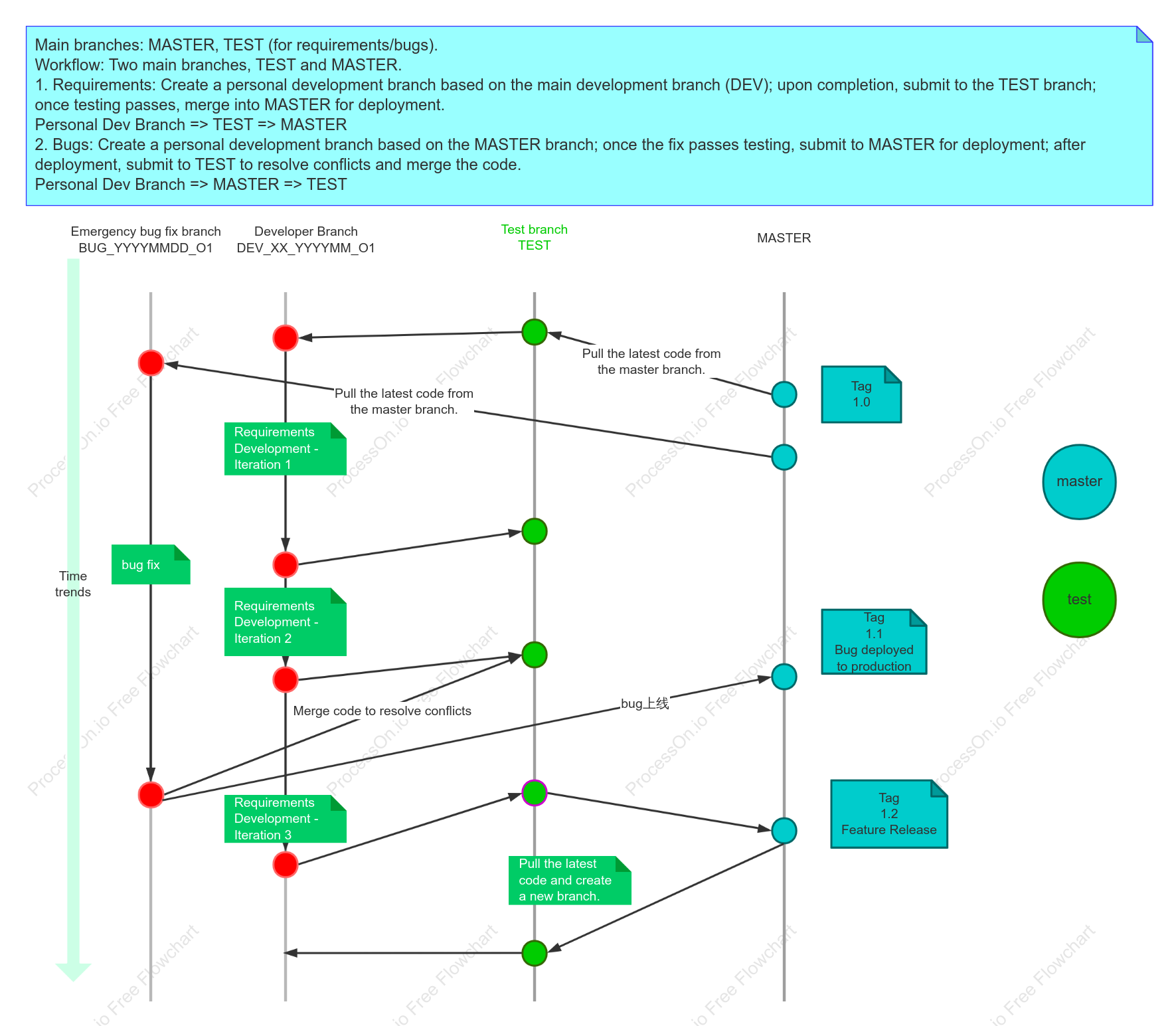

Git Branching and Management Guidelines
0 Report
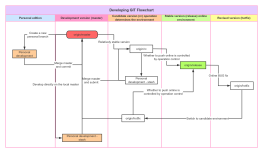
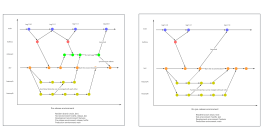
This diagram standardizes a code collaboration management process based on a dual-branch architecture: `test` and `master`. `master` is the main branch, always kept in a release-ready state, and all deployments are version-tagged based on `master`. `test` is the integration testing branch, serving as a repository and verification environment for development results. The development process follows two paths: For feature development, developers pull a personal `dev` branch from `master` for feature development, then merge it into the `test` branch for integration testing. After successful testing, it is merged back into `master` for deployment. For bug fixing, developers pull a personal branch from `master` for fixing, and after deployment, they must synchronize back to the `test` branch to resolve conflicts and maintain branch consistency. Emergency bug fixes use a separate branch naming convention (e.g., `bug_yyyymmdd_01`) to ensure rapid response. The overall process, through branch isolation and phased merging, ensures code quality, version traceability, and multi-environment collaboration.
Related Recommendations
Other works by the author
Outline/Content
See more
bug上线
Tag1.0
Tag1.2Feature Release
Emergency bug fix branchBUG_YYYYMMDD_O1
bug fix
MASTER
Requirements Development - Iteration 3
Merge code to resolve conflicts
Developer BranchDEV_XX_YYYYMM_O1
Tag1.1Bug deployed to production
Requirements Development - Iteration 2
Pull the latest code and create a new branch.
Test branchTEST
master
Pull the latest code from the master branch.
Time trends
Requirements Development - Iteration 1
test
Collect
Collect
Collect
Collect
Collect
Collect
Collect
Collect

0 Comments
Next Page