
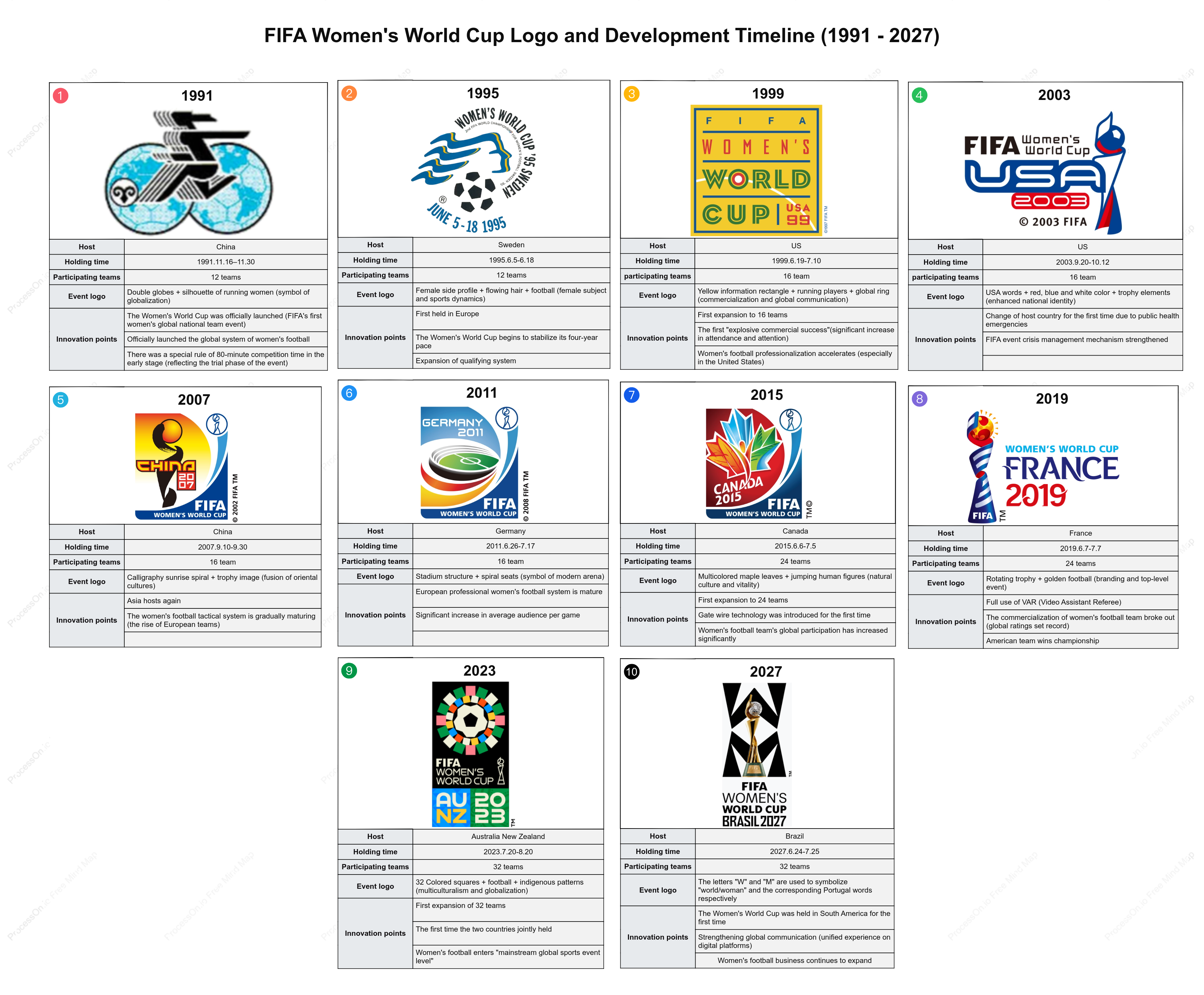

⚽ FIFA Women's World Cup Logos and Evolution Timeline (1991–2027)
1 Report
This overview traces the development of the FIFA Women's World Cup from 1991 to 2027, consolidating information on host nations, tournament logos, scale of participation, and key innovations to illustrate the event's evolution from its inception to its global expansion.
Related Recommendations
Other works by the author
Outline/Content
See more
1991
Host
China
Holding time
1991.11.16–11.30
Participating teams
12 teams
Event logo
Double globes + silhouette of running women (symbol of globalization)
Innovation points
The Women's World Cup was officially launched (FIFA's first women's global national team event)
Officially launched the global system of women's football
There was a special rule of 80-minute competition time in the early stage (reflecting the trial phase of the event)
2007
Host
China
Holding time
2007.9.10-9.30
Participating teams
16 teams
Event logo
Calligraphy sunrise spiral + trophy image (fusion of oriental cultures)
Innovation points
Asia hosts again
The women's football tactical system is gradually maturing (the rise of European teams)
1995
Host
Sweden
Holding time
1995.6.5-6.18
Participating teams
12 teams
Event logo
Female side profile + flowing hair + football (female subject and sports dynamics)
Innovation points
First held in Europe
The Women's World Cup begins to stabilize its four-year pace
Expansion of qualifying system
2011
Host
Germany
Holding time
2011.6.26-7.17
Participating teams
16 teams
Event logo
Stadium structure + spiral seats (symbol of modern arena)
Innovation points
European professional women's football system is mature
Significant increase in average audience per game
2023
Host
Australia New Zealand
Holding time
2023.7.20-8.20
Participating teams
32 teams
Event logo
32 Colored squares + football + indigenous patterns (multiculturalism and globalization)
Innovation points
First expansion of 32 teams
The first time the two countries jointly held
Women's football enters "mainstream global sports event level"
1999
Host
US
Holding time
1999.6.19-7.10
participating teams
16 teams
Event logo
Yellow information rectangle + running players + global ring (commercialization and global communication)
Innovation points
First expansion to 16 teams
The first "explosive commercial success"(significant increase in attendance and attention)
Women's football professionalization accelerates (especially in the United States)
2015
Host
Canada
Holding time
2015.6.6-7.5
Participating teams
24 teams
Event logo
Multicolored maple leaves + jumping human figures (natural culture and vitality)
Innovation points
First expansion to 24 teams
Gate wire technology was introduced for the first time
Women's football team's global participation has increased significantly
2027
Host
Brazil
Holding time
2027.6.24-7.25
Participating teams
32 teams
Event logo
The letters "W" and "M" are used to symbolize "world/woman" and the corresponding Portugal words respectively
Innovation points
The Women's World Cup was held in South America for the first time
Strengthening global communication (unified experience on digital platforms)
Women's football business continues to expand
2003
Host
US
Holding time
2003.9.20-10.12
participating teams
16 teams
Event logo
USA words + red, blue and white color + trophy elements (enhanced national identity)
Innovation points
Change of host country for the first time due to public health emergencies
FIFA event crisis management mechanism strengthened
2019
Host
France
Holding time
2019.6.7-7.7
Participating teams
24 teams
Event logo
Rotating trophy + golden football (branding and top-level event)
Innovation points
Full use of VAR (Video Assistant Referee)
The commercialization of women's football team broke out (global ratings set record)
American team wins championship
Collect
Collect
Collect
Collect

0 Comments
Next Page