
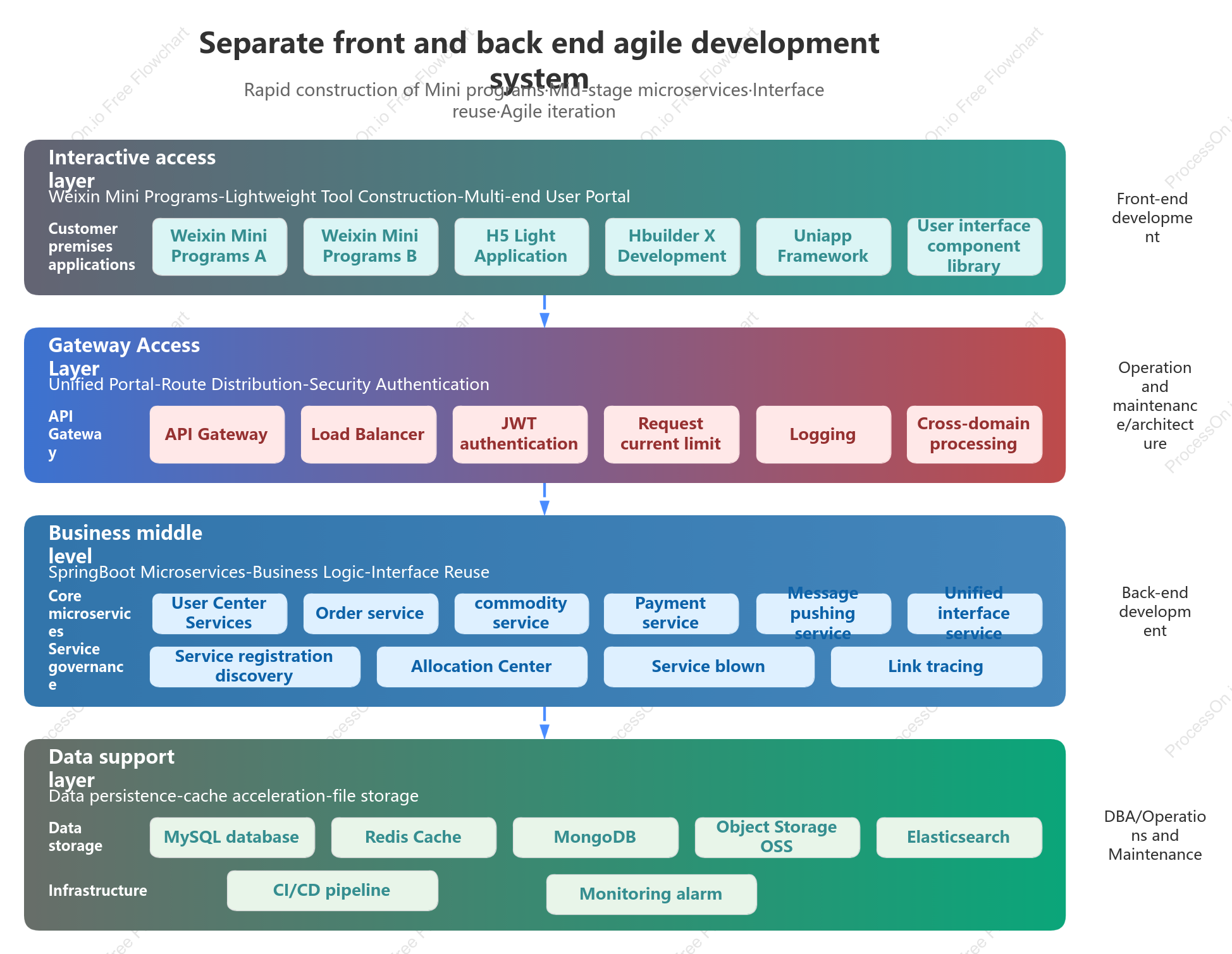

Front-end and Back-end Separation Architecture
0 Report
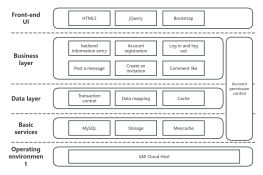
This template system describes the technical architecture of a software system built using a front-end/back-end separation model. It aims to help architects, development engineers, and technical decision-makers fully understand the system's layered structure, interaction mechanisms, and technology selection. Based on the core principle of "separation of concerns," the template divides the architecture into three main modules: the front-end layer, the back-end layer, and the interface layer. The front-end layer focuses on user interface interaction, state management, and routing control; the back-end layer focuses on business logic processing, data persistence, and security control; and the interface layer, based on protocols such as RESTful API, GraphQL, or gRPC, standardizes data communication and contract definitions between the front-end and back-end. The template also covers key design elements such as deployment architecture, cross-domain processing, authentication and authorization (e.g., JWT, OAuth2), API version management, and performance optimization. Through a structured framework, it ensures that the description of the front-end/back-end separation architecture is logically clear, with well-defined responsibilities and traceable protocols, providing a reusable reference for system design reviews, technology selection, and team collaboration.
Related Recommendations
Other works by the author
Outline/Content
See more
Interactive access layer
User Center Services
API Gateway
DBA/Operations and Maintenance
Service governance
MySQL database
Separate front and back end agile development system
commodity service
JWT authentication
Hbuilder X Development
Load Balancer
CI/CD pipeline
Business middle level
Data support layer
Unified interface service
Unified Portal-Route Distribution-Security Authentication
Core microservices
Cross-domain processing
Weixin Mini Programs A
Request current limit
Uniapp Framework
Elasticsearch
Front-end development
Monitoring alarm
Object Storage OSS
Back-end development
SpringBoot Microservices-Business Logic-Interface Reuse
Redis Cache
Payment service
MongoDB
Allocation Center
Data storage
Gateway Access Layer
User interface component library
Service registration discovery
Link tracing
Message pushing service
Rapid construction of Mini programs·Mid-stage microservices·Interface reuse·Agile iteration
Weixin Mini Programs B
Infrastructure
Order service
Weixin Mini Programs-Lightweight Tool Construction-Multi-end User Portal
Logging
H5 Light Application
Operation and maintenance/architecture
Customer premises applications
Service blown
Data persistence-cache acceleration-file storage
Collect
Collect
Collect
Collect

0 Comments
Next Page