

Data Classification
0 Report
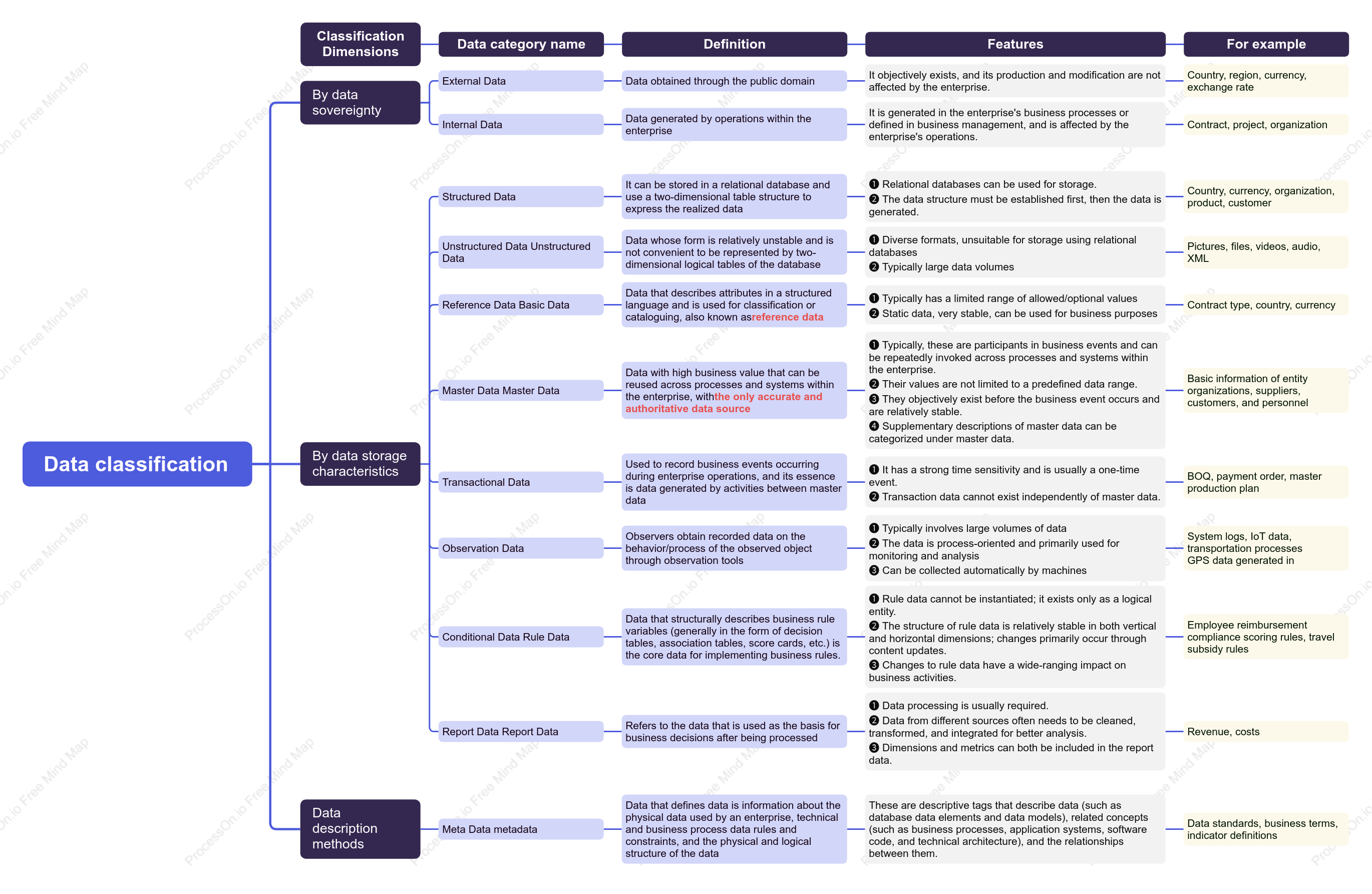
Data is categorized and defined based on its characteristics and governance methods: internal and external data, structured and unstructured data, and metadata. Structured data is further divided into basic data, master data, transaction data, report data, observation data, and rule data.
Related Recommendations
Other works by the author
Outline/Content
See more
By data sovereignty
External Data
Data obtained through the public domain
It objectively exists, and its production and modification are not affected by the enterprise.
Country, region, currency, exchange rate
Internal Data
Data generated by operations within the enterprise
It is generated in the enterprise's business processes or defined in business management, and is affected by the enterprise's operations.
Contract, project, organization
By data storage characteristics
Structured Data
It can be stored in a relational database and use a two-dimensional table structure to express the realized data
❶ Relational databases can be used for storage.
❷ The data structure must be established first, then the data is generated.
❷ The data structure must be established first, then the data is generated.
Country, currency, organization, product, customer
Unstructured Data Unstructured Data
Data whose form is relatively unstable and is not convenient to be represented by two-dimensional logical tables of the database
❶ Diverse formats, unsuitable for storage using relational databases
❷ Typically large data volumes
❷ Typically large data volumes
Pictures, files, videos, audio, XML
Reference Data Basic Data
Data that describes attributes in a structured language and is used for classification or cataloguing, also known asreference data
❶ Typically has a limited range of allowed/optional values
❷ Static data, very stable, can be used for business purposes
❷ Static data, very stable, can be used for business purposes
Contract type, country, currency
Master Data Master Data
Data with high business value that can be reused across processes and systems within the enterprise, withthe only accurate and authoritative data source
❶ Typically, these are participants in business events and can be repeatedly invoked across processes and systems within the enterprise.
❷ Their values are not limited to a predefined data range.
❸ They objectively exist before the business event occurs and are relatively stable.
❹ Supplementary descriptions of master data can be categorized under master data.
❷ Their values are not limited to a predefined data range.
❸ They objectively exist before the business event occurs and are relatively stable.
❹ Supplementary descriptions of master data can be categorized under master data.
Basic information of entity organizations, suppliers, customers, and personnel
Transactional Data
Used to record business events occurring during enterprise operations, and its essence is data generated by activities between master data
❶ It has a strong time sensitivity and is usually a one-time event.
❷ Transaction data cannot exist independently of master data.
❷ Transaction data cannot exist independently of master data.
BOQ, payment order, master production plan
Observation Data
Observers obtain recorded data on the behavior/process of the observed object through observation tools
❶ Typically involves large volumes of data
❷ The data is process-oriented and primarily used for monitoring and analysis
❸ Can be collected automatically by machines
❷ The data is process-oriented and primarily used for monitoring and analysis
❸ Can be collected automatically by machines
System logs, IoT data, transportation processes
GPS data generated in
GPS data generated in
Conditional Data Rule Data
Data that structurally describes business rule variables (generally in the form of decision tables, association tables, score cards, etc.) is the core data for implementing business rules.
❶ Rule data cannot be instantiated; it exists only as a logical entity.
❷ The structure of rule data is relatively stable in both vertical and horizontal dimensions; changes primarily occur through content updates.
❸ Changes to rule data have a wide-ranging impact on business activities.
❷ The structure of rule data is relatively stable in both vertical and horizontal dimensions; changes primarily occur through content updates.
❸ Changes to rule data have a wide-ranging impact on business activities.
Employee reimbursement compliance scoring rules, travel subsidy rules
Report Data Report Data
Refers to the data that is used as the basis for business decisions after being processed
❶ Data processing is usually required.
❷ Data from different sources often needs to be cleaned, transformed, and integrated for better analysis.
❸ Dimensions and metrics can both be included in the report data.
❷ Data from different sources often needs to be cleaned, transformed, and integrated for better analysis.
❸ Dimensions and metrics can both be included in the report data.
Revenue, costs
Data description methods
Meta Data metadata
Data that defines data is information about the physical data used by an enterprise, technical and business process data rules and constraints, and the physical and logical structure of the data
These are descriptive tags that describe data (such as database data elements and data models), related concepts (such as business processes, application systems, software code, and technical architecture), and the relationships between them.
Data standards, business terms, indicator definitions
Collect
Collect
Collect
Collect
Collect
Collect

0 Comments
Next Page