

C# Programming Season 1
1 Report
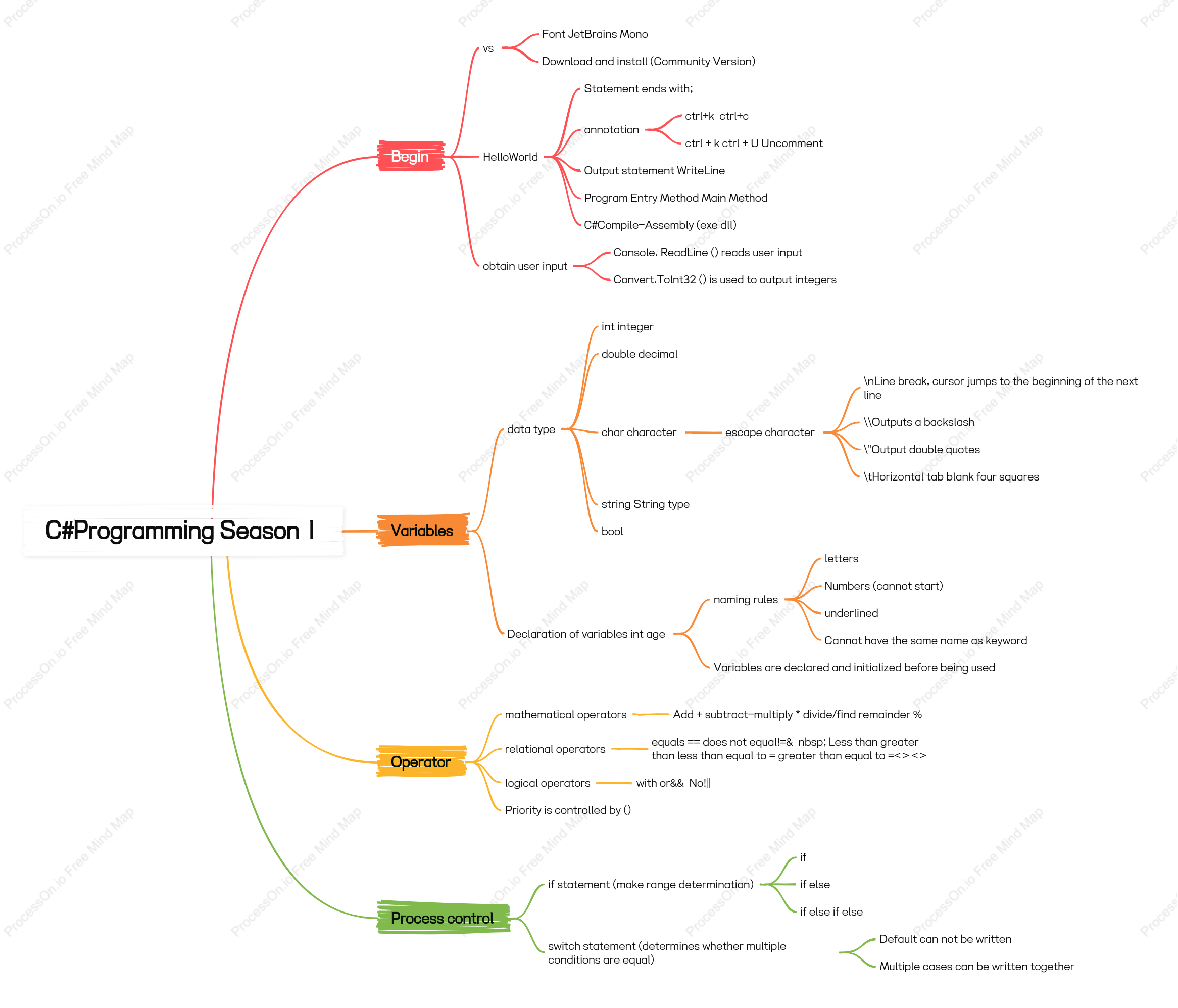
"C# Programming Season 1" is the introductory course in a series designed for beginners and those with no prior experience. It aims to systematically build core programming skills in C# and object-oriented thinking. This section guides students from setting up the development environment (Visual Studio / .NET SDK) to gradually mastering the creation and debugging of console applications. Core knowledge points covered include: variables and data types, operators and expressions, flow control statements (branching and looping), array and string manipulation, and the basic concepts of classes and objects. Through case-driven teaching throughout, such as a simple calculator, grade grading, and a random number guessing game, learners understand syntax rules and programming logic through practical coding exercises. This season emphasizes "learning by doing" and real-time debugging of compilation errors, laying a solid foundation for subsequent in-depth studies in Windows Forms, file operations, and database programming.
Related Recommendations
Other works by the author
Outline/Content
See more
Begin
vs
Font JetBrains Mono
Download and install (Community Version)
HelloWorld
Statement ends with;
annotation
ctrl+k ctrl+c
ctrl + k ctrl + U Uncomment
Output statement WriteLine
Program Entry Method Main Method
C#Compile-Assembly (exe dll)
obtain user input
Console. ReadLine () reads user input
Convert.Tolnt32 () is used to output integers
Variables
data type
int integer
double decimal
char character
escape character
\nLine break, cursor jumps to the beginning of the next line
\\Outputs a backslash
\"Output double quotes
\tHorizontal tab blank four squares
string String type
bool
Declaration of variables int age
naming rules
letters
Numbers (cannot start)
underlined
Cannot have the same name as keyword
Variables are declared and initialized before being used
Operator
mathematical operators
Add + subtract-multiply * divide/find remainder %
relational operators
equals == does not equal!=& nbsp; Less than greater than less than equal to = greater than equal to =< > < >
logical operators
with or&& No!||
Priority is controlled by ()
Process control
if statement (make range determination)
if
if else
if else if else
switch statement (determines whether multiple conditions are equal)
Default can not be written
Multiple cases can be written together
Collect
Collect
Collect
Collect
Collect
Collect

0 Comments
Next Page