

Freelancing vs. Working: A Decision Comparison
0 Report
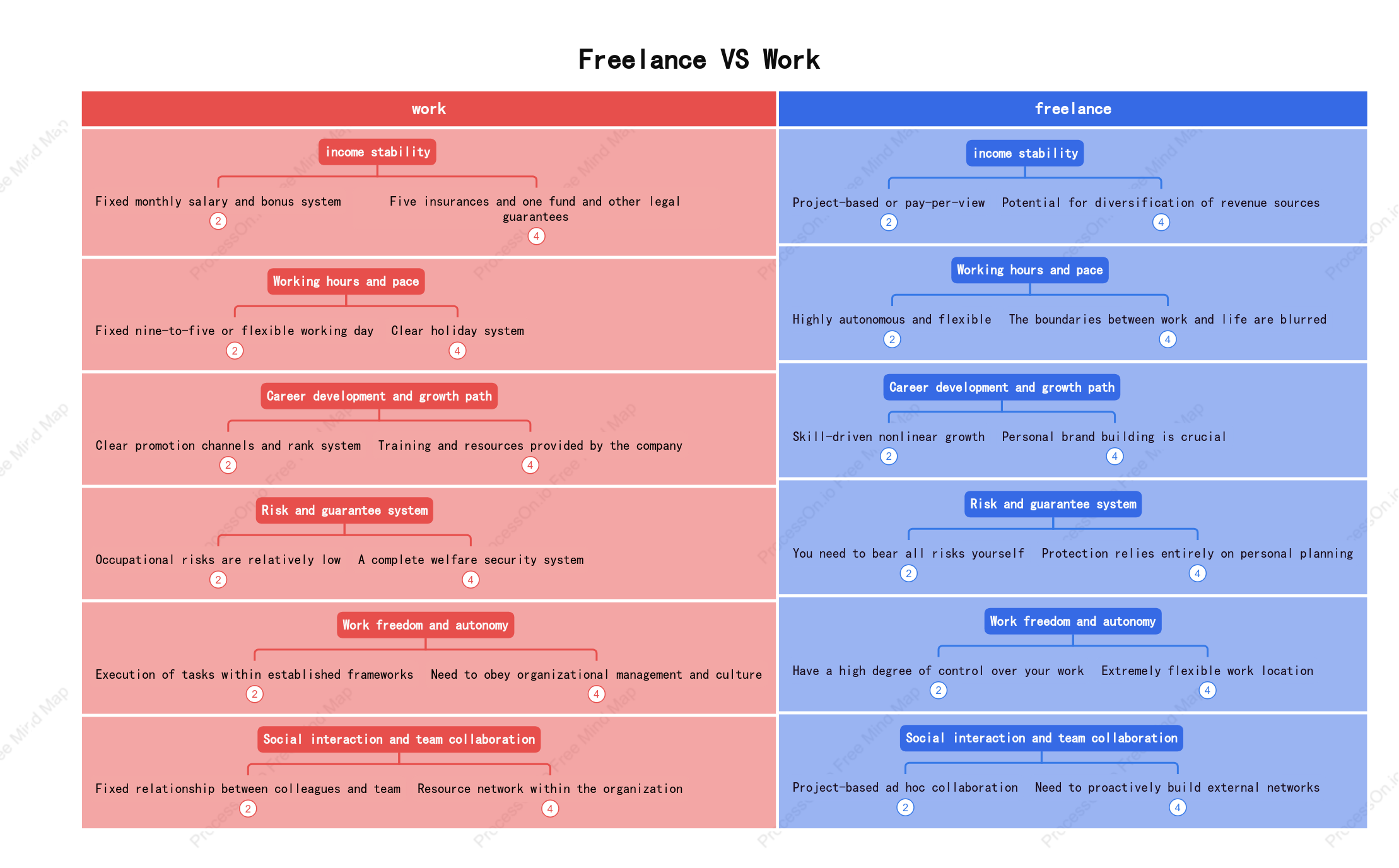
This template is suitable for decision-making comparisons in the "freelancing vs. working" scenario. It uses a structured approach to compare and analyze the two options in terms of income stability, time flexibility, career development, risks and pressures, helping to make a clearer choice.
Related Recommendations
Other works by the author
Outline/Content
See more
work
income stability
Fixed monthly salary and bonus system
Provide predictable monthly cash flow
Year-end bonuses and performance bonuses bring additional income
Five insurances and one fund and other legal guarantees
Social insurance provides long-term stability
Accumulation of provident fund helps asset formation
High career stability and relatively controllable risk of layoffs
Salary adjustment mechanisms are usually linked to company performance and individual performance
Working hours and pace
Fixed nine-to-five or flexible working day
The working day is clear and the boundaries between work and life are relatively clear.
Overtime may be required, especially at project nodes
Clear holiday system
Enjoy paid annual leave, sick leave and other statutory holidays
Holiday arrangements usually follow the company's unified regulations
Commuting time becomes fixed time cost
Work rhythm is influenced by the overall progress of the team and the company
Career development and growth path
Clear promotion channels and rank system
Vertical development path from commissioner to manager and director
The company provides horizontal development opportunities such as internal job transfers
Training and resources provided by the company
Opportunities to participate in systematic professional training
Use the company's platform to access large projects
Professional identity and social recognition are relatively clear
The speed of development is limited by organizational structure and superiors 'evaluation
Risk and guarantee system
Occupational risks are relatively low
The company bears the main operating risks
Labor laws have strong protection for employees
A complete welfare security system
Medical insurance, pension insurance, etc. are borne by the company
Unemployment and work-related injury are covered by insurance
Career development may encounter ceilings or industry downside risks
Individuals have relatively limited control over work content
Work freedom and autonomy
Execution of tasks within established frameworks
Work goals and processes are often stipulated by superiors or the company
There may be limitations on the selection of working methods and tools
Need to obey organizational management and culture
Need to participate in team meetings and abide by company rules and regulations
Personal ideas and ideas need to be realized through organizational processes
Work location is usually fixed (office or designated location)
Decision-making power is limited and more the role of executor
Social interaction and team collaboration
Fixed relationship between colleagues and team
Daily face-to-face communication makes it easy to establish working friendships
There is a clear division of labor and collaboration process
Resource network within the organization
Easily seek cross-department support and collaboration
Participate in company cultural activities and have a sense of belonging
May face office political or interpersonal pressure
Collaboration is often done through internal meetings and communication tools
freelance
income stability
Project-based or pay-per-view
Revenue is directly related to the number and quality of projects completed
May face a project window period and large income fluctuations
Potential for diversification of revenue sources
Serve multiple customers at the same time to spread risk
Opportunity to receive high-value single project remuneration
Lack of a fixed basic salary and rely entirely on the market and personal capabilities
Need to plan your own tax and financial reserves
Working hours and pace
Highly autonomous and flexible
Freedom to arrange the start and end hours of daily work
Tasks can be efficiently arranged based on personal status
The boundaries between work and life are blurred
May need to work non-traditional hours to meet customer needs
Easily overwork leads to burnout
Requires strong self-time management skills
The work intensity can be flexibly adjusted according to the peak season of the project
Career development and growth path
Skill-driven nonlinear growth
Development depends on personal brand and depth of skills
Need to continuously learn new skills to adapt to market needs
Personal brand building is crucial
Build reputation through portfolio and customer word-of-mouth
Success stories are the key to getting better projects
The development path is completely autonomous, but the direction needs to be explored by yourself
Ability to integrate skills across fields to create unique advantages
Risk and guarantee system
You need to bear all risks yourself
Market fluctuations and customer defaults directly affect livelihoods
There is no paid sick leave, and illness means income interruption
Protection relies entirely on personal planning
You need to purchase your own commercial insurance to cover health and elderly care
Emergency reserves need to be established to deal with the income window period
Extremely high requirements for personal self-discipline and risk resistance
Tax, legal and other matters need to be handled by yourself or outsourced
Work freedom and autonomy
Have a high degree of control over your work
You can choose your own cooperation customers and project types
Decide on working methods, tools and delivery processes
Extremely flexible work location
Work anywhere with internet access (home, cafe, etc.)
Freedom to arrange the rhythm of work and rest
You can reject projects or customers that are inconsistent with your values
Requires full responsibility for all business decisions
Social interaction and team collaboration
Project-based ad hoc collaboration
Establish short-term relationships with different customers and partners
Collaboration methods are flexible, but require proactive maintenance of connections
Need to proactively build external networks
Expand your connections through industry activities and online communities
You may face a sense of social isolation that needs to be proactively overcome
Collaboration relies heavily on remote tools and self-disciplined communication
Optionally join collaborative communities or shared office space
Collect
Collect
Collect
Collect

0 Comments
Next Page